Our Products
 Loans
Loans
 Cards
Cards
 Insurance
 Investment
 Stock Market
 Electronics Mall
 CIBIL Score
 Knowledge Centre
 Calculators
Our Services

 Do not call
 En
En
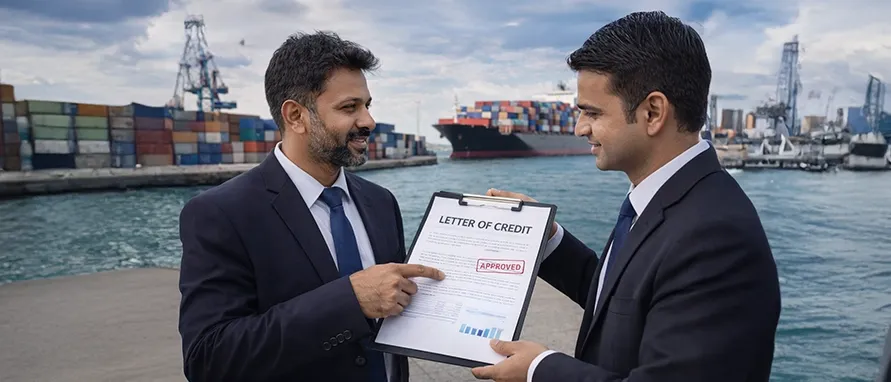
Table of Contents
A letter of credit is a financial contract that guarantees payment to the seller from a buyer. Most businesses around the nation utilise this mode of payment to conduct daily trade transactions. Since it is issued by the bank, the letter of credit ensures timely and full payment to the seller.
Besides, making transactions through this document also minimises risk pertaining to international trade transactions. Keep reading to know more details regarding a letter of credit.
A letter of credit, or a credit letter, is a letter issued by the bank that guarantees payment to a seller from a buyer for a said amount. This type of credit limit is primarily used by businesses that engage in international trading activities.
Large business transactions involve a huge corpus. If a buyer is unable to make payment for such an amount, a bank covers full or the remaining amount on behalf of him/her.
Business organisations working overseas often work with unknown suppliers. Thus, it is important for them to obtain assurance of payment before proceeding with business transactions.
Owing to its importance in business transactions, LC is of immense importance. Here are a few pointers describing the importance this document holds:
LC is a crucial document to conduct international trade transactions.
This letter ensures the buyer that he/she will have to make the payment only when the seller sends proof of product shipment. The buyer is not required to make any advanced payment.
This letter allows companies to secure more funding for their business.
Apart from that, one of the most crucial importance of a letter of credit is that the bank ensures full payment of product or service in case the buyer cannot fulfil the same.
Buyers engaging in major purchases may need a LC to assure a seller that they will make payment on time. In this regard, a bank issues this letter as a guarantee of payment to a seller. Consequently, the bank takes responsibility for paying off the full or remaining amount if a buyer fails to make payment.
To conduct this process, a buyer needs to prove to the bank that he/she has enough assets or a sufficient line of credit.
With regards to Letter of Credit, an issuing bank pays the amount to a beneficiary. If this letter is transferable, a beneficiary may assign some other entity the right to draw the sum.
Letter of credit is a crucial document when it comes to conducting business transactions. Find the key letter of credit features below:
The LC is issued against collateral/security, which may include the buyer's fixed deposits and bank deposits, among other things.
A bank charges different fees depending on the type of letter of credit.
The International Chambers of Commerce (ICC) issues guidelines for any type of Letter of Credit.
Banks hold the right to refuse payment if they discover any error in the buyer's name, product name, shipping date, and other details.
Because all parties deal in documents rather than goods and services, payment will not be based on any defects in goods or services.
To know the meaning of a letter of credit, you need to understand its types. LC can be classified into these categories:
In this type of credit, an entrepreneur provides a bill of exchange to the lender with a sight letter. Following this, he/she receives funds immediately based on the letter. A LC at sight is usually considered an immediate form of LC.
This is a bill of exchange that is drawn and payable after a certain period of time. This type of LC involves a certain time period. It allows the borrowers added duration to make the payment after receiving the goods.
A Standby Letter of Credit (SBLC) is a type of credit letter which allows an importer to obtain foreign currency funds on providing the SBLC from a domestic bank, which guarantees payment to the international bank on failure of payment.
Revocable credit refers to the type of LC in which the issuing bank can change or cancel the terms and conditions. It is not necessary for the issuing bank to notify the beneficiaries of any changes.
In an irrevocable letter of credit, the issuing bank cannot amend the terms and conditions. Instead, the bank has to follow the commitments made in the letter.
As the name implies, transferable credit is a type of LC in which the beneficiary can transfer his/her rights to a third party. The terms and conditions may vary depending on the trade and industry.
Businesses involved in substantial international transactions should know the letter of credit process thoroughly. Find the steps below:
Step 1: You need to approach a bank to issue a LC.
Step 2: After this, you will notice an advising bank (usually an international bank) that will receive LC issued by the buyer's issuing bank. The advising bank will validate this letter of credit by verifying the name, product details, and more.
Step 3: In the next step, the bank shares the LC credit with the seller.
Step 4: Post assurance, the seller ships the goods to the buyer.
Step 5: Following this, the buyer will receive a Bill of Lading, which he/she must present before the nominated bank.
Step 6: In the next step, the bank checks documents and all goods in the shipment before paying to the seller.
Step 7: Nominated bank then shares shipping documents with issuing bank and asks for payment.
Step 8: Issuing bank cross-checks the documents with the buyer and verifies information.
Step 9: In the final letter of LC process, buyer pays the issuing bank, which redirects payment to nominated bank.
Here is a list of leading Indian banks offering the facility of LC:
State Bank of India
HDFC Bank
ICICI Bank
Kotak Mahindra Bank
Axis Bank
Union Bank of India
Lendingkart Finance
IDBI Bank
DBS
Punjab and Sind Bank
Bandhan Bank
As mentioned in the letter of credit process, several entities take part in the completion of payment through this credit route. These entities include:
Buyer
Seller
Nominated bank
Advising bank
Beneficiary
Typically, there are significant similarities between a Bank Guarantee (BG) and LC. However, they come with a major difference, which is that a LC process will continue even if a buyer defaults on payment. On the other hand, a bank reduces the loss incurred if a transaction does not go as planned in a BG.
A term loan is a lump sum amount that an individual borrows for a given tenure at an interest rate. The repayment of term loans is done through EMIs. Meanwhile, LC is a credit or loan limit sanctioned by a bank to a borrower that allows him/her to withdraw small amounts from the total sanctioned limit. A loan does not require a guarantor, however with a letter of credit the bank becomes a guarantor for a buyer.
One of the biggest advantages that LC offers is that it ensures a seller of timely payment from the buyer.
You will typically have to pay around 0.75% to 1.5% of the transaction value depending on the issuing bank’s location.
The duration of availing a letter of credit depends on the guarantor or issuing bank. However, you can obtain it within 15 days to a month.
A letter of credit makes the payment to the seller on behalf of the buyer, if he/she fails to pay for a product on time.
You need to pledge your Fixed Deposit, Bank Deposit, or other assets as a collateral to obtain LC.
You should obtain LC while making massive international business transactions with an unknown buyer.
If a buyer is unable to pay the seller under LC terms and conditions, the bank will take responsibility and complete payment.



Academy by Bajaj Markets

 47202
47202

Navigate the tax maze with ease! Uncover Income Tax 101, demystify jargon with Terms for Beginners, and choose between Old or New Regimes.
 165541
Unlock the world of credit! From picking the perfect card to savvy loan management, navigate wisely.
 97881
97881
Money Management and Financial Planning covers personal finance basics, setting goals, budgeting...
 28606
28606
Explore the investment cosmos! From beginner's guides to sharp-witted strategies, explore India's treasure trove of options.
 18764
18764
Discover essential insights on various types of insurance in India.
 4584
4584
Welcome to Tech in Finance, where we explore the exciting intersection of technology and finance...












 Academy