Our Products
 Loans
Loans
 Cards
Cards
 Insurance
 Investment
 Stock Market
 Electronics Mall
 CIBIL Score
 Knowledge Centre
 Calculators
Our Services

 Do not call
 En
En
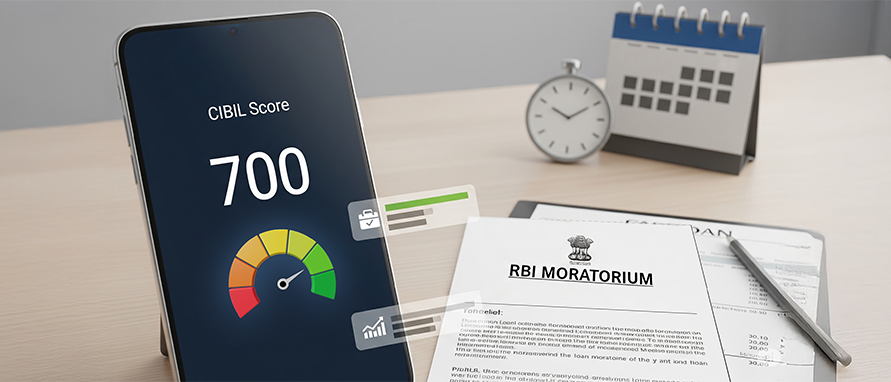
Pausing your loan EMIs may seem like a relief during financial stress, but it can raise serious concerns about your CIBIL score and future loan approvals. Many borrowers worry whether taking this break—especially under the RBI’s moratorium—could silently affect their CIBIL score. With banks like SBI offering options such as the moratorium period for a home loan or the moratorium period for an SBI Education Loan, it’s easy to get confused about the real impact. Knowing how the Reserve Bank of India (RBI) on CIBIL score check works, what your bank reports, and how to verify your score helps you stay protected.
A moratorium is a temporary pause on loan repayments, granted by your bank during times of financial hardship. It allows you to delay paying your EMIs without being labelled a defaulter. During this period, you are not required to make regular instalments, but interest on the outstanding loan continues to accumulate.
The Reserve Bank of India (RBI) introduced the moratorium during the COVID-19 pandemic to ease the financial burden on individuals and businesses. Borrowers could request this break for a few months, giving them time to recover without immediate repayment pressure.
However, it’s important to understand how this pause works, what it means for your overall loan cost, and how it may still impact your CIBIL score once repayments resume. Misunderstanding the terms or missing steps can lead to unexpected issues in your credit report later.
The RBI introduced the moratorium in March 2020 as an emergency measure during the nationwide COVID-19 lockdown. With businesses closed, jobs affected, and income sources uncertain, many people found it difficult to repay their loans on time. To prevent borrowers from defaulting due to circumstances beyond their control, the RBI directed all banks and financial institutions, including SBI, to offer a temporary pause on loan repayments.
This moratorium applied to various loans such as home loans, education loans, personal loans, and more. Initially set for three months, the moratorium period for a home loan and other loans was later extended to six months to offer continued support.
The main goal was to reduce your immediate financial stress and protect your credit history. By pausing repayments without marking them as defaults, the RBI ensured that your CIBIL score wouldn’t be affected during this period—provided the moratorium was correctly approved and reported by your bank.
Your CIBIL score shows how well you manage loan repayments. Lenders use it to decide if they should approve your future loan or credit card applications. Missing even one EMI can reduce your score and make it harder to borrow later. That’s why staying consistent with payments is so important.
The RBI stated that using a moratorium will not affect your score if it’s handled correctly. You must formally opt for the moratorium and ensure your bank follows the RBI’s rules. If reported properly, your loan will appear as ‘standard’ during the pause—not delayed or defaulted.
That said, you must be careful about a few things:
You need to officially opt in for the moratorium—it’s not automatic
Your bank must report your loan status accurately to CIBIL and other credit bureaus
Errors in reporting or delays in updates can still damage your credit score
To avoid any surprises, it’s smart to do an RBI on CIBIL score check once your moratorium period ends. This helps you catch any mistakes early and correct them before they cause long-term harm to your credit profile.
If you skipped your loan payments without officially applying for the moratorium, your bank would treat it as a missed payment. This is seen as a default, which can lower your CIBIL score and harm your credit history. Many borrowers assumed that the moratorium was applied automatically. However, unless you submitted a formal request and received approval from your bank, your EMIs were still considered due.
Missing payments without opting in would result in negative remarks on your credit report. These missed EMIs would be reported to credit bureaus as delays, which directly impact your score. That’s why it was important to confirm your loan status and moratorium approval with your bank before skipping any payments.
Here’s why this matters: understanding how the moratorium works for each loan type helps you avoid confusion, missed payments, and long-term damage to your CIBIL score:
If you had a home loan, including the moratorium period for an SBI Home Loan, you could request a break from EMIs during the COVID-19 crisis. This pause reduced short-term financial stress, but interest continued to accumulate throughout the moratorium. After the pause ended, your EMI may have increased or your loan tenure may have been extended. Always confirm how your lender adjusted the repayment terms to avoid any unexpected changes later.
For education loans, especially the moratorium period for an SBI Education Loan, repayments usually begin after course completion and an additional job search period. During the COVID-19 crisis, if your loan had already entered repayment, you could apply for the RBI’s moratorium. You should check with your bank whether both moratoriums were applied together or treated separately. This helps you clearly understand when your EMIs will begin and how much you need to repay.
Here are key mistakes you must avoid to protect your CIBIL score during and after the moratorium period:
Missing EMIs before officially opting in can still damage your credit score
Assuming the moratorium was automatic without written confirmation may lead to payment defaults
Believing all your loans were covered without checking with each lender can cause reporting issues
Ignoring revised EMI schedules after the pause may result in missed payments
Not checking your credit report regularly increases the risk of unnoticed reporting errors
Failing to dispute incorrect entries can allow score damage to continue over time
Overlooking communication from your bank may lead to missed updates or moratorium conditions
Not keeping written proof of moratorium approval can create problems if disputes arise later
Forgetting to update your repayment standing with lenders post-moratorium may result in delayed reporting
Relying only on assumptions instead of verifying with your bank can put your credit health at risk
Here are practical steps you can take to protect your CIBIL score before, during, and after the moratorium period:
Confirm with your lender that your moratorium request was received and officially approved
Keep written proof or email confirmation of the moratorium approval for future reference
Check your repayment schedule to see how your EMIs or loan tenure have changed
Monitor your loan account every month to ensure payments are updated correctly
Do a CIBIL score check three months after the moratorium ends to spot any errors
Report any incorrect entries on your credit report to CIBIL and raise a dispute promptly
Follow up with your bank if your updated loan status is not visible on your credit report
Set reminders for upcoming EMIs to avoid accidental missed payments after the pause ends
Ask your bank for a repayment plan in writing to avoid confusion later
Avoid applying for new loans during this period unless absolutely necessary to maintain credit stability
Knowing the benefits and drawbacks of a moratorium helps you make an informed decision that protects both your finances and your credit health. Here’s a clear comparison to guide you:
| Pros | Cons |
|---|---|
Gives you immediate relief from EMI payments during financial stress |
Interest continues to accrue during the moratorium period |
Prevents your loan account from being marked as defaulted |
Can result in higher EMIs or a longer repayment term after the pause |
Protects your CIBIL score if reported correctly by the bank |
Risk of reporting errors that could affect your credit score |
Offers time to organise your finances and prioritise essentials |
Not all loans may be covered unless you confirm with each lender |
Allows smoother cash flow during income disruptions |
May delay overall loan closure and increase total interest outgo |
No penalty is charged for deferring approved EMIs |
Can affect your eligibility for new loans in the short term |
Before opting for a moratorium, asking the right questions helps you avoid future confusion, plan your repayments better, and protect your credit score. Here are the key questions you should ask:
Will interest be charged during the moratorium period, and how will it be calculated?
How will the moratorium affect my EMI amount or extend my loan tenure later?
Will my loan be reported to CIBIL as ‘standard’ or ‘deferred’ during the pause?
Can I make part-payments during the moratorium to reduce interest build-up?
How do I receive written confirmation or proof that my moratorium request is approved?
Will my standing instructions or auto-debit be paused, or should I cancel them manually?
Are all my active loans covered, or do I need to apply separately for each one?
What happens if I choose to resume payments before the moratorium ends?
These questions ensure clarity, prevent reporting errors, and help you manage your finances with confidence during the moratorium period.
A moratorium offers short-term relief during financial stress, but you should use it only when necessary. It does not affect your CIBIL score if reported correctly. Always confirm your bank has approved the moratorium and provided written confirmation. Check if your EMI amount or loan tenure will change after the pause ends. Monitor your credit report to ensure the moratorium is reported as ‘standard’ and not as a missed payment. Whether it’s a moratorium period for a home loan or an SBI education loan, clear communication and follow-up help protect your credit health.



Academy by Bajaj Markets

 47199
47199

Navigate the tax maze with ease! Uncover Income Tax 101, demystify jargon with Terms for Beginners, and choose between Old or New Regimes.
 165298
Unlock the world of credit! From picking the perfect card to savvy loan management, navigate wisely.
 97849
97849
Money Management and Financial Planning covers personal finance basics, setting goals, budgeting...
 28588
28588
Explore the investment cosmos! From beginner's guides to sharp-witted strategies, explore India's treasure trove of options.
 18763
18763
Discover essential insights on various types of insurance in India.
 4583
4583
Welcome to Tech in Finance, where we explore the exciting intersection of technology and finance...











 Academy