Our Products
 Loans
Loans
 Cards
Cards
 Insurance
 Investment
 Stock Market
 Electronics Mall
 CIBIL Score
 Knowledge Centre
 Calculators
Our Services

 Do not call
 En
En
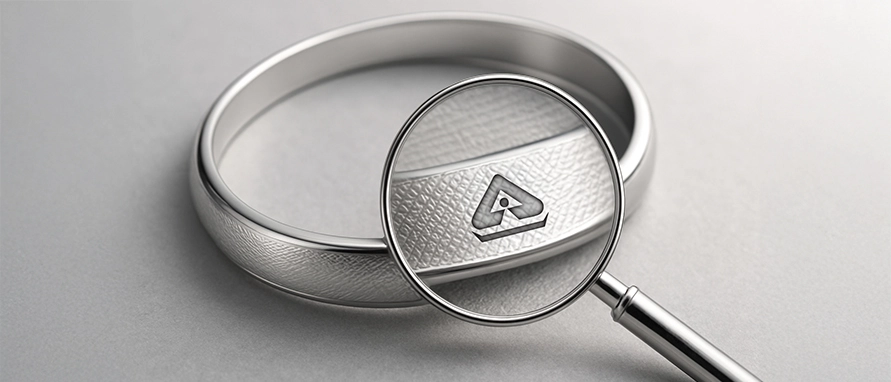
Table of Contents
Silver holds a significant place in Indian households, valued for its cultural and financial importance. It is considered auspicious during festive occasions and is also one of the most preferred investment avenues for earning stable returns.
For centuries, authorities have faced challenges arising from adulteration. Historically, different rulers attempted to resolve these issues by introducing identification marks or hallmarks to verify metal purity.
A more formalised system of hallmarking for precious metals like gold and silver emerged in the late twentieth and early twenty-first centuries.
Many countries, including India, adopted the practice of hallmarking silver to:
Protect consumers from adulterated silver
Compel jewellers and manufacturers to maintain legal purity standards
Read on to learn more about the history of silver hallmarks and how to check the purity of silver in India.
Hallmarks serve as an official guarantee of a precious metal’s purity and authenticity. They are applied after the item is tested and verified by an authorised assay office.
In the case of silver, hallmarking ensures that consumers receive the purity they are promised and that jewellers comply with established legal standards.
The main purposes of using hallmark for silver include:
Confirms that the silver content matches the stated fineness
Safeguards buyers from fraudulent or substandard products
Promotes uniformity in silver purity mark across the market
Requires jewellers and manufacturers to adhere to national regulations
Makes Indian silver items recognised and trusted internationally
A standard silver hallmark consists of multiple symbols or marks that together confirm its authenticity and purity. Each component provides specific information as mandated by the Bureau of Indian Standards (BIS).
Here are the main elements of a silver hallmark in India:
Indicates that the item has been hallmarked under the BIS certification scheme
Represents the silver content in parts per thousand (e.g., 925, 900, 800)
Identifies the BIS-recognised centre that tested and certified the item
Denotes the jeweller or manufacturer registered with BIS
Indicates when the item was hallmarked
The earliest attempt at regulating the standards of silver was made by Henry III in 1238. An order was passed to appoint six goldsmiths to supervise and maintain purity standards in London. However, the first formal attempt at hallmarking silver dates back to the reign of Edward I.
Edward I passed a statute in 1300 requiring the ‘Guardians of the Craft’ to inspect shops and verify purity standards. They were instructed to apply a ‘leopard mark’ as an identification for sterling silver, denoting a purity level of 92.5%.
Initially, silver hallmarking was confined to London, but assay offices were later established in other major centres of Britain. During the fifteenth and seventeenth centuries, new offices began operating in Edinburgh and Dublin.
The rapid increase in silver production during the eighteenth century led to the establishment of additional assay offices in Birmingham and Sheffield, following an Act of Parliament in 1773.
Over subsequent centuries, various modifications were made to the silver hallmarking system, such as the introduction of the maker’s mark. While the hallmarking system flourished in Britain, it was later adopted by other countries too.
This development culminated in the formation of the International Convention on Hallmarking, signed in Vienna in 1972. The convention, now comprising 21 signatory countries, allows citizens of member nations to transport hallmarked silver items across borders without the need for additional testing.
If you are wondering how to identify pure silver in India, there is a hallmarking system for silver in place. As per a government notification from 2017, silver has been subjected to the hallmarking system.
This system is managed by the Bureau of Indian Standards (BIS). It conducts regular audits and random sample testing from the market to maintain qualified standards of silver authenticity.
Moreover, it has notified six different standards grades for silver:
Grade 990
Grade 970
Grade 925 hallmark
Grade 900
Grade 835
Grade 800
It is easier to understand these silver hallmarks with an example. If you purchase sterling silver, the Grade notified for it by BIS is ‘Grade 925’.
Sterling silver contains 92.5% of pure silver and 7.5% of other metals like zinc or copper mixed with it. Similarly, Grade 990 is the finest grade of silver as it will contain 99% of pure silver. However, unlike gold, the government has still not made hallmarking mandatory for silver jewellery, coins, or bars.
As mentioned above, silver hallmarks are not mandatory, but you can ask the jeweller to get a piece of jewellery hallmarked at the time of purchase. The jeweller will take the silver to the nearest BIS assaying centre for testing.
If the silver meets the BIS regulatory standards, it will be hallmarked by the centre. For the identification of silver marks by the BIS, you need to look for the following signs:
The most trusted indicator of silver purity is the BIS mark. It is the logo of BIS which is a dot inside a triangle.
The 3-digit number on the silver ornaments denotes its Grade, i.e., its fineness or purity.
This denotes the year in which a particular silver item was manufactured.
This is a unique mark of the jeweller.
Know the Silver Rate in Various cities
The Bureau of Indian Standards (BIS) engraves silver hallmarks. These hallmarks are the best silver hallmark.
The 3-digit number available on your silver jewellery is its Grade or fineness.
You can identify silver and its quality through its hallmark.
The highest rating of silver is Grade 990, which contains 99% of pure silver.
Yes, 925 silver can react with ozone and hydrogen, which can cause rusting in the long term.
You can check the BIS silver hallmark to check if your silver is real.
You can use a mixture of nitric acid and muriatic acid to determine your silver’s purity. As silver is not magnetic, you can also put it through a magnet test.
Grade 990 is real silver as it is the purest form of silver available in the market.
Sterling silver, i.e., Grade 925 is best for daily wear.



Academy by Bajaj Markets

 47202
47202

Navigate the tax maze with ease! Uncover Income Tax 101, demystify jargon with Terms for Beginners, and choose between Old or New Regimes.
 165541
Unlock the world of credit! From picking the perfect card to savvy loan management, navigate wisely.
 97881
97881
Money Management and Financial Planning covers personal finance basics, setting goals, budgeting...
 28606
28606
Explore the investment cosmos! From beginner's guides to sharp-witted strategies, explore India's treasure trove of options.
 18764
18764
Discover essential insights on various types of insurance in India.
 4584
4584
Welcome to Tech in Finance, where we explore the exciting intersection of technology and finance...












 Academy