Our Products
 Loans
Loans
 Cards
Cards
 Insurance
 Investment
 Stock Market
 Electronics Mall
 CIBIL Score
 Knowledge Centre
 Calculators
Our Services

 Do not call
 En
En
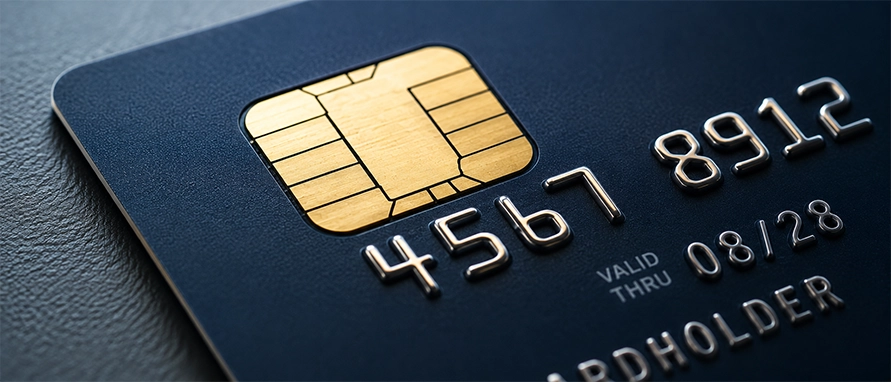
Table of Contents
An EMV chip card is a payment card embedded with a microchip that securely authenticates transactions using dynamic data. Named after Europay, Mastercard, and Visa, the three organisations that developed the standard, EMV chip cards are now the global benchmark for card payment security.
The full form is Europay, Mastercard, and Visa, the three global payment networks that jointly developed and introduced the chip card standard in the mid-1990s. Europay International, which has since merged with Mastercard, was one of the key pioneers behind the initiative.
The EMV standard was established to create a globally interoperable, tamper-resistant specification for chip-based payment cards. The goal was to replace the vulnerable magnetic stripe with a more secure technology that generates unique transaction data each time a card is used. Today, EMVCo, a consortium comprising Visa, Mastercard, American Express, Discover, JCB, and UnionPay manages and evolves the EMV specification globally. The EMV chip card full form, while rooted in three founding companies, now underpins a worldwide payment security infrastructure adopted across 160+ countries.
An EMV chip card is a debit or credit card embedded with a small metallic microprocessor chip that stores and processes cardholder data securely. Unlike a traditional magnetic stripe card, which holds static data that can be easily copied, a chip EMV card generates a unique, one-time cryptographic code for every transaction making it virtually impossible to replicate.
When you look at an EMV chip card, you will notice a small gold or silver square on the front that is the chip. The chip communicates directly with the point-of-sale (POS) terminal during a transaction, verifying the card's authenticity in real time.
EMV chip cards come in two primary interaction modes:
In India, the Reserve Bank of India (RBI) mandated that all debit and credit cards issued by banks must be EMV chip-based, phasing out the use of magnetic stripe-only cards. This was done to significantly reduce card fraud and bring India in line with global payment security standards.
When an EMV chip card is used at a terminal, a series of highly secure processes take place in the background to verify the card and authorise the transaction. Here is a breakdown of what happens.
Step 1 – Card Insertion (Dipping): Insert your EMV chip card into the chip reader slot at the bottom of the POS terminal, chip-side up and facing forward. EMV chip cards must be dipped at chip-enabled terminals.
Step 2 – Card and Terminal Handshake: The chip and the terminal exchange data immediately. The terminal reads the card's chip and initiates a communication session to authenticate both parties.
Step 3 – Tokenisation: The chip generates a unique token for this specific transaction. Unlike magnetic stripe cards, which transmit your actual card number, the EMV chip sends a one-time digital code that cannot be reused.
Step 4 – Dynamic Cryptogram Generation: The chip creates a dynamic cryptogram — an encrypted digital signature specific to this transaction. Even if intercepted, this cryptogram is useless for any other purchase, which is what makes chip EMV cards so resilient against fraud.
Step 5 – Cardholder Verification: Depending on the transaction type and amount, you will be prompted to enter your PIN or provide a signature to confirm your identity.
Step 6 – Issuer Authorisation: The encrypted transaction data is sent to your card-issuing bank, which validates the cryptogram and authorises or declines the transaction.
Step 7 – Transaction Complete: Once approved, remove your card only after the terminal displays a success message. Removing the card too early may cancel the transaction.
EMV chip cards offer a range of significant advantages over traditional magnetic stripe cards, both for cardholders and merchants.
Every EMV chip transaction generates a unique, one-time cryptographic code. This means that even if a fraudster intercepts the transaction data, they cannot reuse it. This dynamic authentication dramatically reduces counterfeit card fraud, which was a major vulnerability of magnetic stripe cards.
Skimming — where criminals attach devices to ATMs or POS terminals to secretly copy magnetic stripe data — is a common method of card fraud. Because EMV chip cards do not transmit static data, skimming devices cannot capture usable information from them. The chip's encrypted communication makes it effectively immune to this type of attack.
Cloning a magnetic stripe card is relatively straightforward with the right equipment. Cloning an EMV chip card, however, is extraordinarily difficult. The chip stores data in an encrypted format and uses dynamic cryptography, so even if someone attempts to replicate the card, the cloned version would fail authentication at the terminal. This makes chip EMV cards highly resistant to counterfeiting.
This policy reallocates financial liability to accelerate the adoption of modern chip-based payment terminals. Responsibility for counterfeit fraud is determined by the technology used at the point of sale:
Merchant Liability: If a secure chip card is used at a terminal that only supports older magnetic stripes, any counterfeit fraud losses shift to the merchant or their bank.
Infrastructure Incentive: Moving the financial risk away from card issuers penalises the use of outdated systems, motivating businesses to upgrade their terminals.
EMV is a globally recognised standard, making chip EMV cards widely accepted across the world. Whether you are transacting in India, Europe, or North America, your EMV chip card is typically accepted at EMV-compatible terminals.
While magnetic stripe cards rely on static data that remains vulnerable to duplication, EMV chip cards introduce dynamic encryption that changes with every transaction, fundamentally shifting the landscape of payment security.
| Feature | EMV Chip Card | Magnetic Stripe Card |
|---|---|---|
Data Storage |
Encrypted microchip |
Static magnetic stripe |
Transaction Code |
Dynamic — unique per transaction |
Static — same every time |
Fraud Risk |
Lower compared to magnetic stripe cards |
High |
Cloning Risk |
Difficult |
Easily cloned |
Skimming Vulnerability |
Highly resistant |
Highly vulnerable |
Authentication |
PIN / cryptographic verification |
Signature or PIN |
POS Interaction |
Dip (insert) or tap |
Swipe |
Transaction Speed |
Slightly slower |
Faster |
Merchant Liability Shift |
Yes, applicable |
No |
RBI Mandate (India) |
Mandatory |
Being phased out |
The fundamental difference lies in how the two technologies handle data. A magnetic stripe card stores your card details in a fixed, readable format that can be copied. An EMV chip card encrypts your data and generates a fresh code for every transaction, making it far more secure for everyday use.
Contactless EMV chip cards use Near Field Communication (NFC) technology to enable tap-and-pay transactions without physically inserting the card into a terminal. The card communicates wirelessly with the POS terminal when held within a few centimetres of the contactless reader typically identified by a wave or Wi-Fi-like symbol on the terminal.
Just like a contact chip transaction, a contactless EMV transaction still generates a dynamic cryptogram, ensuring a similar level of fraud protection as chip-based transactions. The key advantage is speed and convenience; contactless payments are completed in seconds.
In India, the RBI has set a PIN-less transaction limit of ₹5,000 for contactless card payments. This means:
Transactions up to ₹5,000 can be completed with a simple tap — no PIN entry required.
Transactions above ₹5,000 require the cardholder to enter their PIN for additional verification.
Obtaining an EMV chip credit card in India is straightforward, as the RBI has made it mandatory for banks to issue chip-based cards.
RBI Mandate: The Reserve Bank of India directed all banks to replace magnetic stripe-only debit and credit cards with EMV chip-and-PIN cards. This mandate was implemented in phases, and today, all new cards issued by Indian banks are EMV chip cards by default.
Replacement of Existing Magnetic Stripe Cards: If you still hold an older magnetic stripe card, your bank is obligated to replace it with an EMV chip card. You can:
EMV stands for Europay, Mastercard, and Visa — the three payment networks that created the global chip card standard.
When you dip your card at a POS terminal, the chip generates a one-time dynamic cryptogram specific to that transaction. This encrypted code is verified by your bank before the payment is authorised.
No. The dynamic cryptography used by EMV chips makes cloning extremely difficult. Even if data is intercepted, it cannot be reused or replicated to create a functional duplicate card.
Yes, significantly. Magnetic stripe cards store static data that can be easily copied via skimming. EMV chip cards generate unique transaction codes each time, which significantly reduces the risk of counterfeit fraud.
You should not swipe an EMV chip card at a chip-capable terminal; you must dip (insert) it. Some terminals may allow a swipe as a fallback if the chip fails to read, but this is less secure and should be avoided where possible.


Most Viewed

Academy by Bajaj Markets

 47202
47202

Navigate the tax maze with ease! Uncover Income Tax 101, demystify jargon with Terms for Beginners, and choose between Old or New Regimes.
 165541
Unlock the world of credit! From picking the perfect card to savvy loan management, navigate wisely.
 97881
97881
Money Management and Financial Planning covers personal finance basics, setting goals, budgeting...
 28606
28606
Explore the investment cosmos! From beginner's guides to sharp-witted strategies, explore India's treasure trove of options.
 18764
18764
Discover essential insights on various types of insurance in India.
 4584
4584
Welcome to Tech in Finance, where we explore the exciting intersection of technology and finance...












 Academy