Our Products
 Loans
 Cards
 Insurance
 Investment
 Stock Market
 Electronics Mall
 CIBIL Score
 Knowledge Centre
 Calculators
Our Services

 Do not call
 En
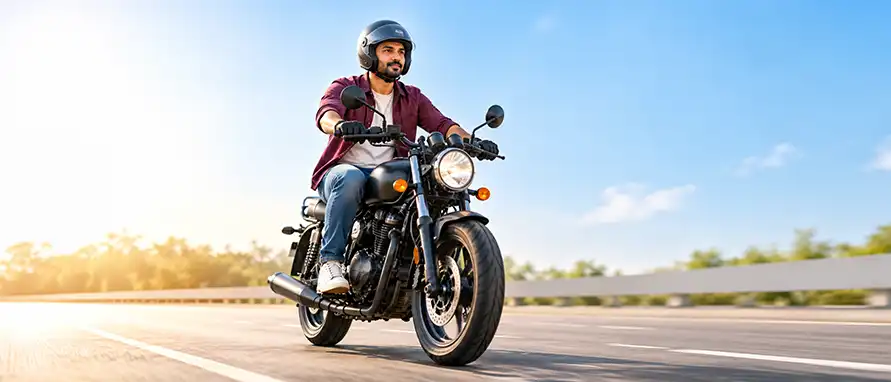
Before you start learning, make sure you have the right equipment, basic knowledge, and a safe environment for practice. Being prepared can help you learn faster and reduce the risk of accidents.
Here are the things you need before learning to ride a bike:
A suitable motorcycle or scooter that's easy to handle and not too heavy
A properly fitted helmet that meets safety standards
Closed-toe footwear with a good grip
Comfortable clothing that allows free movement
Basic knowledge of traffic rules and road signs
A safe practice area away from heavy traffic
An experienced rider or instructor to guide you, if possible
Patience and confidence to learn at your own pace
Choosing the right location is important when learning to ride a bike. A quiet area allows you to focus on balance, braking, and steering without the pressure of traffic.
Here are some suitable places to practise:
Empty parking lots
Open grounds with firm surfaces
Quiet residential roads with minimal traffic
Driving training centres
Private roads where riding is permitted
Avoid practising on busy roads until you are confident with the basic controls.
A drum brake consists of a cylindrical drum that rotates with the wheel, along with brake shoes positioned inside the drum. A wheel cylinder pushes the shoes outward against the inner surface of the drum when the brake is applied, and the resulting friction slows the wheel's rotation. Drum brakes are commonly used on the rear wheels of two-wheelers and in some entry-level or budget vehicle models.
The right bike can make the learning process easier and more comfortable. Beginners should start with a motorcycle that is easy to control and inspires confidence.
Here are a few factors to consider:
Choose a lightweight bike that is easy to manoeuvre
Ensure your feet can touch the ground comfortably
Start with a lower engine capacity, such as 100cc to 150cc
Look for a comfortable riding posture
Select a bike with smooth clutch and gear operation
Consider a scooter if you want to learn balance before managing gears
Before you push off, it helps to know what each part of the bike does. Most bikes share the same basic controls:
Handlebars – Steer the bike and keep your balance. Hold them with a relaxed grip, hands resting lightly on the brake levers.
Brakes – The levers on each side of the handlebars. On most bikes, the left lever controls the front brake and the right controls the rear. Squeeze both gently and evenly to slow down; grabbing the front brake alone can send you over the bars.
Pedals – Push down in a smooth, circular motion to move forward. Keep the ball of your foot over the pedal axle for the best power.
Gears – Shifters on the handlebars change how hard it is to pedal. Use lower gears for hills and starting off, higher gears for flat roads and speed. Shift while pedalling, not while stationary.
Saddle – Your seat height matters. Set it so your leg is almost straight at the bottom of the pedal stroke, but you can still touch the ground with your toes when stopped.
Bell – A quick ring lets pedestrians and other riders know you’re coming.
Get comfortable finding each of these without looking down. Once your hands and feet know where everything is, you can keep your eyes on the road ahead.
Riding a bike for the first time can feel challenging, but following the right approach helps you build confidence and control safely. Focus on learning one skill at a time rather than rushing onto busy roads.
Here are the steps to ride a bike for the first time:
Wear a helmet and other protective gear before starting
Familiarise yourself with the bike's controls while it is stationary
Sit comfortably and ensure both feet touch the ground
Start the engine and pull in the clutch if you are riding a geared bike
Shift into first gear and release the clutch gradually while gently accelerating
Look ahead and maintain a straight line as you begin moving
Practise balancing at a slow speed before attempting turns
Use both brakes smoothly to bring the bike to a controlled stop
Repeat the process until starting, moving, and stopping feel natural
Changing gears correctly helps you maintain speed, control, and fuel efficiency. The ideal gear depends on your speed and riding conditions.
Here are the steps to change gears on a bike:
Pull in the clutch lever fully
Shift to the required gear using the gear lever
Release the clutch gradually while applying gentle throttle
Shift to higher gears as your speed increases
Shift to lower gears when slowing down or climbing an incline
Avoid riding in the wrong gear for extended periods, as it can affect performance and engine efficiency
A gearless scooter is generally easier to learn because it does not require clutch or gear operation. You only need to manage acceleration, braking, and balance.
Here are the steps to ride a gearless scooter:
Start the scooter and keep both hands on the handlebars.
Twist the throttle gently to move forward.
Maintain a steady speed while keeping your eyes on the road ahead.
Use both brakes smoothly when slowing down or stopping.
Practise turning and balancing in an open area before riding in traffic.
Avoid sudden acceleration or braking while learning.
Maintaining balance at low speeds is one of the most important skills for new riders. Smooth inputs and proper posture can help you stay in control while turning, stopping, or moving through slow traffic.
Here are some tips to balance and steer a bike at low speed:
Keep your eyes focused ahead rather than looking at the ground.
Maintain a relaxed grip on the handlebars.
Use smooth throttle inputs to avoid sudden movements.
Keep your feet on the footpegs once the bike is moving.
Turn the handlebars gently when changing direction.
Practise riding in straight lines and wide circles to improve balance.
Avoid abrupt braking or steering inputs at low speeds.
Correct braking helps you stop safely and maintain control of the bike. Learning proper braking techniques can also reduce tyre wear and improve rider safety.
Here are the steps to brake correctly on a two-wheeler:
Apply both front and rear brakes together for balanced stopping
Increase braking pressure gradually rather than braking suddenly
Keep the bike upright when braking whenever possible
Reduce speed before entering a turn
Maintain a safe distance from other vehicles to avoid harsh braking
Avoid locking the wheels, especially on wet or uneven roads
Practise emergency braking in a safe, open area
Once you are comfortable with the basics, you can begin riding in light traffic. Safe riding habits help you anticipate hazards and reduce the risk of accidents.
Here are some tips for riding a bike safely in traffic:
Wear a helmet and protective gear on every ride
Follow traffic signals and road signs at all times
Maintain a safe distance from other vehicles
Use indicators before turning or changing lanes
Check your mirrors regularly and be aware of your surroundings
Stay visible to other road users and avoid blind spot
Avoid sudden lane changes or aggressive manoeuvres
Adjust your speed according to road and traffic conditions
Stay focused and avoid using a mobile phone while riding
Most beginner wobbles come from a handful of habits that are easy to fix once you know them:
The time required to learn bike riding varies from person to person. Most beginners can learn the basics within a few days, while gaining confidence in different road conditions may take several weeks.
Here are some factors that affect learning time:
Previous experience with cycling or scooters
Frequency of practice sessions
Type of bike being used
Confidence and comfort level
Guidance from an experienced rider or instructor
Before riding on public roads, you must carry the required documents to comply with Indian traffic regulations. Keeping these documents readily available can help you avoid penalties during inspections.
Here are the documents required to ride a bike legally in India:
| Document | Purpose |
|---|---|
Driving Licence |
Authorises you to ride the vehicle |
Registration Certificate (RC) |
Proves vehicle ownership and registration |
Valid Insurance Policy |
Provides mandatory third-party insurance coverage |
Pollution Under Control (PUC) Certificate |
Confirms compliance with emission norms |
Learner's Licence (if applicable) |
Required while learning to ride on public roads |
You can practise on private property without a licence. However, to ride on public roads, you need at least a valid learner's licence and must follow its conditions.
Most beginners find a gearless scooter easier to learn because it does not require clutch or gear operation. Once you are comfortable with balance and braking, learning a geared bike becomes easier.
You can obtain a licence for certain low-capacity geared or gearless two-wheelers from the age of 16, subject to applicable regulations. For standard motorcycles, the minimum age is generally 18 years.
Yes, helmet requirements generally apply to both the rider and the pillion rider. You should check and follow the rules applicable in your state.
Yes, you can ride with a learner's licence, provided you comply with the applicable rules, such as displaying the required learner markings and carrying the licence while riding.
Stay calm, switch on the hazard lights if available, restart the bike safely, and move off smoothly when the road is clear. Avoid panicking or making sudden movements.
Apply both brakes to stop the bike, keep your foot firmly on the ground, and use controlled clutch and throttle inputs when moving off again.
Yes, at least third-party motor insurance is mandatory for riding a bike legally on public roads in India. Riding without valid insurance can attract penalties.




 165542

Unlock the world of credit! From picking the perfect card to savvy loan management, navigate wisely.
 97890
Money Management and Financial Planning covers personal finance basics, setting goals, budgeting...
 28606
Explore the investment cosmos! From beginner's guides to sharp-witted strategies, explore India's treasure trove of options.
 47203
Navigate the tax maze with ease! Uncover Income Tax 101, demystify jargon with Terms for Beginners, and choose between Old or New Regimes.
 18764
Discover essential insights on various types of insurance in India.
 4584
Welcome to Tech in Finance, where we explore the exciting intersection of technology and finance...











 Academy