Our Products
 Loans
Loans
 Cards
Cards
 Insurance
 Investment
 Stock Market
 Electronics Mall
 CIBIL Score
 Knowledge Centre
 Calculators
Our Services

 Do not call
 En
En
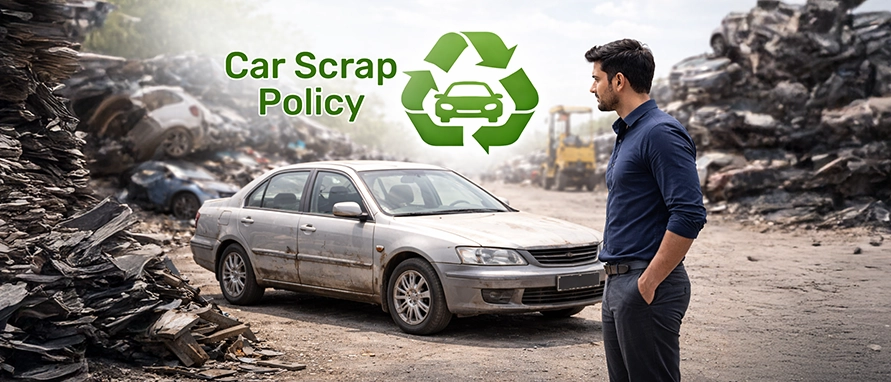
Table of Contents
The car scrap policy in India aims to safely phase out old and polluting vehicles while encouraging owners to switch to cleaner, more efficient alternatives. Introduced by the Government of India, this policy defines clear rules, benefits, and a structured scrapping process for end-of-life vehicles, helping reduce emissions, improve road safety, and promote sustainable mobility.
The car scrapping policy in India, officially known as the Vehicle Scrapping Policy, is a government initiative that regulates how old and unfit vehicles are removed from use. It focuses on identifying end-of-life vehicles based on age, fitness, and pollution levels, and sending them to authorised scrapping centres.
Under the Indian vehicle scrap policy, vehicles that fail mandatory fitness tests or exceed prescribed age limits are discouraged from being used through higher re-registration costs, while scrapping them offers financial and regulatory incentives.
To ensure uniform implementation, the car scrap rule in India follows specific guidelines:
Private cars older than 20 years and commercial vehicles older than 15 years must undergo periodic fitness tests
Vehicles failing fitness or emission norms are categorised as end-of-life vehicles
Vehicles declared unfit by the RTO cannot be re-registered
Heavy commercial vehicles face stricter compliance checks due to higher pollution impact
Vehicles must be scrapped only at government-approved scrapping centres
These centres issue a certificate of destruction, which is essential for deregistration
Scrapping an old vehicle under the India car scrap policy offers several advantages:
Reduces pollution and emission levels from ageing vehicles
Promotes recycling of materials like metal, tyres, suspension parts, and batteries
Owners receive scrap value based on vehicle weight and material
Road tax rebates and registration fee waivers on new vehicles may apply
A scrapping certificate helps cancel vehicle registration smoothly with the RTO
Avoids penalties linked to fitness failures and pollution non-compliance
The scrapping process under the old car scrap policy in India is straightforward when done correctly:
Confirm whether your car qualifies as an end-of-life vehicle based on age or fitness status.
Choose a registered scrapping centre approved by the Government of India.
You’ll need basic identity proof such as a PAN card or passport, along with vehicle documents.
The centre dismantles the vehicle safely, recycling usable components and disposing of waste responsibly.
After completion, you receive a scrapping certificate and certificate of destruction, which can be used for deregistration and future benefits.
The Indian vehicle scrap policy is a major step toward cleaner roads, safer vehicles, and a greener environment. By clearly defining rules, benefits, and the scrapping process, the policy makes it easier for owners to responsibly retire old vehicles while gaining financial and regulatory advantages. Understanding the car scrap policy in India helps you make an informed decision when your vehicle reaches the end of its usable life.
The policy identifies old or unfit vehicles through fitness and emission checks and mandates scrapping them at authorised centres, offering incentives for compliance.
Scrap value depends on the vehicle’s weight, material composition, and current scrap metal rates set by the scrapping centre.
If a car fails fitness norms or has high maintenance and pollution costs, scrapping is usually safer and more beneficial than resale.
The best way is to approach a government-approved scrapping centre to ensure legal compliance and proper documentation.
You can check scrap value by contacting authorised scrapping centres or requesting a valuation based on your vehicle’s specifications.




 47202
47202

Navigate the tax maze with ease! Uncover Income Tax 101, demystify jargon with Terms for Beginners, and choose between Old or New Regimes.
 165541
Unlock the world of credit! From picking the perfect card to savvy loan management, navigate wisely.
 97881
97881
Money Management and Financial Planning covers personal finance basics, setting goals, budgeting...
 28606
28606
Explore the investment cosmos! From beginner's guides to sharp-witted strategies, explore India's treasure trove of options.
 18764
18764
Discover essential insights on various types of insurance in India.
 4584
4584
Welcome to Tech in Finance, where we explore the exciting intersection of technology and finance...












 Academy