Our Products
 Loans
Loans
 Cards
Cards
 Insurance
 Investment
 Stock Market
 Electronics Mall
 CIBIL Score
 Knowledge Centre
 Calculators
Our Services

 Do not call
 En
En
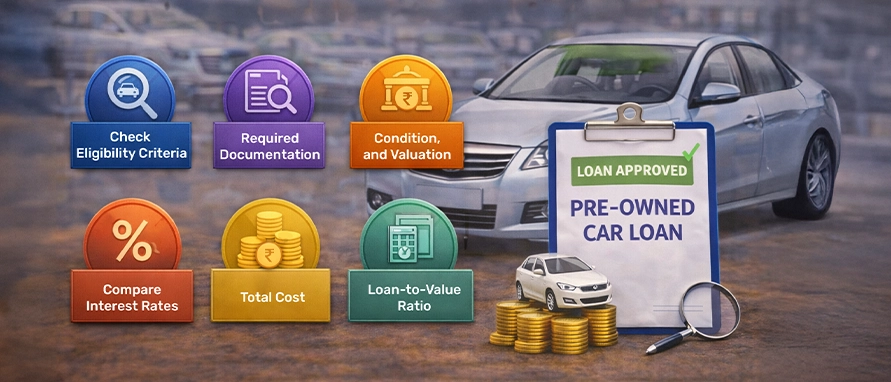
Table of Contents
Buying a pre-owned car can offer significant savings, but securing the right loan for it requires thoughtful planning. With numerous financing options available, it's crucial to evaluate various factors that influence your loan terms. From the car’s condition to the lender’s requirements, each element plays a key role in determining your loan approval and repayment terms. Understanding these factors will help you make a smart, financially sound choice that fits your budget and long-term goals.
Financing a second-hand vehicle can make the purchase more affordable, but it’s essential to consider certain aspects before committing to a loan. Whether it's assessing the car's age, loan interest rates, or understanding the total cost of ownership, these elements can impact your decision. To ensure you get the most favorable deal, it's important to do thorough research and make well-informed decisions. Below are seven key things you should keep in mind before applying for a pre-owned car loan.
Different credit providers have distinct used car loan requirements. You must fulfil these criteria to be eligible for accessing their second-hand vehicle loan facility. Discussed below are certain parameters that banks and non-banking finance companies (NBFCs) check before extending credit.
Currently, several calculators and digital tools can aid in performing instant eligibility checks before application to avoid unnecessary pre-owned car loan rejection.
The next aspect in the used car loan guide is the varying bank interest slabs. Lending rates differ between different credit providers due to their distinct credit policy. Therefore, before choosing any pre-owned car loan, you must compare the lending rate offered by different providers given your credentials. Moreover, another important consideration here is floating vs fixed rate options.
| Particulars | Fixed Interest Rate | Floating Interest Rate |
|---|---|---|
Meaning |
The interest rate remains constant throughout the loan tenure, irrespective of market trends. |
The interest rate changes with a change in market rate. |
Initial Rate |
The starting rate is usually higher than the floating rate. |
The starting rate is usually lower than the fixed rate. |
Choosing an optimal bank or NBFC lending rate allows you to keep credit in control and reduce unnecessary burden.
One of the key things to know before taking a used car loan is the condition of the second-hand car you are about to purchase. Banks usually finance cars up to a certain age. For instance, if XYZ bank gives pre-owned car loans for vehicles which are up to 5 years old, you cannot avail the credit for a 7 year old used car.
Moreover, the loan amount depends on the vehicle market value and not the selling price charged. This market value further depends on the condition of the car. If a vehicle is not of optimal quality, then the creditor can reject the loan application or ask for a high down payment. Therefore, before finalising a car, ensure you have access to the following quality checks and certifications.
Vehicle inspection report
Odometer verification
Vehicle ownership records
Moreover, before applying for a loan, you can use digital car resale value estimators to anticipate the prospective credit terms and avoid unnecessary rejections.
Loan to Value (LTV) ratio helps a creditor assess the risk associated with a loan. It shows the loan amount as a percentage of asset value. It helps in down payment assessment, along with finalising eligibility and interest rate.
For example, if the market value is ₹5 Lakhs and LTV is at 80%, then loan amount will be ₹4 Lakhs and down payment would be ₹1 Lakhs.
A low LTV denotes low credit risk and increased down payment for a given loan amount. However, a high LTV can mean higher risk and lower down payment. Depending on this credit risk and applicant’s credentials, the bank or NBFC determines other credit terms like interest rate.
Interest is the cost of debt. However, along with it there are several other charges like processing fees, penalty rates, the actual loan amount, etc., that act as a cost of borrowing. Individuals should ideally take a holistic look at overall credit terms of different lenders to choose one with the most suitable terms. The table below shows the general pre-owned car loan terms on Bajaj Markets.
Max Loan Amount |
₹2.5 Crores |
Minimum Interest Rate |
10% |
Pre-owned car loan processing usually requires different documentation. Some pertain to the applicant, while others pertain to the car. Listed below are some common document requirements.
Know Your Customer or KYC documents like Aadhaar Card, Voter ID, etc.
Employee ID card
Salary slip
Bank account statements
Vehicle registration certificate
ITR
Vehicle insurance copy
Often while choosing a loan facility, users limit research to interest and loan corpus. However, other additional charges like the processing fee, penalty rates, etc., can increase the ultimate credit burden. Therefore, while comparing and choosing a credit policy, investors must consider the other costs of debt as well.
Follow the steps mentioned below to apply for Used Car Finance on Bajaj Markets:
Go to the official website of Bajaj Markets.
Find and select the ‘Used Car Loan’ option under the ‘Loans’ section.
Click on the ‘Check Offer’ button.
You will be directed to a new page.
Provide your details, including your ‘Mobile Number’ and ‘Pincode’.
From the drop-down menu, select your preferred ‘Loan Type’.
Agree to the terms and conditions, then click ‘Proceed’.
You will now see all the loan offers you're eligible for.
Complete the verification process and receive your loan sanction letter.
Yes, lenders usually extend credit for cars within a particular age limit. The actual car age eligibility can vary from one lender to another.
On Bajaj Markets the usual interest rate for pre-owned cars can be 10.50%. However, the rate can vary from one lender to another.
Some creditors can extend up to 100% financing. However, it is important to check the LTV of individual lenders.
The approval window can vary from a few hours to several days depending on the insurer and credibility of the applicant. An individual with a high credit score and income can get faster approval than others.
Yes, self-employed individuals can get a second-hand car loan given that they have documents like bank statements, ITR files, etc., to prove income.
Yes, banks or NBFCs can have a minimum credit score requirement for used car loans. Moreover, a high credit score helps in achieving better credit terms like flexible EMI options.




 47202
47202

Navigate the tax maze with ease! Uncover Income Tax 101, demystify jargon with Terms for Beginners, and choose between Old or New Regimes.
 165541
Unlock the world of credit! From picking the perfect card to savvy loan management, navigate wisely.
 97881
97881
Money Management and Financial Planning covers personal finance basics, setting goals, budgeting...
 28606
28606
Explore the investment cosmos! From beginner's guides to sharp-witted strategies, explore India's treasure trove of options.
 18764
18764
Discover essential insights on various types of insurance in India.
 4584
4584
Welcome to Tech in Finance, where we explore the exciting intersection of technology and finance...












 Academy