Our Products
 Loans
Loans
 Cards
Cards
 Insurance
 Investment
 Stock Market
 Electronics Mall
 CIBIL Score
 Knowledge Centre
 Calculators
Our Services

 Do not call
 En
En
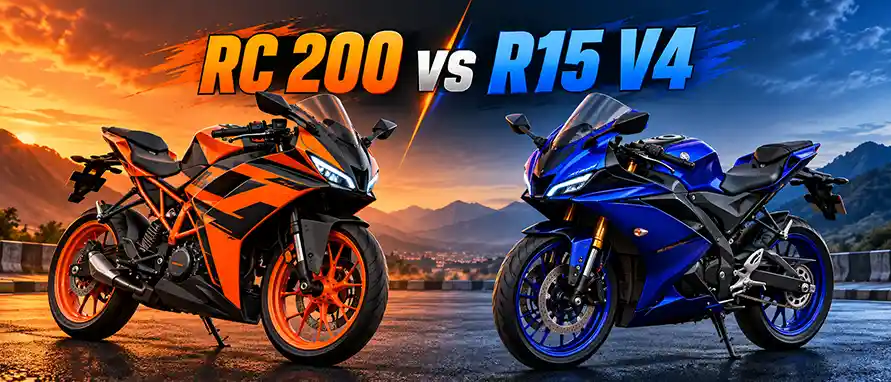
The entry-level supersport motorcycle segment in India remains highly competitive, catering to young riders who crave racetrack-derived dynamics alongside everyday utility. Two dominant choices in this class are the Austrian-engineered Austrian track-weapon, the KTM RC 200, and the Japanese marvel, the Yamaha R15 V4. Both motorcycles offer striking fairings, forward-leaning postures, and sophisticated technological components.
When analyzing ktm rc 200 vs r15 v4 which is better, buyers are faced with a definitive choice between pure mechanical aggression and highly tech-loaded efficiency. While both machines deliver impeccable cornering stability, they follow vastly different philosophies. This comprehensive guide details a granular ktm rc 200 vs r15 v4 comparison, covering their prices, performance metrics, features, and everyday urban mannerisms to help you make an informed decision.
Budgetary constraints play a crucial role when making a purchase decision. Comparing the ktm rc 200 vs r15 v4 price highlights a substantial gap between these entry-level sportbikes. The Yamaha R15 V4 leverages its smaller engine capacity to offer an accessible price point, whereas the KTM RC 200 commands a premium due to its performance capabilities.
The table below provides an approximate pricing overview for the standard models:
| Motorcycle Model | Approximate Ex-Showroom Price | Estimated On-Road Price |
|---|---|---|
Yamaha R15 V4 (Standard / Dark Knight) |
₹1,71,982 onwards |
₹1,96,355 onwards |
KTM RC 200 (Standard / GP Edition) |
₹2,14,721 onwards |
₹2,44,199 onwards |
The Yamaha R15 V4 line is highly versatile, offering six distinctive colour variants, including the premium R15M and Carbon Fibre editions, which bridge the price gap slightly closer to the KTM. The KTM RC 200 keeps its product range streamlined with two premium variants but carries a definitive cost premium of roughly ₹43,000 ex-showroom over the entry-level R15 V4.
To appreciate the core differences between the ktm rc 200 vs r15, you must examine their underlying specifications. The RC 200 is a true 200cc machine that thrives on explosive power delivery, whereas the R15 V4 relies on Variable Valve Actuation (VVA) to extract peak performance from a compact 155cc displacement.
| Specification Parameter | KTM RC 200 | Yamaha R15 V4 |
|---|---|---|
Engine Displacement |
199.5 cc |
155 cc |
Engine Configuration |
Single Cylinder, Liquid-Cooled, DOHC |
Single Cylinder, Liquid-Cooled, SOHC, 4-Valves |
Maximum Power |
24.6 bhp @ 10,000 rpm |
18.1 bhp @ 10,000 rpm |
Maximum Torque |
19.2 Nm @ 8,000 rpm |
14.2 Nm @ 7,500 rpm |
Gearbox / Transmission |
6-Speed Manual |
6-Speed Manual with Assist & Slipper Clutch |
Fuel Tank Capacity |
13.7 Litres |
11 Litres |
Kerb Weight |
160 kg |
141 kg |
Analyzing the raw numbers reveals that the ktm 200 vs r15 v4 mechanical showdown favors the Austrian manufacturer in power output. Generating 24.6 bhp and 19.2 Nm of torque, the RC 200 accelerates fiercely and pulls strongly in the mid-range. However, the Yamaha R15 V4 counters with a lightweight 141 kg kerb weight, giving it a nimble power-to-weight ratio.
Modern electronics add immense value to high-speed sportbikes. When analyzing whether the rc 200 vs r15 v4 battle favours electronics over raw mechanics, Yamaha historically takes the lead by packing big-bike telemetry into a smaller package.
| Feature Component | KTM RC 200 Features | Yamaha R15 V4 Features |
|---|---|---|
Braking System |
Dual-Channel ABS (Supermoto Mode) |
Dual-Channel ABS |
Front Suspension Setup |
WP APEX 43 mm USD Forks |
Premium Upside Down Front Forks |
Traction Control System |
Absent |
Present (Selectable) |
Quickshifter Technology |
Absent |
Present (Bi-directional on top variants) |
Instrument Console |
Digital LCD Unit with Bluetooth |
Bluetooth-enabled LCD / TFT Screen |
Chassis Framework |
Steel Trellis Frame (Powder Coated) |
Signature Yamaha Deltabox Frame |
The feature comparison showcases that the Yamaha R15 V4 provides a more advanced electronic safety suite, featuring Traction Control and a factory-fitted Quickshifter. Conversely, the KTM RC 200 focuses heavily on high-end structural hardware, utilizing 43mm WP APEX front forks and larger 320mm front disc brakes, paired with a specialized "Supermoto" ABS mode that lets the rider disable rear ABS interventions.
Both motorcycles offer distinct performance characteristics. Weighing up the strengths and limitations of the ktm rc 200 compared to r15 v4 breakdown can clarify which model best suits your riding style.
| Bike Model | Advantages (Pros) | Drawbacks (Cons) |
|---|---|---|
KTM RC 200 |
• Superior 24.6 bhp power output • More relaxed ergonomics than older generations • Excellent WP APEX track-oriented suspension |
• Considerably higher purchase price • Lower overall fuel efficiency • High engine heat in stop-and-go urban traffic |
Yamaha R15 V4 |
• Exceptional fuel economy (45–51 kmpl) • Packed with Traction Control & Quickshifter • Lightweight and easy to manage |
• Committed, aggressive posture causes wrist ache • Reduced top-end pulling power with a pillion • Compact pillion seat profile |
Evaluating the ktm rc 200 vs r15 v3 or older V4 dynamics for daily use reveals that track-focused aesthetics require some compromises on public roads. Daily commuting demands comfortable ergonomics, manageable heat dissipation, and economical running costs.
Ergonomics and Comfort: With its generation updates, the KTM RC 200 features a revised trellis frame that provides taller clip-on handlebars and a thicker saddle. This makes its riding position more accommodating for long city commutes compared to the aggressive, low-set clip-ons of the Yamaha R15 V4.
Fuel Efficiency and Economy: If running costs are your main priority, the ktm rc 200 vs r15 v4 mileage comparison swings heavily in Yamaha's favour. The R15 V4 delivers an impressive 45–51 kmpl, whereas the larger engine of the RC 200 delivers a more modest 35 kmpl.
Urban Heat Management: The R15 V4 manages engine temperatures exceptionally well in stop-and-go gridlock. The high-compression motor of the RC 200 can radiate noticeable heat onto the rider's legs when trapped in heavy urban traffic.
Whether you choose the performance-focused KTM RC 200 or the highly efficient Yamaha R15 V4, arranging funding is straightforward on Bajaj Markets. You can explore tailored two-wheeler loan digital solutions to bring your dream sportbike home without financial stress.
High Loan-to-Value Financing: Secure funding for up to 95% or even 100% of the on-road price of your chosen sportbike, minimizing your upfront down payment.
Adaptable Repayment Plans: Distribute the cost of your motorcycle over flexible loan tenures ranging from 12 to 60 months.
Quick Online Processing: Enjoy minimal paperwork, competitive interest rates, and rapid online approval to ensure quick showroom delivery.
The KTM RC 200 offers a more upright and comfortable seating position than the Yamaha R15 V4, reducing wrist strain during city commutes. However, the Yamaha R15 V4 is lighter, runs cooler, and offers superior fuel economy, making it highly economical for daily use if you can manage its aggressive riding stance.
The ktm rc 200 vs r15 v4 mileage difference is significant. The Yamaha R15 V4 delivers an impressive real-world mileage of 45 to 51 kmpl due to its VVA technology. In contrast, the performance-tuned KTM RC 200 yields around 35 kmpl.
The Yamaha R15 V4 is considerably cheaper, with prices starting around ₹1,71,982 (ex-showroom). The KTM RC 200 is priced higher, starting at approximately ₹2,14,721 (ex-showroom), making the Yamaha more accessible.
Yes, the Yamaha R15 V4 offers more electronic rider aids, including a Traction Control System and a Quickshifter for clutchless upshifts. The KTM RC 200 focuses its hardware value on premium WP APEX suspension components and a specialized Supermoto ABS mode.
Yes, you can apply for a two-wheeler loan for either motorcycle on Bajaj Markets. The platform offers quick online processing, high financing eligibility, and flexible EMI repayment tenures to suit your budget.




 47202
47202

Navigate the tax maze with ease! Uncover Income Tax 101, demystify jargon with Terms for Beginners, and choose between Old or New Regimes.
 165541
Unlock the world of credit! From picking the perfect card to savvy loan management, navigate wisely.
 97881
97881
Money Management and Financial Planning covers personal finance basics, setting goals, budgeting...
 28606
28606
Explore the investment cosmos! From beginner's guides to sharp-witted strategies, explore India's treasure trove of options.
 18764
18764
Discover essential insights on various types of insurance in India.
 4584
4584
Welcome to Tech in Finance, where we explore the exciting intersection of technology and finance...












 Academy