Our Products
 Loans
Loans
 Cards
Cards
 Insurance
 Investment
 Stock Market
 Electronics Mall
 CIBIL Score
 Knowledge Centre
 Calculators
Our Services

 Do not call
 En
En
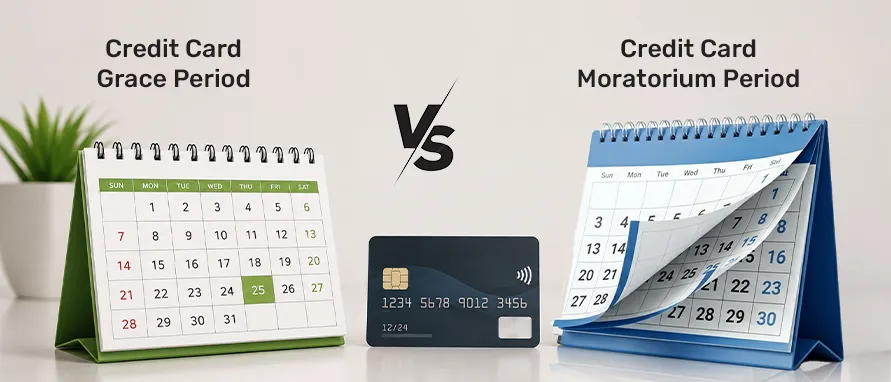
Table of Contents
Understanding the difference between a credit card grace period and a moratorium period can help you manage your finances better and avoid unnecessary interest charges. While both terms relate to a window of time around your credit card payments, they serve very different purposes and come with very different consequences.
A credit card grace period is an interest-free window that card issuers provide between the end of your billing cycle and your payment due date. In India, this period typically ranges from 18 to 48 days, depending on your card issuer and billing cycle.
To understand how the credit card grace period is calculated, consider this: if your billing cycle ends on the 5th of the month and your due date is the 25th, your grace period is 20 days. During this window, no interest is charged on your outstanding purchases — but only if you pay the full outstanding balance by the due date.
It is important to know what happens if you miss your credit card grace period. If you do not pay the full amount by the due date, interest kicks in — not just on the remaining balance, but often retroactively on all purchases made during that billing cycle. Additionally, a late payment fee may be levied, and your credit score could be negatively impacted.
In a credit card, the grace period of repayment only applies to new purchases. Cash advances and balance transfers typically do not enjoy this interest-free benefit and start accruing interest from the day of the transaction.
A moratorium period on credit cards refers to a temporary payment holiday granted by the bank or financial institution, usually during extraordinary financial circumstances. Unlike the grace period, a moratorium is not a standard feature — it is an exceptional relief measure.
The most prominent example in India was the RBI COVID-19 moratorium offered from March to August 2020, during which borrowers — including credit card holders — were allowed to defer their minimum due payments for up to six months.
However, a moratorium is not free relief. Interest continues to accrue on the outstanding amount throughout the moratorium period. This means that while you are not required to make payments, your overall debt can grow significantly during this time.
A moratorium is typically applicable to a broad set of borrowers — often all customers of a bank or those who opt in — rather than being a personalised arrangement. It is designed as a systemic response to financial crises rather than a routine feature of your credit card agreement.
The question "Is moratorium the same as grace period?" is common — and the answer is a clear no. Here is a detailed comparison:
| Feature | Grace Period | Moratorium Period |
|---|---|---|
Duration |
18–48 days per billing cycle |
Weeks to months (as declared) |
Interest Charges |
No interest if full dues are paid |
Interest continues to accrue |
Who It Applies To |
All cardholders, every billing cycle |
Specific borrowers during crisis periods |
Payment Requirement |
Full payment needed by due date |
No payment required during the period |
Purpose |
Routine interest-free repayment window |
Emergency financial relief measure |
Frequency |
Available every month |
Rare; granted only in exceptional cases |
Initiated By |
Standard feature of every credit card |
Bank or regulator (e.g., RBI directive) |
The grace period vs moratorium distinction is crucial — one is a regular feature that rewards timely payment, while the other is a relief measure that defers but does not eliminate your financial obligation.
Making the most of the grace period on a credit card is one of the simplest ways to use credit smartly. Here is how:
Pay the full outstanding balance by the due date. This is the single most important step. Paying only the minimum amount does not preserve your grace period — the remaining balance will begin attracting interest, sometimes at rates exceeding 36–42% per annum.
Set up auto-debit for the full amount. Many card issuers allow you to automate full payment from your linked bank account. This eliminates the risk of forgetting due dates and ensures you consistently benefit from the credit card grace period after the due date never becoming an issue.
Track your billing cycle. Knowing when your cycle starts and ends helps you plan large purchases strategically. A purchase made just after a billing cycle begins gives you the maximum grace period before payment is due.
Avoid cash advances. These transactions do not benefit from a grace period and attract interest from day one, making them a costly way to access funds.
Does a credit card grace period affect your credit score? Not if you pay on time. When you pay your full dues within the grace period each month, it reflects positively on your credit report — showing disciplined repayment behaviour and helping build a strong CIBIL score over time.
However, missing your payment even after the grace period can lead to a late payment mark on your credit report, which can lower your score significantly.
The moratorium period, on the other hand, has a more complex impact. While the RBI had directed that accounts under the COVID-19 moratorium should not be classified as Non-Performing Assets (NPAs), some lenders did flag these accounts differently in their internal systems. In certain cases, this led to adverse remarks on CIBIL reports, which could affect future loan eligibility.
In general, a moratorium should be opted for only when genuinely necessary. Using one opportunistically — when you can actually afford to pay — could lead to higher interest accumulation and potential credit score complications down the line.
A: The grace period typically ranges from 18 to 48 days, starting from the end of the billing cycle to the payment due date. During this period, no interest is charged, provided you pay the full outstanding balance.
A: No, as long as you pay your dues in full within the grace period. Timely payments during this window actually help improve your credit score over time.
A: You will be charged interest on the outstanding amount, often retroactively. A late payment fee may also apply, and your credit score could be negatively impacted.
A: It is the number of days between the end of your billing cycle and your payment due date. This can vary from 18 to 48 days depending on your card issuer.
A: No. A grace period is a standard monthly feature where no interest is charged if you pay in full. A moratorium is an exceptional, temporary payment holiday where interest still accrues. They are fundamentally different in purpose and implication.
A: Only if you are genuinely facing financial hardship. Interest continues to accumulate during a moratorium, increasing your total debt. If you can make payments, it is always better to do so.


Most Viewed

Academy by Bajaj Markets

 47202
47202

Navigate the tax maze with ease! Uncover Income Tax 101, demystify jargon with Terms for Beginners, and choose between Old or New Regimes.
 165541
Unlock the world of credit! From picking the perfect card to savvy loan management, navigate wisely.
 97881
97881
Money Management and Financial Planning covers personal finance basics, setting goals, budgeting...
 28606
28606
Explore the investment cosmos! From beginner's guides to sharp-witted strategies, explore India's treasure trove of options.
 18764
18764
Discover essential insights on various types of insurance in India.
 4584
4584
Welcome to Tech in Finance, where we explore the exciting intersection of technology and finance...












 Academy