
Our Products
 Loans
 Cards
 Insurance
 Investment
 Stock Market
 Electronics Mall
 CIBIL Score
 Knowledge Centre
 Calculators
Our Services

 Do not call
 En
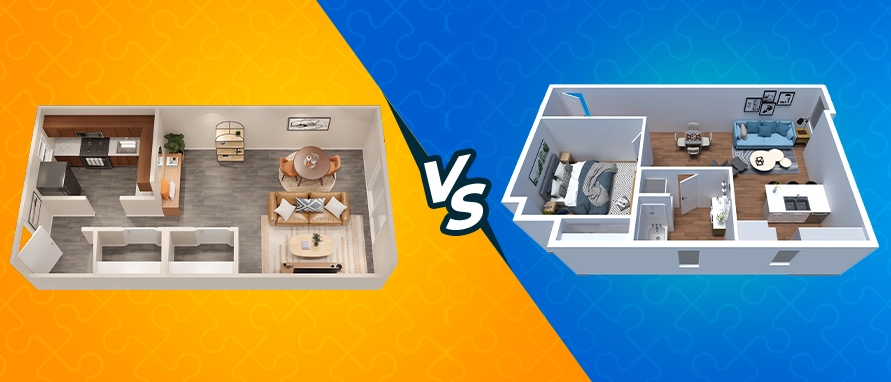
Choosing between a 1 RK and a 1 BHK apartment usually comes down to space, privacy and budget. A 1 RK packs a bedroom, living area and dining space into one multipurpose room with a separate kitchen, while a 1 BHK gives you a dedicated bedroom, a separate hall and a kitchen. Both are popular with bachelors, young professionals and small families across Indian cities, but they suit very different budgets and lifestyles.
This guide breaks down what 1 RK and 1 BHK actually mean, how they compare on size, cost and layout, and which one might work better for you — along with how home loan financing applies to each.
Note: RK and BHK are real-estate market conventions, not terms with a single legal or regulatory definition. Size and price ranges below are typical figures reported across multiple listing platforms and can vary by city, project and builder — always confirm exact carpet area and pricing on the specific property's floor plan and RERA listing before deciding.
A 1 RK apartment stands for '1 Room-Kitchen' — a compact home with a single multipurpose room that doubles as the bedroom, living room and dining space, plus a separate kitchen and a bathroom (usually attached). There is no separate hall or dedicated bedroom; everything except the kitchen and bathroom happens in one room.
A 1 RK apartment typically has a carpet area of around 200 to 400 sq. ft., though some city listings go up to 500 sq. ft. depending on the project.
1 RK homes are popular with bachelors, students, single working professionals and frequent travellers who need a functional, low-maintenance base rather than a large family home. They're widely available in cities like Mumbai, Pune, Bengaluru, Delhi NCR and Noida.
A 1 BHK apartment stands for '1 Bedroom-Hall-Kitchen' — a home with a dedicated bedroom, a separate hall that functions as the living and dining area, an independent kitchen, and one or more bathrooms. Each space has its own walls, giving you clearly defined zones instead of one shared room.
A 1 BHK apartment typically spans around 400 to 695 sq. ft. of carpet area, offering noticeably more room to move around than a 1 RK.
1 BHK homes work well for couples, small families, remote workers who need a separate space to take calls, and anyone who values privacy and a defined bedroom over sheer affordability.
RK stands for 'Room Kitchen' (sometimes written as 'Room and Kitchen') — a single room combined with a kitchen, with no separate hall or bedroom. BHK stands for 'Bedroom, Hall, Kitchen' — the number before BHK simply tells you how many bedrooms the home has, so a 1 BHK has one bedroom, one hall and one kitchen, a 2 BHK has two bedrooms, and so on. Neither abbreviation formally counts the bathroom, even though virtually every 1 RK and 1 BHK unit includes one.
At a glance, here is how a 1 RK and a 1 BHK apartment compare:
| Feature | 1 RK | 1 BHK |
|---|---|---|
|
|
|
|
|
|
|
|
|
|
|
|
|
|
|
|
|
|
|
|
|
Note: Figures mentioned are for illustration purposes only.
Carpet area — the usable floor space inside a unit's walls, excluding balconies and shared common areas — is the clearest way to compare a 1 RK and a 1 BHK, since both can otherwise look similar in marketing photos.
| Configuration | Typical carpet area | Rooms included |
|---|---|---|
|
|
|
|
|
|
Because a 1 BHK physically separates the bedroom from the living area, it generally offers close to double the usable space of a 1 RK — useful if you need room for a work-from-home setup, guests, or simply more storage. Always check the carpet area (not the super built-up area, which includes lobbies and staircases) on the RERA listing before comparing two properties, since units in the same configuration can vary noticeably in size between projects.
Price is usually the deciding factor between the two. A 1 RK apartment is the more affordable option to both buy and rent, simply because it offers less carpet area and fewer separate spaces to build and maintain. A 1 BHK costs more upfront and typically comes with higher monthly maintenance charges, since it has more floor area, an extra room, and often more fittings (a second door, extra flooring, sometimes an additional bathroom).
| Factor | 1 RK | 1 BHK |
|---|---|---|
|
|
|
|
|
|
|
|
|
|
|
|
Note: Actual purchase price, rent and maintenance charges vary hugely by city, locality and project — this table shows the general direction of the comparison rather than fixed figures. Check current listings and society maintenance schedules for the specific property you're considering.
| Pros | Cons |
|---|---|
More affordable to buy or rent |
No separate bedroom or hall — limited privacy |
Lower maintenance and utility costs |
Not practical for families or long-term multi-person living |
Easy to clean, furnish and manage |
Limited storage space |
Ideal for short stays, students and single professionals |
Cooking smells and clutter are harder to contain in a shared room |
Popular rental choice near business/IT hubs, so can offer steady rental demand from bachelors |
Narrower resale and rental market compared with a 1 BHK |
| Pros | Cons |
|---|---|
Dedicated bedroom offers real privacy |
Higher purchase price and rent than a 1 RK |
More usable space for storage, work-from-home or guests |
Higher society maintenance and utility bills |
Wider tenant and buyer pool — generally easier to rent or resell |
May be more space (and cost) than a single occupant needs |
Better suited for couples and small families for the long term |
More area to clean and furnish |
Separate, enclosed kitchen keeps cooking contained |
Requires a larger upfront down payment for a home loan |
1 RK and studio apartments are often used interchangeably in everyday conversation, and in casual listings they can mean much the same thing — but where developers and rental platforms do distinguish them, a few differences tend to hold:
● Size: Studio apartments generally run larger (roughly 300–600 sq. ft.) than 1 RK units (roughly 200–400 sq. ft.), though this varies by city and project.
●Layout: A 1 RK typically has a demarcated kitchen area within or beside the main room, while a studio is usually a fully open-plan space combining living, sleeping and kitchen areas, most often with a separate bathroom.
● Amenities and cost: Studios are more often found in larger, professionally managed complexes with additional amenities, and typically rent for more than a comparable 1 RK — reported at roughly 20–50% higher in some city comparisons.
In short: think of a 1 RK as the more basic, budget-first version of the compact single-room home, and a studio as a slightly larger, more open-plan take on the same idea. If a listing calls something a 'studio,' it's still worth checking the actual floor plan and carpet area rather than assuming it's automatically bigger than a 1 RK.
Note: Usage of 'RK' vs 'studio' is not standardised across India — some listings use the terms interchangeably regardless of these general distinctions, so always verify the floor plan directly.
A 1 RK costs less to buy or rent and carries lower ongoing maintenance and utility charges — the natural choice if affordability is the priority.
A single person or a couple comfortable sharing one open space can manage well in a 1 RK; anyone who needs a separate bedroom — for privacy, sleep schedules, or simply personal space — will find a 1 BHK more livable.
For a short stay of a year or two (a work posting, a course, a first job in a new city), a 1 RK is often enough. For a stay of several years, or if you expect your household to grow, a 1 BHK tends to accommodate that better.
If you work from home, host guests, or need room for hobbies, the extra separation and space in a 1 BHK will matter more day to day than it might first appear.
If you're buying as an investment, a 1 BHK generally draws a wider pool of tenants and buyers and tends to hold resale value better than a 1 RK, which appeals mainly to singles and short-stay renters.
Home loan eligibility works largely the same way for a 1 RK and a 1 BHK apartment — lenders assess your income, age, employment stability, credit (CIBIL) score, existing debt obligations (FOIR), and the loan-to-value ratio they're willing to offer against the property's value, rather than applying a different rulebook based on configuration.
A few practical points to keep in mind specifically when financing a compact 1 RK unit:
●Property approval matters as much as your own profile — lenders check that the project or building is RERA-registered (or otherwise legally clear) and that the title is undisputed, regardless of unit size.
●Older or unapproved buildings — where 1 RK units are more common in some cities — can sometimes face more scrutiny or a lower loan-to-value offer than a comparable 1 BHK in a newer, approved project; this depends on the specific lender and property, not the RK/BHK label itself.
●Because a 1 BHK typically costs more, it usually involves a larger loan amount and a proportionately larger down payment, but the eligibility criteria applied are the same set of factors.
Whichever configuration you choose, it's worth using a home loan eligibility calculator with your actual income, tenure preference and city to get an accurate, personalised estimate before you start shortlisting properties.
A 1 RK and a 1 BHK apartment both offer compact, city-friendly living, but they serve different needs. A 1 RK is the more affordable, lower-maintenance option, well suited to singles, bachelors and shorter stays. A 1 BHK costs more but delivers a dedicated bedroom, more usable space, and generally stronger resale and rental potential — a better fit for couples, small families, or anyone planning to stay put for a few years. Weigh your budget, privacy needs and how long you plan to live there, and check the actual carpet area and RERA listing of any property before you decide. If you need financing either way, home loan eligibility is assessed on the same core factors regardless of configuration.
|
|
RK stands for 'Room Kitchen' — a single multipurpose room combined with a separate kitchen, with no separate hall or bedroom.
BHK stands for 'Bedroom, Hall, Kitchen.' The number before BHK indicates how many bedrooms the home has — a 1 BHK has one bedroom, one hall and one kitchen.
A 1 RK apartment typically has a carpet area of around 200 to 400 sq. ft., though this can extend up to 500 sq. ft. depending on the city and project.
A 1 BHK apartment typically spans around 400 to 695 sq. ft. of carpet area.
A 1 RK has one multipurpose room (combining bedroom, living and dining space) with a separate kitchen, while a 1 BHK has a dedicated bedroom, a separate hall and a separate kitchen — giving a 1 BHK more space, privacy and generally a higher price than a 1 RK.
A 1 RK apartment is a compact home consisting of one multipurpose room used as the bedroom, living room and dining area, along with a separate kitchen and a bathroom.
RK is a separate term from BHK, not a part of it — RK (Room Kitchen) describes a layout without a separate bedroom or hall, while BHK (Bedroom, Hall, Kitchen) describes a layout that has both. The two terms are used to label different apartment configurations, not different parts of the same one.
Yes. A 1 RK apartment includes a bathroom, typically attached to or opening directly off the main room, even though the abbreviation 'RK' itself doesn't mention it.
In some older or larger-carpet-area 1 RK units, owners partition the single room to create a separate bedroom, effectively converting it into a 1 BHK-style layout. This depends on the unit's size, the building's structural and society rules, and local municipal approval for any structural changes — it isn't possible or advisable in every 1 RK, especially smaller ones.
Yes. A 1 RK is generally cheaper to buy or rent than a 1 BHK, and it also tends to carry lower maintenance charges and utility bills, since it offers less carpet area and fewer separate rooms.
Yes. Home loans are available for 1 RK apartments on the same core eligibility factors as any other configuration — income, age, credit score, employment stability and the property's legal and RERA status. Loan amount and down payment will generally be smaller than for a 1 BHK, given the lower property value.




 165542

Unlock the world of credit! From picking the perfect card to savvy loan management, navigate wisely.
 97885
Money Management and Financial Planning covers personal finance basics, setting goals, budgeting...
 28606
Explore the investment cosmos! From beginner's guides to sharp-witted strategies, explore India's treasure trove of options.
 47203
Navigate the tax maze with ease! Uncover Income Tax 101, demystify jargon with Terms for Beginners, and choose between Old or New Regimes.
 18764
Discover essential insights on various types of insurance in India.
 4584
Welcome to Tech in Finance, where we explore the exciting intersection of technology and finance...












 Academy


