Our Products
 Loans
Loans
 Cards
Cards
 Insurance
 Investment
 Stock Market
 Electronics Mall
 CIBIL Score
 Knowledge Centre
 Calculators
Our Services

 Do not call
 En
En
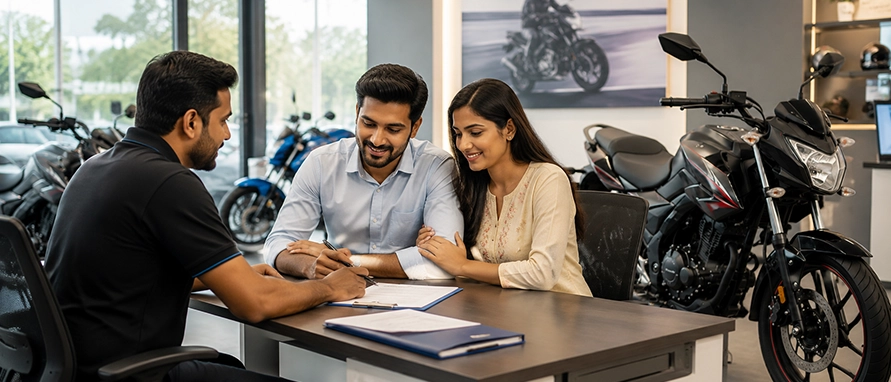
Learn the role of co-applicants in two-wheeler loan applications. Discover how adding a co-applicant can improve loan eligibility and approval chances.
Owning a two-wheeler can make daily life much easier, whether you live in a large city or a small town. For many people in India, a bike is a practical and affordable way to travel to work, manage errands, and support family needs. When savings fall short, a two-wheeler loan becomes a helpful option, provided you meet the basic two-wheeler loan eligibility criteria set by the lender.
In many cases, lenders may ask for a co-applicant. Adding a co-applicant can improve your chances of loan approval and may even help you get better loan terms. However, a co-applicant also shares equal responsibility for repayment. Understanding their role clearly can help you avoid financial stress and make smarter borrowing decisions.
A co-applicant in a bike loan is someone who submits the loan application jointly with you and is equally liable for repaying the borrowed amount. From the lender’s point of view, both applicants are legally liable for paying the monthly instalments on time.
Lenders assess income, job stability, existing debts, and credit score before approving a two-wheeler loan. If your income is not sufficient or your credit score is low, adding a co-applicant with a stable income and good credit history can improve your chances of approval. It may also help you qualify for a higher loan amount.
A co-applicant is usually a close family member, such as a spouse or parent. The lender will check their financial details just as carefully as yours.
It is important to note that a co-applicant is not the same as a guarantor. A guarantor steps in only if the borrower defaults. A co-applicant, however, is equally responsible from day one. If the EMI is missed, it can affect both credit scores and future loan eligibility.
Before adding a co-applicant to your bike loan, make sure both of you clearly understand the financial commitment involved.
Here are the main eligibility factors lenders review before accepting someone as a co-applicant for a two-wheeler loan:
The co-applicant must fall within the lender’s approved age bracket, which is usually between 18 and 65 years
The person should have a regular and verifiable source of income to support EMI payments
A good credit history with a satisfactory CIBIL score is generally required
The co-applicant’s existing financial obligations should not be too high compared to their monthly income
Most lenders prefer the co-applicant to be an immediate family member, such as a spouse or parent
Valid KYC and income documents must be submitted for verification
The co-applicant must agree to sign the loan agreement and accept equal legal responsibility for repayment
Here are the practical and financial benefits you should understand before adding a co-applicant to your two-wheeler loan:
A co-applicant with stable income and a good credit score can make your bike loan application stronger and improve your approval prospects.
When lenders assess the combined income of both applicants, you may qualify for a larger two-wheeler loan amount.
A strong financial background from the co-applicant can help you secure a more competitive interest rate on your loan.
If you have limited income or no credit history, a co-applicant can help you meet the lender’s basic eligibility requirements.
Both applicants are equally responsible for paying the EMIs, which reduces financial pressure on one person and adds repayment security.
Timely repayment of the bike loan can help both applicants maintain or improve their credit scores over time.
Here are the essential documents a lender may request from a co-applicant to ensure smooth and timely processing of a two-wheeler loan:
| Document Type | Acceptable Documents |
|---|---|
Identity Proof |
Aadhaar card, PAN card, Passport, Voter ID |
Address Proof |
Aadhaar card, Utility bill, Passport, Driving licence |
PAN Card |
Permanent Account Number (PAN) |
Income Proof (Salaried) |
Recent salary slips, Form 16, last 3–6 months’ bank statements |
Income Proof (Self-employed) |
Income tax returns, profit and loss statement, last 3–6 months’ bank statements |
Bank Statements |
Latest 3–6 months’ personal bank statements |
Photographs |
Recent passport-sized colour photographs |
Relationship Proof (If Required) |
Marriage certificate or other valid relationship proof as per lender policy |
Here are the key responsibilities and legal liabilities you must clearly understand before agreeing to become a co-applicant on a two-wheeler loan:
A co-applicant is legally bound to repay the full loan amount along with the primary borrower.
If the main borrower misses an EMI, the lender has the right to recover the payment from the co-applicant.
Any delay or default in repayment will negatively affect the credit scores of both applicants.
In case of continued non-payment, the lender can initiate legal recovery proceedings against both borrowers.
The co-applicant remains responsible for the loan until it is fully repaid and officially closed.
The ongoing two-wheeler loan will be considered a financial obligation when the co-applicant applies for any future credit.
Here are the important factors you should carefully evaluate before adding a financial co-applicant to your two-wheeler loan:
Choose someone you trust, as both of you will share equal legal and financial responsibility for the bike loan.
Ensure the co-applicant has a steady income and manageable existing debts to avoid repayment stress.
A good credit score will strengthen the loan application, while a poor record may reduce approval chances.
Consider how this loan may affect the co-applicant’s ability to apply for future loans such as a home or personal loan.
Discuss in advance who will pay the EMIs and how payments will be managed to prevent confusion later.
Make sure the co-applicant fully understands that they are legally liable for repayment until the two-wheeler loan is closed.
Adding a co-applicant to your two-wheeler loan can improve approval chances, increase loan eligibility, and even help you secure better terms, but it also creates equal legal responsibility for repayment. Before moving ahead with a bike loan, both applicants should clearly understand the bike loan eligibility criteria & documents required, and the impact on their credit scores and future borrowing ability. With mutual trust and proper planning, a co-applicant can make the loan process smoother while protecting the financial interests of everyone involved.
In most two-wheeler loan cases, lenders prefer the co-applicant to be an immediate family member such as a spouse or parent. This reduces legal risk and improves repayment assurance. However, the exact rule depends on the lender’s policy and internal credit guidelines.
In a joint bike loan, lenders usually review both CIBIL scores carefully. If one applicant has a low score, the other’s strong credit profile can balance the risk. In practice, both credit histories matter equally for loan approval and interest rate decisions.
A co-applicant cannot easily withdraw after the bike loan is approved. Removal is possible only if the lender agrees and the primary borrower qualifies independently. In most cases, the loan must be refinanced or fully repaid to release liability.
No, a co-applicant does not always have to be a co-owner of the bike. Ownership depends on the loan agreement and lender policy. However, even without ownership rights, the co-applicant remains legally responsible for loan repayment.
Yes, a retired person can be a co-applicant for a bike loan if they meet the lender’s age limit and have stable income, such as pension or investments. The lender will still assess their credit score and repayment capacity before approval.




 47201
47201

Navigate the tax maze with ease! Uncover Income Tax 101, demystify jargon with Terms for Beginners, and choose between Old or New Regimes.
 165300
Unlock the world of credit! From picking the perfect card to savvy loan management, navigate wisely.
 97872
97872
Money Management and Financial Planning covers personal finance basics, setting goals, budgeting...
 28591
28591
Explore the investment cosmos! From beginner's guides to sharp-witted strategies, explore India's treasure trove of options.
 18763
18763
Discover essential insights on various types of insurance in India.
 4583
4583
Welcome to Tech in Finance, where we explore the exciting intersection of technology and finance...











 Academy