Our Products
 Loans
Loans
 Cards
Cards
 Insurance
 Investment
 Stock Market
 Electronics Mall
 CIBIL Score
 Knowledge Centre
 Calculators
Our Services

 Do not call
 En
En
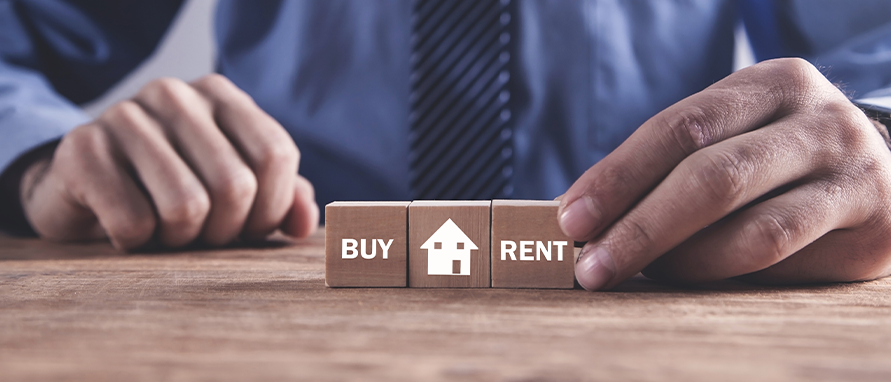
Table of Content
Check the Difference Between Buying vs Renting House
The Indian real estate market has always been buzzing with activity for several decades now. Despite occasional dips, real estate has witnessed tremendous growth over the years.
Moving from the macro to the micro, at some point, you may find yourself in a dilemma revolving around buying a house. The alternative, renting, may involve a much lower capital outlay. But it has always been the dream of most Indians to have a home to call their own. And you too may have that on your wishlist.
So, should you buy or rent a house? This is the question we’re going to decode in this article, so you can make an informed decision about buying vs renting a house. Let us begin by checking out how these two options are different.
Financial Implications
The financial implications of buying and renting a house are very different. When you buy a house, you take a step closer towards wealth creation, since your asset holdings increase. However, the initial outlays are huge, because you need to pay around 20% of the cost of the house as a down payment on your loan.
Renting a house, on the other hand, may be easier on your finances at the outset. The security deposit for your house will be much lower than a down payment. However, in the long run, renting a house does not get you any closer to wealth creation.
Flexibility vs Stability
Buying a house means you have a place to call home. This gives you a great deal of stability and may be better if you are looking for a place to settle down in or to start a family in. It also contributes to your and your family’s emotional security.
On the other hand, renting gives you more flexibility than buying. When you rent a house, you only need to give your landlord around 3 months of notice before moving out. This can be particularly useful if you have a job that requires you to travel often, or if you are looking for a more flexible housing option.
Repairs and Maintenance
Before you decide to buy or rent a house, you also need to factor in how repairs and maintenance work in the two cases. If you have your own home, you will have to take care of all the repairs and maintenance work on your own. The costs associated with such upkeep and repairs are also entirely yours to bear.
But if you live in a rented space, the onus of taking care of the repairs and maintenance falls on your landlord. So, you need not worry about setting aside a sum of money each month for these additional expenses.
Tax Implications
Tax implications in buying vs renting a house are vastly different. In case you plan to buy a house, you will have to avail a home loan. This comes with various tax benefits as per different sections of the Income Tax Act, 1961.
The principal component of your home loan EMIs is deductible from your total income up to Rs. 1.5 Lakhs u/s 80C. And the interest component of your home loan EMIs is deductible to the extent of Rs. 2 Lakhs u/s 24.
But in case you plan to live in a rented space, these benefits will not be available to you, as you will not have to avail a home loan. That said, if you are a salaried person living in a rented accommodation, you can claim tax exemption on the HRA you receive, as per section 10(13A) of the Income Tax Act, 1961.
Predictability of Costs
Another key point of difference between buying vs renting a house is about the predictability of the costs involved. Both buying and renting come with their own specific costs. In the case of home ownership, home loan EMIs are the most recurrent costs. If your home loan has a fixed rate of interest, you will know beforehand what your monthly outlay will be. And this will remain the same throughout the loan tenure, which may be the next 20 or so years.
However, if you are a tenant, your most recurrent costs will be the rent you pay. And there is always the possibility of an unpredictable rise in your home rent. Your landlord may raise the rent by 10% or more, depending on the agreement you have. Additionally, if the real estate prices shoot up, this will be reflected in your rental charges.
Renting a home comes with its own set of advantages and disadvantages. This is why it may or may not be the right option for you. To get a better idea of whether it is better to rent or buy a house, let’s break down the pros and cons of renting a home.
Pros of Renting a Home
Renting a home has the following advantages.
More Affordable: It is more affordable because your only recurrent outlay will be your monthly rent. You don’t have to shell out a huge sum of money right away.
Greater Flexibility: Renting also gives you greater flexibility to choose the location, the type of home, and the city. You can also move homes whenever you need to or want to, with a short notice to your landlord.
Lower Financial Burden: You do not need to worry about the repairs and maintenance costs. These will be taken care of by the landlord.
Freedom to Invest Elsewhere: Since you can save a lot more each month, you can redirect those savings towards investment vehicles to meet your life goals easily.
Cons of Renting a Home
Check out the downsides of renting a house.
Lesser Stability: Moving often may not be very convenient for some people. The lack of stability is definitely a downside.
No Asset Creation: You cannot add to your asset portfolio by renting a house. If you do not use your savings wisely, you may fall back on your investment plan by quite a bit.
Less Control: You do not have a great deal of control over your living space. Structural alterations and other such changes will not be permitted by your landlord. You have to adjust to the space you rent, rather than the other way around.
If you decide to buy a house, there are many advantages and disadvantages here as well. It is essential to know what they are, so you can make a more informed decision about whether it is better to rent or buy a house.
Pros of Buying a Home
Buying a home has the following advantages.
More Stability: When you have a home of your own, you do not need to keep moving often. If you are someone who prefers stability, this may be the right option for you.
A Family Inheritance: Buying a home allows you to leave behind a legacy for your loved ones, as it acts as an inheritance for your family.
Comprehensive Tax Benefits: If you buy a home using a housing loan, you can enjoy comprehensive tax benefits on the interest and the principal components of your EMI up to Rs. 2 Lakhs and Rs. 1.5 Lakhs respectively.
Greater Privacy: In a rented space, your landlord may live above your home or nearby. Or, they may drop in for a scrutiny periodically. But a home of your own gives you greater privacy.
Cons of Buying a Home
Check out the downsides of buying your own home.
Maintenance and Upkeep: The costs of maintenance and upkeep may add up over the long term. You will have to bear them on your own as the homeowner.
Low Liquidity: In case you want to sell your home, it may take a while to find the right buyer and finish the process. So, since a house property is not a very liquid asset, it cannot be sold easily in case you need funds to take care of a financial emergency.
Possibility of Investment Losses: Over the long term, the costs may add up and you may end up spending more on your house than you expected to. This, coupled with a less-than-average rise in property values, could result in an investment loss on your home.
This sums up the key details about buying vs renting a house. If, after checking out the pros and cons outlined above, you decide that buying a house is the right option for you, you can consider availing a home loan to fund your purchase.
On Bajaj Markets, you can apply for a home loan online easily, in just a few steps. You also get other benefits like flexible repayment tenure and competitive interest rates starting at just 7.25% p.a..
A house can be a good investment depending on its location and its resale value. If you are buying a house to settle in, with no plans to sell it, it may not qualify as an investment, per se. But if you want to invest in a house in order to sell it for a profit a few years later, that would be an investment. Make sure you check historic trends as well as the potential a locality has before buying a house.
The answer to this is quite subjective, and it needs to take into account several different factors. If you are looking for a stable place to live in or if you want to invest in real estate, buying may be a good choice. But if you move frequently and do not want to or cannot afford to take a loan now, renting may be better suited for your situation.




 47202
47202

Navigate the tax maze with ease! Uncover Income Tax 101, demystify jargon with Terms for Beginners, and choose between Old or New Regimes.
 165541
Unlock the world of credit! From picking the perfect card to savvy loan management, navigate wisely.
 97881
97881
Money Management and Financial Planning covers personal finance basics, setting goals, budgeting...
 28606
28606
Explore the investment cosmos! From beginner's guides to sharp-witted strategies, explore India's treasure trove of options.
 18764
18764
Discover essential insights on various types of insurance in India.
 4584
4584
Welcome to Tech in Finance, where we explore the exciting intersection of technology and finance...












 Academy