Our Products
 Loans
Loans
 Cards
Cards
 Insurance
 Investment
 Stock Market
 Electronics Mall
 CIBIL Score
 Knowledge Centre
 Calculators
Our Services

 Do not call
 En
En
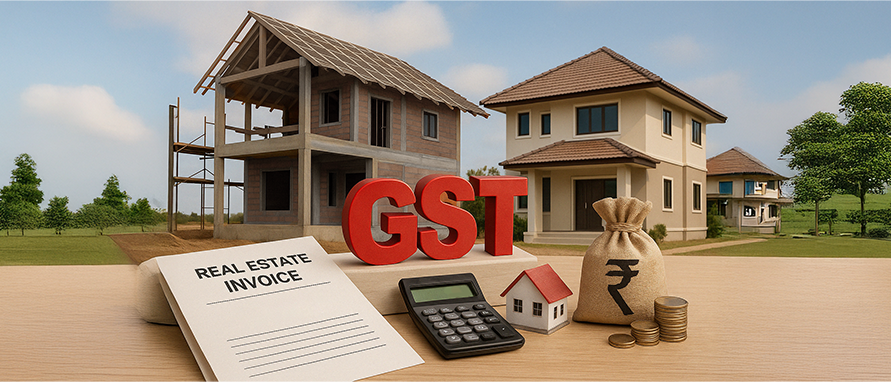
Think of GST, or Goods and Services Tax, as a single tax that the government charges on most goods and services we use. When it comes to buying a house or getting one built, GST is also applicable. It basically combined many of the older taxes into one, aiming to make things simpler.
Before GST came into effect, buying a property involved paying multiple indirect taxes. You had things like Value Added Tax (VAT), service tax, excise duty (on construction materials), and others. These different taxes were levied at various stages of construction and sale, often making it a bit complicated to understand the total tax burden.
Under GST, many of these earlier taxes have been rolled into one. Now, when you buy an under-construction property or get construction services, GST is the main indirect tax you'll encounter. The exact rate can vary depending on the type of property.
The materials used in building a house, like cement, steel, paints, and fittings, also attract GST. These materials fall under different GST rate slabs, such as 18% or 28%. The taxes paid on these materials by the builder can, in some cases, be set off against the GST they charge on the sale of the property. This is known as Input Tax Credit (ITC).
If you hire someone to construct your house or if you're buying an under-construction property where the builder is providing construction services, GST is applicable to the service part as well. The rate for these services is linked to the overall GST rate for the property.
For someone looking to buy a home, GST adds to the overall cost of an under-construction property. However, the idea behind GST was to remove the cascading effect of multiple taxes, which ideally should lead to more transparency and potentially offset some of the earlier hidden tax burdens. For ready-to-move-in properties (where the completion certificate has been issued), GST is generally not applicable.
Developers now have to manage GST on both their input costs (materials and services) and the output (sale of property). The Input Tax Credit mechanism allows them to claim back the GST paid on their inputs, which can potentially reduce their overall tax liability. However, the rules around ITC can be complex and require careful compliance.
Other players in the real estate sector, like suppliers of construction materials and providers of various services (architects, engineers, etc.), are also under the GST regime. This has streamlined the tax process for them as well, with a single tax to manage instead of multiple ones.
GST has brought about significant changes in the real estate sector.
Impact of GST on Affordable Property
The government has often provided concessional GST rates for affordable housing projects to make them more accessible. This can help in keeping the prices relatively lower compared to what they might have been with the older tax structure.
Impact of GST on Luxury Property
Luxury properties generally attract the standard GST rates. While the ITC benefit is available to developers, the overall tax incidence on high-value properties remains a significant component of their final cost.
Impact of GST on Under-Construction Property
Under-construction properties are subject to GST. The exact rate applicable has been revised over time, and it's crucial for buyers to understand the current rates when making a purchase decision.
It's important to note that GST is a central tax and is different from state-level charges like stamp duty and registration fees that you pay when you finalize the property purchase. These continue to be levied separately by the state governments.
GST is not directly applicable to the principal or interest amount of a home loan. However, services provided by banks or financial institutions related to the loan processing might attract GST.
Calculating GST on an under-construction property involves applying the applicable GST rate to the sale value of the property, excluding the land value (as land is exempt from GST). The exact calculation can be a bit intricate and usually, the developer provides the break-up of the property cost and the GST component.
Certain real estate transactions are exempt from GST. The most common exemption is for the sale of a completed property for which the completion certificate has been issued by the competent authority. Also, the sale of land is outside the purview of GST.
The GST rates for real estate have been revised over time. Currently, for under-construction residential properties, the effective GST rates are generally 1% for affordable housing and 5% for other residential properties. These rates are applicable after considering the deemed value of land. It's always best to check the latest official notifications for the most up-to-date rates.
Yes, GST is applicable to the real estate business, particularly on the sale of under-construction properties and on the construction services provided. Developers need to register for GST and comply with its regulations.
Homebuyers should ask the developer for a clear breakdown of the property's cost, including the GST component. Understanding the applicable GST rate and how it's being applied to the sale value will help in assessing the overall impact on the final price.
Affordable housing projects often qualify for a lower GST rate (currently 1%). This is a significant benefit aimed at making housing more accessible to a larger segment of the population. The criteria for what qualifies as affordable housing are defined by the government.
No, not all properties are subject to GST. Ready-to-move-in properties (with a completion certificate) and the sale of land are generally exempt from GST. Under-construction properties are the primary category where GST is applicable.




 47202
47202

Navigate the tax maze with ease! Uncover Income Tax 101, demystify jargon with Terms for Beginners, and choose between Old or New Regimes.
 165541
Unlock the world of credit! From picking the perfect card to savvy loan management, navigate wisely.
 97881
97881
Money Management and Financial Planning covers personal finance basics, setting goals, budgeting...
 28606
28606
Explore the investment cosmos! From beginner's guides to sharp-witted strategies, explore India's treasure trove of options.
 18764
18764
Discover essential insights on various types of insurance in India.
 4584
4584
Welcome to Tech in Finance, where we explore the exciting intersection of technology and finance...












 Academy