Our Products
 Loans
Loans
 Cards
Cards
 Insurance
 Investment
 Stock Market
 Electronics Mall
 CIBIL Score
 Knowledge Centre
 Calculators
Our Services

 Do not call
 En
En
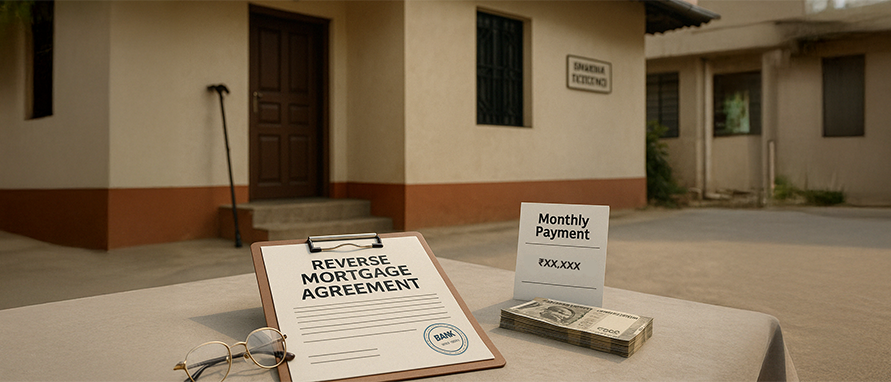
As India’s senior population grows, many retirees face the challenge of sustaining their lifestyle without a steady income. While traditional savings and pensions provide some support, they may not suffice for all expenses. The Reverse Mortgage Scheme could offer a solution, enabling senior citizens to convert their home equity into a regular income stream without selling their property.
A reverse mortgage is a financial arrangement where homeowners aged 60 or above could pledge their residential property as security to a lender in exchange for regular payments. The title of the home remains with the borrower.
Unlike a traditional mortgage, the borrower is not required to make monthly repayments. The loan becomes due when the borrower permanently moves out of the property or passes away. Interest and other charges are added to the loan amount over time, increasing the total balance.
Borrowers are responsible for paying property taxes and home insurance, using the house as their primary residence, and keeping the property well-maintained.
Example:
Suppose you are a 65-year-old retiree and own a self-occupied house in a metropolitan city, valued at ₹1 crore. Through a reverse mortgage, you could receive monthly payments, for example ₹25,000, based on the property’s value and your age. You may retain the ownership and occupancy rights of your property. The loan is usually settled later, typically by selling the property.
Here's a more detailed look at which type of property could be used for a reverse mortgage loan scheme:
Residential Property: Residential properties located within India may be eligible.
Ownership and Clear Title: The property should ideally be owned by the senior citizen and free from any legal claims or disputes.
Primary Residence: The property may be the borrower’s primary and permanent place of residence.
Self-Acquired and Self-Owned: Typically the property is expected to be self-acquired and not inherited.
Ancestral Properties: These properties are generally not eligible for reverse mortgage.
These conditions could ensure that the property qualifies as a secure asset for the reverse mortgage loan.
To qualify for a reverse mortgage in India, applicants might be required to meet certain conditions such as:
Age: The primary applicant to be at least 60 years old or more. For joint applications, the spouse is generally expected to be at least 58 years old.
Property Ownership: The applicant must own a self-acquired, self-occupied residential property in India with a clear title.
Property Condition: The house to be kept in good condition and preferably less than 20 years old.
Primary Residence: The property should ideally be the applicant’s primary and permanent place of residence.
Applicants might need to furnish the following documents:
Identity Proof: Aadhaar card, PAN card, or passport.
Address Proof: Utility bills, ration card, or voter ID.
Age Proof: Birth certificate or school leaving certificate.
Property Documents: Title deed, property tax receipts, and approved building plan.
While reverse mortgages could provide financial relief, they might come with certain costs:
Processing Fee: Typically ranges from 0.25% to 1% of the loan amount.
Legal and Valuation Charges: Fees for property valuation and legal verification.

Regular Income
Provides a steady income stream, enhancing financial independence during retirement.

Retain Home Ownership
Allows seniors to live in their homes without the need to sell or vacate.

No Immediate Repayment
Repayment is deferred until the borrower’s demise or permanent relocation.

Flexible Disbursement Options
Borrowers can choose between monthly payments, lump sums, or a line of credit.
Accumulating Interest: The loan balance increases over time due to interest accrual, potentially reducing the property's equity.
Impact on Inheritance: Heirs may receive a diminished inheritance, as the property might need to be sold to repay the loan.
Eligibility Constraints: Not all properties qualify; commercial properties and those with existing loans could be ineligible.
Limited Availability: Not all financial institutions offer reverse mortgage products, limiting options for borrowers.
Property Maintenance: Borrowers are responsible for property upkeep, taxes, and insurance, failing which the loan may become due.
The Reverse Mortgage Scheme is tailored for senior citizens seeking financial stability without parting with their homes. It might offer a dignified solution to meet daily expenses, medical bills, or other financial needs during retirement. Through the reverse mortgage scheme, senior citizens could access funds without selling the property by leveraging the value of their home.
It is a loan where a homeowner pledges their residential property and receives payments from a lender, based on the home’s value.
Homeowners aged 60 years or older are eligible for a reverse mortgage. In case of joint borrowers, the spouse is generally expected to be at least 58 years old.
Yes. The title remains in the borrower's name during the loan period, subject to meeting the terms of the loan.
When the borrower permanently moves out, sells the house, or passes away.
The loan is settled by selling the property or through repayment by the heirs. Any remaining balance after recovery goes to the legal heirs, if applicable.




 47202
47202

Navigate the tax maze with ease! Uncover Income Tax 101, demystify jargon with Terms for Beginners, and choose between Old or New Regimes.
 165541
Unlock the world of credit! From picking the perfect card to savvy loan management, navigate wisely.
 97881
97881
Money Management and Financial Planning covers personal finance basics, setting goals, budgeting...
 28606
28606
Explore the investment cosmos! From beginner's guides to sharp-witted strategies, explore India's treasure trove of options.
 18764
18764
Discover essential insights on various types of insurance in India.
 4584
4584
Welcome to Tech in Finance, where we explore the exciting intersection of technology and finance...












 Academy