Our Products
 Loans
 Cards
 Insurance
 Investment
 Stock Market
 Electronics Mall
 CIBIL Score
 Knowledge Centre
 Calculators
Our Services

 Do not call
 En
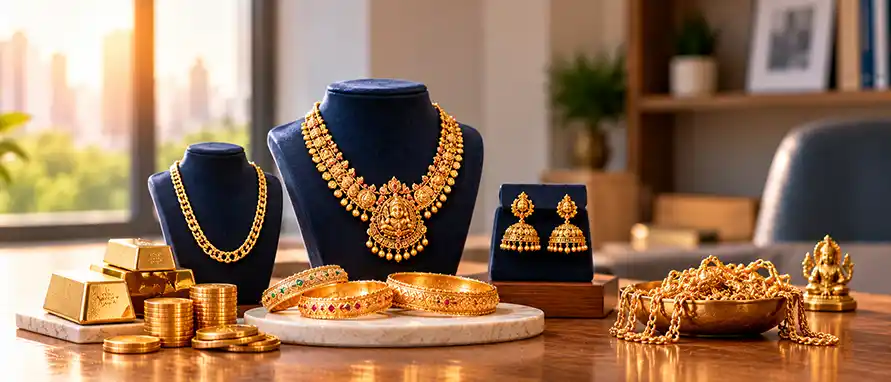
Gold comes in far more varieties than most buyers realise, from different colours and carats to distinct finishes and jewellery-making techniques. Each type suits a different purpose, budget, and style preference. This guide walks through every major category of gold, so you can choose confidently, whether you're buying jewellery or considering gold as an investment. If you already own gold and want to access funds against it, you can also explore a gold loan as a practical option.
Pure gold is too soft to hold its shape in daily-wear jewellery, so manufacturers blend it with other metals to create a gold alloy. This process changes the metal's colour, strength, and price, depending on the ratio used. The karat system measures how much pure gold a piece contains, with higher karats indicating greater purity. Understanding this system helps you judge both the quality and value of any gold item you buy. You can check the current gold rate to see how purity levels affect pricing in real time.
Manufacturers create different gold colours by changing the metals mixed into the alloy. Each colour carries its own look, durability, and price point.
Yellow gold blends pure gold with silver and copper, producing the warm, classic tone most people associate with gold jewellery. It remains the most popular choice for traditional and bridal pieces.
White gold combines pure gold with palladium or nickel, then usually receives a rhodium plating to enhance its silvery shine. This plating wears off over time and needs periodic reapplication.
Rose gold gets its pink hue from a higher copper content in the alloy mix. Jewellers use it widely in vintage-style and contemporary designs alike.
Grey gold forms through an alloy of gold, palladium, and silver, creating a muted, understated tone. Designers use it mainly in modern, minimalist jewellery pieces.
Purple gold results from combining gold with aluminium, forming an intermetallic compound with a distinct violet shade. Jewellers use it sparingly, mostly in decorative or statement jewellery, since it can be brittle.
Blue gold forms through an alloy containing indium or gallium, giving it a rare blue tint. This variety appears mainly in specialised or artistic jewellery designs.
Black gold does not occur naturally; jewellers create it through a ruthenium coating, rhodium plating, or a controlled oxidation process. It gives jewellery a bold, dramatic finish.
Carat, often written as karat, measures gold purity on a scale of 24 points, with 24K representing pure gold. Lower karats include more alloy metals, which increases durability but reduces gold content. Hallmarked gold in India carries a purity stamp to confirm its exact karat value.
24K gold contains 99.9% pure gold, making it the purest form available. Investors favour it for gold bullion and coins, but it stays too soft for everyday jewellery.
22K gold contains 91.6% pure gold, often labelled as 916 gold on hallmarked jewellery. Indian jewellers use it extensively for traditional and bridal pieces.
18K gold contains 75% pure gold, striking a balance between purity and strength. Designers commonly choose it for diamond jewellery and other fine, detailed pieces.
14K gold contains 58.5% pure gold, offering strong durability at a more accessible price. Many buyers choose it for everyday jewellery that withstands daily wear.
10K gold contains 41.7% pure gold, the lowest karat commonly sold as gold jewellery. Its higher alloy content makes it highly durable and budget-friendly.
Beyond colour and carat, gold jewellery also varies by how manufacturers apply gold to a piece. This affects both cost and longevity.
Manufacturers create gold-plated jewellery through electroplating, depositing a thin layer of gold onto a base metal. This method keeps costs low, but the gold layer wears off relatively quickly.
Solid gold jewellery contains gold alloy throughout the entire piece, with no separate base metal core. It carries hallmark certification and holds the highest resale value among these categories.
Gold-filled jewellery uses a thick layer of gold mechanically bonded to a base metal through heat and pressure. It lasts significantly longer than gold-plated pieces, thanks to this stronger bond.
Gold vermeil jewellery uses a sterling silver base coated with a thicker layer of gold than standard plating. Manufacturers must meet a minimum gold thickness to qualify as true vermeil.
Jewellers apply different surface finishes to gold to create distinct visual effects, independent of the metal's colour or purity.
Polished gold carries a mirror-like, high-gloss finish, achieved through careful buffing. This remains the most traditional and widely recognised gold finish.
Matte finish gold has a satin, non-reflective surface, giving jewellery a softer, understated appearance. Many contemporary designs favour this finish over a high shine.
Brush finish gold features fine, linear texture lines created through a brushing technique. This finish adds subtle depth and a modern edge to jewellery pieces.
Hammered finish gold displays a handcrafted, textured surface, created by hammering the metal repeatedly. Artisan jewellery often uses this finish to achieve a rustic, one-of-a-kind look.
Selecting the right type of gold depends on a few practical factors, rather than appearance alone.
Check the gold purity: Higher karats suit investment purposes, while lower karats work better for daily-wear jewellery.
Match it to the jewellery's purpose: Bridal and ceremonial pieces often call for higher-purity gold, while everyday pieces benefit from added durability.
Consider your budget: Gold-plated or lower-karat options offer an affordable way to enjoy gold's look without the higher cost of solid gold.
Think about maintenance: White gold requires periodic rhodium replating, while yellow gold needs comparatively little upkeep.
Verify hallmark certification: Always check for proper hallmarking to confirm the gold's purity before you buy.
24-carat gold contains 99.9% pure gold, which makes it too soft to hold intricate shapes or withstand daily wear. Jewellers mix it with other metals to improve strength and durability.
Yellow gold, white gold, and rose gold remain the most popular choices among buyers worldwide. Each offers a distinct look while suiting different skin tones and style preferences.
White gold combines gold with palladium or nickel and usually carries a rhodium plating for extra shine. Yellow gold, by contrast, blends gold with silver and copper, keeping its natural warm tone.
International gold prices, the USD-INR exchange rate, and overall demand and supply all influence gold prices. Import duty and taxes add further cost for buyers in India.
Green gold forms through an alloy of gold and silver, giving it a subtle greenish tint. Black gold does not occur naturally; jewellers create it using surface coatings or a controlled oxidation process.
India commonly sells 24K, 22K, 18K, 14K, and 10K gold, each offering a different balance of purity and durability. Jewellers primarily use 22K and 18K gold for jewellery, while 24K suits investment purchases.
Rose gold typically costs slightly less than standard yellow or white gold of the same karat, since it contains more copper and less pure gold. However, prices still depend heavily on the karat value, whether 24K, 22K, or 18K, alongside prevailing market rates.



Academy by Bajaj Markets

 165542

Unlock the world of credit! From picking the perfect card to savvy loan management, navigate wisely.
 97887
Money Management and Financial Planning covers personal finance basics, setting goals, budgeting...
 28606
Explore the investment cosmos! From beginner's guides to sharp-witted strategies, explore India's treasure trove of options.
 47203
Navigate the tax maze with ease! Uncover Income Tax 101, demystify jargon with Terms for Beginners, and choose between Old or New Regimes.
 18764
Discover essential insights on various types of insurance in India.
 4584
Welcome to Tech in Finance, where we explore the exciting intersection of technology and finance...












 Academy