Our Products
 Loans
Loans
 Cards
Cards
 Insurance
 Investment
 Stock Market
 Electronics Mall
 CIBIL Score
 Knowledge Centre
 Calculators
Our Services

 Do not call
 En
En
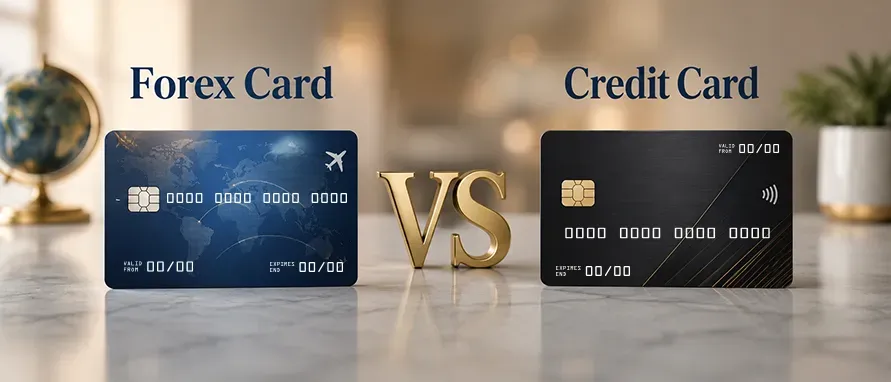
Managing your money smoothly when travelling abroad requires the right financial tools. When planning an international trip, deciding between a forex card vs credit card is a very important choice. A forex card is a prepaid travel card that you load with foreign currency before you leave. An international credit card is a borrowing tool that lets you spend up to a set limit while on the go. This simple guide breaks down the main differences between the two options to help you choose the best payment partner for your trip.
To understand your choices, you must first ask: what is a forex card? A forex card is a safe, prepaid card made just for spending money in other countries. You load it with the foreign currency of your destination before leaving home, so your travel funds are ready to use.
Key features include:
On the other hand, what is a credit card when you travel? It is a card given by a bank that lets you borrow money up to a certain limit based on your financial history.
Key features include:
Choosing the right option means looking at how each card affects your wallet. The table below shows the clear difference between forex card and credit card usage:
| Feature | Forex Card | Credit Card |
|---|---|---|
Type of Money |
Prepaid; uses your own pre-loaded money. |
Borrowed money; relies on a bank credit limit. |
Exchange Rate |
Locked and fixed at the time you load it. |
Changes daily; based on the rate on the day you buy something. |
Foreign Fees |
No extra transaction fees on loaded currencies. |
Extra markup fee usually between 1.5% and 3.5% per purchase. |
Acceptance |
Widely accepted, but some car rentals or hotels prefer credit. |
Accepted almost everywhere in the world. |
Budget Control |
High; you can only spend what you load on the card. |
Lower; it is easy to overspend up to your credit limit. |
Rewards & Perks |
Very few or none; focuses on saving money instead of rewards. |
High; offers travel miles, reward points, and airport lounge access. |
Credit Score Impact |
None; these cards do not report to credit bureaus. |
High; directly affects your repayment history. |
Debt Risk |
Zero risk of debt or interest charges. |
High risk of high interest (36% to 48% a year) on unpaid bills. |
Best Used For |
Everyday expenses, food, and getting cash from ATMs. |
Hotel bookings, emergencies, and expensive tickets. |
Choosing a dedicated travel card gives you clear money saving advantages when visiting other countries:
Even though it saves you money, a prepaid card has a few limits:
Using a credit line gives you great freedom when travelling to different destinations:
Using a credit card for different currencies can become expensive if you do not pay attention:
The best choice depends entirely on how you spend money and your travel plans.
For standard family holidays, quick city breaks, or student travel with a set budget, a prepaid forex card is highly recommended. It fixes your currency costs early, helps you avoid high extra fees, and keeps your spending under control.
For business travellers, luxury trips, or long journeys with unexpected costs, a credit card is an essential tool. It provides the financial backup you need for large hotel deposits and sudden emergencies.
For the best safety and comfort, experienced travellers suggest carrying both cards. Use your pre-loaded forex card for daily needs like food, transport, and ATM cash at fixed rates. Keep your international credit card hidden safely as a backup for major hotel bookings, emergencies, and earning premium rewards.
To save the most money, check this simple list before heading to the airport:
Yes, you can use a forex card to buy things on international websites. It works just like a standard debit card. You enter the card details and type in a one-time password (OTP) sent to your phone to finish the payment safely.
Forex cards are safer in terms of fraud risk because they are not linked to your main bank account. If the card is lost or stolen, a thief can only access the money you loaded onto the card, leaving your main savings completely untouched.
Yes, credit cards offer much better rewards, such as airline miles, cashback, hotel points, and free airport lounge access. Forex cards focus on saving you money on fees and locking in good exchange rates rather than giving points.
Using both is best. However, a forex card is often better for long stays in a single country like student study programmes because it protects your budget from sudden currency drops. A credit card is still needed as a reliable backup.
Yes, most cards charge a fixed fee every time you take cash out of an international ATM. While this fee is usually lower than a credit card's instant cash fee, it is smart to withdraw larger amounts less often to save on fees.
Yes, you can reload your card while travelling. Most modern banks let you or your family add money digitally through an online banking website or mobile app, converting and loading the new balance within a few hours.



Academy by Bajaj Markets

 47202
47202

Navigate the tax maze with ease! Uncover Income Tax 101, demystify jargon with Terms for Beginners, and choose between Old or New Regimes.
 165541
Unlock the world of credit! From picking the perfect card to savvy loan management, navigate wisely.
 97881
97881
Money Management and Financial Planning covers personal finance basics, setting goals, budgeting...
 28606
28606
Explore the investment cosmos! From beginner's guides to sharp-witted strategies, explore India's treasure trove of options.
 18764
18764
Discover essential insights on various types of insurance in India.
 4584
4584
Welcome to Tech in Finance, where we explore the exciting intersection of technology and finance...










 Academy