Our Products
 Loans
Loans
 Cards
Cards
 Insurance
 Investment
 Stock Market
 Electronics Mall
 CIBIL Score
 Knowledge Centre
 Calculators
Our Services

 Do not call
 En
En
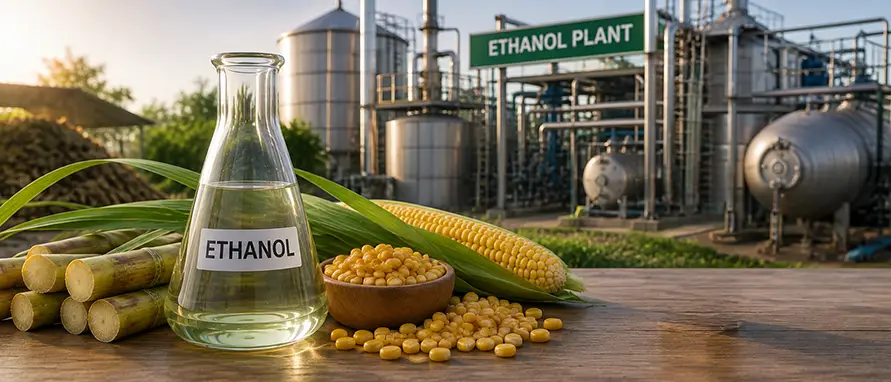
Table of Contents
Ethanol is a renewable fuel produced primarily from agricultural feedstocks such as sugarcane, molasses, and grains, through a process of fermentation, distillation, and dehydration. As countries look to reduce their dependence on crude oil imports and lower vehicle emissions, ethanol has become a central part of fuel-blending policies worldwide, including programmes promoting higher blends such as E20. This guide walks through how ethanol is produced, the raw materials involved, and its wide-ranging applications, including its role in ethanol fuel blending.
Ethanol, chemically known as ethyl alcohol (C₂H₅OH), is a type of alcohol produced by fermenting sugars derived from plant-based materials. As a biofuel, it is classified as a renewable energy source because it is derived from crops and agricultural residues that can be replenished season after season, unlike finite fossil fuels. When produced for fuel applications, ethanol undergoes additional purification and dehydration to make it suitable for blending with petrol. Its renewable origin, combined with its ability to burn more cleanly than conventional petrol, has made it an increasingly important component of national ethanol fuel strategies aimed at reducing overall carbon emissions.
Ethanol can be produced from a variety of agricultural raw materials, with the choice of feedstock often depending on regional availability and government policy. Common raw materials include:
The diversity of raw materials used reflects a broader effort to make ethanol production more sustainable, reduce reliance on any single crop, and make use of agricultural surpluses and waste that would otherwise go unused.
Ethanol production follows a well-established industrial process, moving from raw feedstock to fuel-grade ethanol through several distinct stages.
1.Feedstock preparation
The chosen raw material, whether sugarcane juice, molasses, or a starch-based grain such as corn, is first prepared for fermentation. Starch-based feedstocks require cleaning, milling, and a saccharification step, where enzymes break down starches into simpler, fermentable sugars. Sugar-based feedstocks such as molasses require comparatively less processing, since they already contain fermentable sugars.
2.Fermentation
The prepared feedstock is combined with yeast, which converts the fermentable sugars into ethanol and carbon dioxide. This stage typically takes place in large fermentation tanks under carefully controlled temperature and acidity conditions, and usually takes around one to three days to complete. The resulting liquid, often called the fermented mash, typically contains ethanol concentrations of around 8–14%, along with water and residual solids.
3.Distillation
The fermented mash is then subjected to distillation, a process that separates ethanol from water and other components based on differences in boiling point. Since ethanol boils at a lower temperature than water, it vaporises first and is collected separately. However, distillation alone typically only achieves ethanol purity of around 95%, since ethanol and water form what is known as an azeotropic mixture, which cannot be fully separated through distillation alone.
4.Dehydration
To produce anhydrous (water-free) ethanol suitable for blending with petrol, the distilled ethanol undergoes a further dehydration process. Modern facilities commonly use molecular sieve technology to remove the remaining water content, achieving the high purity levels required for fuel-grade ethanol.
5.Blending and distribution
Once dehydrated, the fuel-grade ethanol is blended with petrol at specified ratios, such as 5%, 10%, or 20% (commonly referred to as E5, E10, and E20 fuel), before being distributed to fuel stations for consumer use. This blending process is central to national fuel policies aiming to reduce crude oil imports and vehicle emissions through greater use of renewable fuel sources.
Ethanol production methods are generally categorised based on the type of feedstock and technology used:
Ethanol's versatility means it finds application well beyond fuel blending:
Given its role across such a wide range of industries, ethanol production continues to expand, supported by both agricultural policy and growing demand for cleaner fuel alternatives.
Ethanol is produced by fermenting sugars derived from feedstocks such as sugarcane, molasses, or corn using yeast, followed by distillation to separate the ethanol from water, and finally dehydration to achieve the high purity required for fuel blending.
Common raw materials include sugarcane, molasses, corn, other grains such as broken rice, damaged food grains, and increasingly, agricultural waste and crop residues.
Yes, sugarcane is one of the most widely used feedstocks for ethanol production, since its juice contains readily fermentable sugars that require minimal preprocessing before fermentation.
Yes, corn (maize) is a common starch-based feedstock for ethanol production. It requires an additional saccharification step to convert its starch content into fermentable sugars before fermentation can take place.
The process generally involves five key stages: feedstock preparation, fermentation, distillation, dehydration, and finally blending with petrol for fuel use.
The fermentation stage alone typically takes between one and three days, though the complete process, including feedstock preparation, distillation, and dehydration, can take longer depending on the scale of production and the specific feedstock used.
Ethanol is generally considered more environmentally friendly than fossil fuels, since it is produced from renewable agricultural sources and tends to burn more cleanly. However, its overall environmental impact can vary depending on factors such as feedstock choice, water usage, and land use considerations.
First-generation ethanol is produced from food-based crops such as sugarcane, molasses, and corn, using conventional fermentation and distillation techniques. It remains the most established and widely used form of ethanol production globally.
Second-generation ethanol is produced from non-food biomass, such as agricultural residues and crop waste, using more advanced processing techniques to break down plant fibres into fermentable sugars. This approach helps reduce reliance on food crops for fuel production.
Ethanol's major uses include blending with petrol as a transport fuel, serving as a solvent and preservative in pharmaceuticals, functioning as an industrial chemical feedstock, and forming the alcoholic component in beverages such as beer, wine, and spirits.


Most Viewed

Academy by Bajaj Markets

 47202
47202

Navigate the tax maze with ease! Uncover Income Tax 101, demystify jargon with Terms for Beginners, and choose between Old or New Regimes.
 165541
Unlock the world of credit! From picking the perfect card to savvy loan management, navigate wisely.
 97881
97881
Money Management and Financial Planning covers personal finance basics, setting goals, budgeting...
 28606
28606
Explore the investment cosmos! From beginner's guides to sharp-witted strategies, explore India's treasure trove of options.
 18764
18764
Discover essential insights on various types of insurance in India.
 4584
4584
Welcome to Tech in Finance, where we explore the exciting intersection of technology and finance...












 Academy