Our Products
 Loans
Loans
 Cards
Cards
 Insurance
 Investment
 Stock Market
 Electronics Mall
 CIBIL Score
 Knowledge Centre
 Calculators
Our Services

 Do not call
 En
En
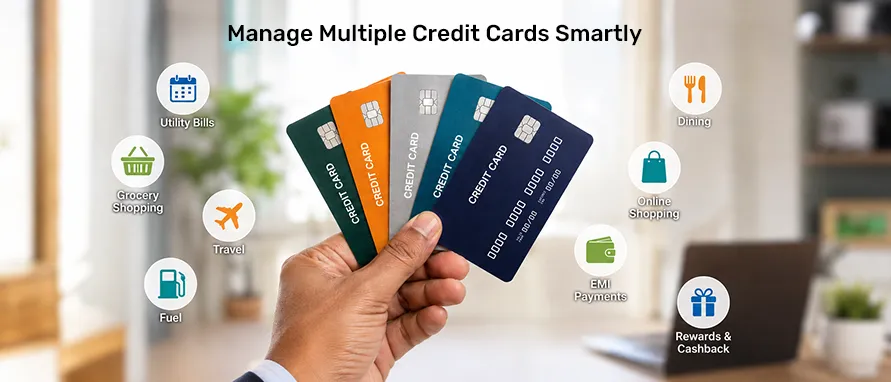
Juggling more than one credit card? You're not alone. Millions of Indians now hold two, three, or even more cards — but without a clear system, things can unravel fast. This guide walks you through everything you need to know about managing multiple credit cards smartly, from tracking due dates to keeping your credit score intact.
There's no one-size-fits-all answer and depends majorly on your eligibility for the credit cards you want. However for many people in India, two to three cards hits the sweet spot. Here's a practical way to think about it:
One card for everyday spends — groceries, utility bills, online shopping. Pick one with strong cashback or reward points on daily categories.
One for travel or premium benefits — airport lounge access, air miles, or hotel upgrades.
One for specific categories — fuel surcharge waivers, for instance, can save a meaningful amount if you drive regularly.
Beyond three cards, you start running into real management complexity. Four or more cards means more due dates to track, more annual fees to justify, and more opportunities for things to slip through the cracks. Multiple credit cards management becomes a part-time job if you're not careful.
That said, having two or three cards — used responsibly — can actually work in your favour. You spread your spending across a higher combined credit limit, which helps keep your overall utilisation ratio in check. The key is that each card should earn its place in your wallet with a clear purpose.
Let's be honest about the downsides before diving into solutions. Here are the most common pain points people run into:
Missing due dates. Every card has its own billing cycle and payment deadline. Miss one, and you're looking at late payment fees, interest charges, and a potential dip in your CIBIL score.
Overspending. When you have multiple cards, it's easy to lose track of your total outstanding balance. Each individual card might seem fine, but collectively you could be overextended.
High credit utilisation. Maxing out even one card — even if the others are mostly clear — can hurt your credit score. Lenders look at both per-card and total utilisation.
Annual fee overhead. Premium cards come with fees ranging from ₹500 to ₹10,000 or more. If you're not earning back that value in rewards or benefits, you're simply paying for the privilege.
Mental load. Keeping tabs on statements, reward point expiry dates, milestone spends, and fee waivers across multiple accounts is genuinely taxing. Many people find that tips for managing multiple credit cards focus on tools, but the cognitive effort is just as real.
Getting organised doesn't have to be complicated. These strategies work reliably for most people.
Set up auto-pay — but do it thoughtfully. Most Indian banks allow you to set up NACH mandates for automatic payment. You can typically choose between the minimum amount due, a fixed amount, or the full outstanding balance. The full balance option is ideal — it eliminates interest entirely. If cash flow is tight, at least automate the minimum to protect your credit score, then pay the rest manually.
Pick a single payment day. Rather than paying each card on its individual due date (which scatter throughout the month), call your bank and request a due date change. Align all your cards to roughly the same date — say, the 5th of every month. This way, you do one focused review of all your cards at once rather than playing catch-up throughout the month.
Maintain a simple tracker. A spreadsheet or a notes app works well. List each card, its credit limit, the current outstanding balance, the due date, and the annual fee renewal month. Review it once a week — it takes less than five minutes and gives you a clear picture at a glance. If you prefer something more automated, several money management apps can pull your SMS data, with the right permissions from your side, and build this view for you.
Assign one card per spending category. This is the single most effective way to manage multiple credit cards without confusion. Decide upfront: Card A is for online shopping, Card B is for fuel and offline purchases, Card C is for travel bookings. You'll always know which card to reach for, and you'll naturally track where your money is going.
Set calendar reminders for annual fee dates. About 45 days before your annual fee is due, block time to evaluate whether you're getting value from that card. This gives you enough runway to either downgrade the card, call retention to get the fee waived, or cancel cleanly before being charged.
Use spend limits if your bank offers them. Several issuers allow you to set transaction limits or monthly caps through their apps. This is a useful guardrail if you find yourself overspending on a particular card.
The bottom line: how to manage multiple credit cards comes down to automation, categorisation, and a regular review habit. None of these are difficult on their own — the challenge is building them into a routine.
Visibility is everything when you're managing more than one card. Here are the most practical tools and habits.
Personal finance apps. Different money management apps read your bank and card SMS alerts to automatically categorise your spending. These apps give you a consolidated view across all your cards without manual data entry.
Bank SMS and email alerts. Every transaction triggers an SMS from your bank. Enable these if they aren't already on — they serve as real-time receipts and help you catch unauthorised transactions immediately. Most banks also send monthly statement emails that are worth reading, not just archiving.
Check statements monthly, not just at bill time. Many people only look at their card statement when payment is due. Instead, build a habit of reviewing your full monthly statement when it's generated. Look for recurring charges you'd forgotten about, reward points earned, and any fees applied. This monthly check also keeps you honest about your spending patterns.
Use your card issuer's app. Most major issuers have solid apps that let you see real-time balances, set spend alerts, and manage your card settings. Keep these installed and check them periodically.
Annual consolidated spend review. At the end of each financial year, download your annual statements and do a full review. Which card gave you the most rewards? Which did you barely use? This analysis should directly inform whether you keep, cancel, or replace a card the following year.
Credit utilisation — the percentage of your total available credit that you're using — is one of the most important factors in your CIBIL score. Keeping it below 30% across all your cards combined is the widely recommended benchmark.
Here's how to manage it practically:
Track total utilisation, not just per-card. If you have three cards with a combined limit of ₹3 lakh, your total outstanding balance across all three should ideally stay below ₹90,000 at any given time. Even if one card is maxed out, it's flagged negatively regardless of how clean the others are.
Request a credit limit enhancement. If you've been a responsible cardholder for 12 months or more, you're usually eligible to request a limit increase. A higher limit — with the same or lower spending — automatically brings your utilisation ratio down. Most banks process this through their app or net banking.
Spread large purchases across cards. Planning a big purchase? If it would push one card's utilisation above 30%, consider splitting it across two cards. This keeps each card's individual utilisation low and avoids a sudden spike.
Avoid maxing out any single card. Even if your overall utilisation is fine, a single maxed-out card is viewed negatively by credit bureaus. Each card should ideally stay below 30% of its own limit, not just the aggregate.
Cancelling a card is sometimes the right call — but it needs careful thought, because it does affect your credit profile.
When the annual fee no longer makes sense. If a card charges ₹5,000 per year but you're not getting equivalent value in rewards, lounge access, or other benefits, it's worth reassessing. Do the maths: add up the cashback earned, the lounge visits used, and any milestone benefits received over the past year. If it doesn't add up, consider downgrading to a no-fee variant or cancelling.
Before you cancel, call for a retention offer. This is genuinely worth doing. Banks retain customers by offering annual fee waivers, bonus reward points, or complimentary memberships. Simply calling the customer care number and saying you're considering cancellation often triggers an offer. It takes ten minutes and can easily save you thousands of rupees.
Avoid cancelling your oldest card. The average age of your credit accounts matters for your CIBIL score. Your oldest card — even if you barely use it — contributes to a longer credit history. If the card has no annual fee, keep it open and use it occasionally to keep it active.
A rarely used card isn't always a problem. If a card has no annual fee and isn't causing any management overhead, there's little reason to cancel it. It keeps your total available credit higher and your utilisation lower. Cancel if the card is genuinely creating cost or complexity — not just because you're not using it often.
Ans: Yes, having multiple credit cards can be beneficial if you use them with purpose. Different cards offer different rewards — cashback on groceries, air miles for travel, fuel surcharge waivers — and together they can maximise the value you get from your spending. The key is to keep the number manageable (two to three is ideal for most people) and ensure you never miss a payment. Used responsibly, multiple cards also help keep your credit utilisation low across a higher combined limit, which can positively impact your CIBIL score over time.
Ans: The simplest approach is to request a due date change from your bank so all your cards fall due around the same time each month. Pair this with a money management app which sends automatic payment reminders. You can also set up calendar alerts a few days before each due date. If you prefer something manual, a basic spreadsheet listing each card's due date, outstanding balance, and minimum payment works well. Many people also find that setting up auto-pay for the full outstanding amount removes the need to track due dates altogether.
Ans: Not inherently — in fact, managed well, multiple cards can help your score by increasing your total available credit and lowering your overall utilisation ratio. What hurts your score is missing payments, maintaining high utilisation on any one card, or applying for several new cards in quick succession (each application triggers a hard enquiry). As long as you pay on time and keep utilisation in check, managing multiple credit cards is unlikely to damage your CIBIL score.
Ans: For most people in India, two to three cards is the ideal number. One card for daily spending, one for travel or premium benefits, and optionally one for a specific category like fuel. Beyond three, the management overhead tends to outweigh the incremental benefits. That said, the right number depends on your financial discipline, spending patterns, and how much time you're willing to invest in tracking and optimising your cards.
Ans: The most reliable system is to automate as much as possible. Set up auto-pay for the full outstanding balance on each card so you never miss a payment or incur interest. Align all your due dates to the same week of the month for easier oversight. Use a finance app or a simple spreadsheet to monitor balances and upcoming payments. If auto-pay for the full balance isn't feasible every month, at least automate the minimum payment to protect your credit score, and pay down the remaining balance as early as you can.



Academy by Bajaj Markets

 47202
47202

Navigate the tax maze with ease! Uncover Income Tax 101, demystify jargon with Terms for Beginners, and choose between Old or New Regimes.
 165541
Unlock the world of credit! From picking the perfect card to savvy loan management, navigate wisely.
 97881
97881
Money Management and Financial Planning covers personal finance basics, setting goals, budgeting...
 28606
28606
Explore the investment cosmos! From beginner's guides to sharp-witted strategies, explore India's treasure trove of options.
 18764
18764
Discover essential insights on various types of insurance in India.
 4584
4584
Welcome to Tech in Finance, where we explore the exciting intersection of technology and finance...












 Academy