Our Products
 Loans
Loans
 Cards
Cards
 Insurance
 Investment
 Stock Market
 Electronics Mall
 CIBIL Score
 Knowledge Centre
 Calculators
Our Services

 Do not call
 En
En
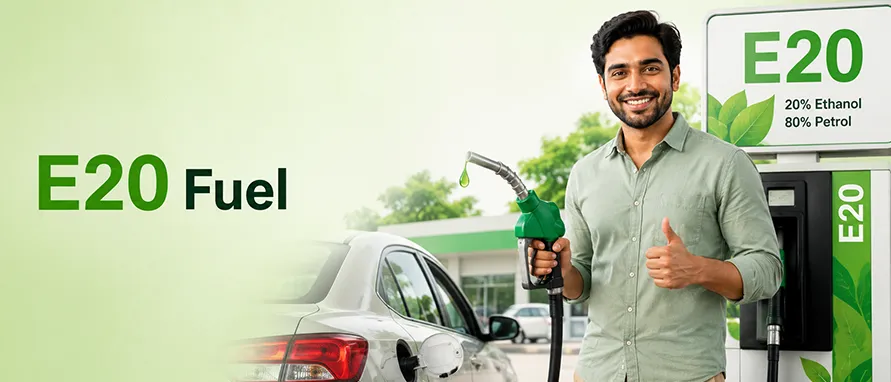
Table of Contents
As India works to reduce air pollution and lower its reliance on foreign crude oil, E20 fuel has become a central part of the nation's energy strategy. Introduced under the Government of India’s Ethanol Blended Petrol (EBP) Programme, E20 is a blended petrol designed to cut exhaust emissions, save foreign exchange, and support local farming.
The shift from standard petrol or E10 (10% ethanol) to E20 (20% ethanol) is a major step towards cleaner transport. By making bio-ethanol locally from crops like sugarcane, maize, and surplus grains, India is creating a more sustainable energy supply.
E20 fuel is a motor fuel mixture made of 20% bio-ethanol and 80% standard unleaded petrol by volume.
E20 fuel operates like standard petrol in a regular engine, but its chemical mixture changes how it burns:
Because bio-ethanol contains extra oxygen, E20 allows fuel to burn more completely inside the engine cylinder. This significantly reduces unburnt carbon monoxide and harmful gases coming out of the exhaust pipe.
With a higher octane rating E20 provides smooth combustion. This stops engine knocking (pre-ignition) under heavy acceleration.
Ethanol carries less energy per litre than pure petrol. Because of this lower energy density, E20 fuel delivers slightly less energy per litre compared to E10 or pure petrol.
Modern engines use an Electronic Control Unit (ECU) to adjust fuel injection and air ratios automatically. In E20-compliant cars, fuel pipes, rubber seals, and tanks are made from special corrosion-resistant materials to prevent ethanol damage over time.
Using E20 petrol offers several clear advantages for the environment and the economy:
Vehicle compatibility depends on when your car or bike was manufactured and how its fuel system was built:
Vehicles manufactured in India under BS6 Phase 2 standards feature rubber parts, gaskets, and fuel lines specifically built to handle E20 fuel safely.
Older cars and bikes built for E10 or pure petrol can run on E20 fuel without immediate engine failure. However, over long periods, the ethanol may cause faster wear on older rubber seals or fuel hoses. Drivers may also notice a small drop in fuel mileage.
Flex-fuel vehicles have special sensors and modified engine tuning designed to run on high ethanol blends ranging from E20 up to E85 (85% ethanol) or even E100 (100% ethanol).
Comparing E20 fuel with standard petrol helps you understand how ethanol blends affect your vehicle, your wallet, and the environment. While E20 petrol burns cleaner and helps your engine run smoothly, standard petrol holds slightly more energy per litre.
Here is a simple side-by-side comparison between E20 fuel and standard petrol:
| Comparison Point | E20 Fuel (20% Ethanol) | Standard Petrol |
|---|---|---|
Performance |
Higher octane rating (95 RON). Helps stop engine knocking and keeps acceleration smooth. |
Standard octane rating (91 RON). Delivers normal everyday power. |
Mileage |
Gives about 3% to 6% lower mileage because ethanol holds less energy per litre. |
Gives slightly better mileage because pure petrol carries more energy. |
Cost |
Cheaper to make in India, which helps keep long-term national fuel prices steady. |
Price depends heavily on international crude oil rates. |
Emissions |
Burns much cleaner, releasing far fewer toxic gases from the exhaust pipe. |
Creates higher exhaust pollution and carbon emissions. |
Engine Compatibility |
Built for new cars and bikes made from April 2023 onwards (BS6 Phase 2). Older rubber fuel lines may wear out faster. |
Safe to use in any petrol vehicle, no matter how old it is. |
E20 fuel is a motor fuel mixture containing 20% bio-ethanol and 80% standard petrol.
It works by providing extra oxygen during burning inside the engine. This creates a cleaner burn, reduces exhaust pollution, and helps prevent engine knocking.
Yes, E20 is completely safe for all E20-compliant and BS6 Phase 2 vehicles. Older cars can also run on it, though they might see a small drop in mileage.
All petrol cars sold in India from April 2023 onwards (BS6 Phase 2 standards) are factory-built to run on E20 petrol.
Yes, older vehicles can use E20 petrol. While it will not break the engine immediately, older rubber lines may wear out faster over time.
E20 cuts toxic exhaust emissions, lowers crude oil imports, boosts local farming income, and improves fuel octane levels.
Yes, because ethanol carries slightly less energy than pure petrol, E20 can lower fuel efficiency by about 3% to 6%.
E20 is better for the environment and national economy because it burns cleaner and uses renewable bio-ethanol. However, standard petrol carries slightly more energy per litre.
In E20-compatible engines, performance remains smooth with better anti-knock properties. Non-calibrated older engines will run normally, but may show a minor drop in fuel economy.
Yes, E20 petrol is available across fuel stations in India operated by major oil companies.


Most Viewed

Academy by Bajaj Markets

 47202
47202

Navigate the tax maze with ease! Uncover Income Tax 101, demystify jargon with Terms for Beginners, and choose between Old or New Regimes.
 165541
Unlock the world of credit! From picking the perfect card to savvy loan management, navigate wisely.
 97881
97881
Money Management and Financial Planning covers personal finance basics, setting goals, budgeting...
 28606
28606
Explore the investment cosmos! From beginner's guides to sharp-witted strategies, explore India's treasure trove of options.
 18764
18764
Discover essential insights on various types of insurance in India.
 4584
4584
Welcome to Tech in Finance, where we explore the exciting intersection of technology and finance...












 Academy