Our Products
 Loans
Loans
 Cards
Cards
 Insurance
 Investment
 Stock Market
 Electronics Mall
 CIBIL Score
 Knowledge Centre
 Calculators
Our Services

 Do not call
 En
En
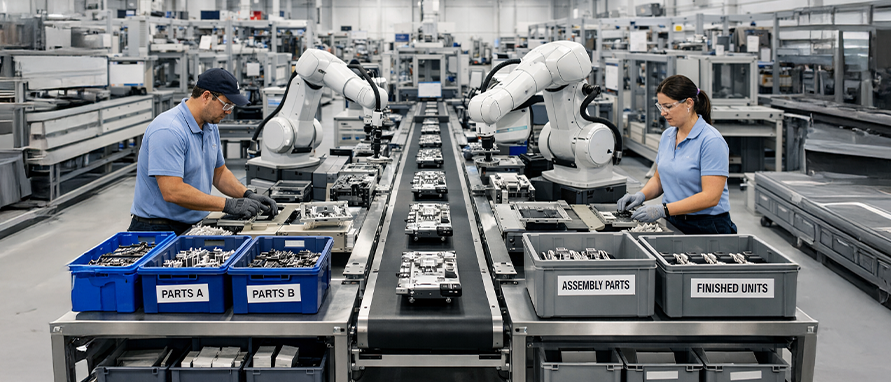
Lean manufacturing is a management and production philosophy focused on creating more value for customers while using fewer resources. In simple terms, the lean manufacturing meaning revolves around removing waste from the manufacturing process so that every activity directly contributes to customer value. When people ask what lean manufacturing is, the answer is not just about cost-cutting, but about building a smarter, more responsive manufacturing system that delivers high-quality products faster, more efficiently, and with greater consistency.
Lean manufacturing originated in post-WWII Japan, born out of necessity. Facing a lack of resources and a need to compete with American mass production, Toyota executives pioneered a new way of thinking.
Origin at Toyota:
Taiichi Ohno and his team created what became the Toyota Production System, the foundation of modern lean thinking. The goal was to eliminate inefficiencies that caused wasting time, inventory build-up, and inconsistent output.
Focus on time and flow:
Instead of producing in large batches, the system prioritised time production, smooth flow, and synchronised operations, dramatically improving the production cycle.
Global adoption:
By the 1980s, Western manufacturers began adopting lean practices after recognising Toyota’s superior productivity, quality, and customer satisfaction.
Today, lean manufacturing is used across automotive, electronics, healthcare, construction, and even service industries.
At the heart of lean are several principles of lean manufacturing that guide every decision.
Define value from the customer’s perspective
Value is what the customer is willing to pay for. Everything else is potential waste.
Map the value stream
Through stream mapping, companies analyse each step in the production process to identify non-value-adding activities and opportunities for reducing lead times.
Create continuous flow
Work moves steadily through the system without bottlenecks, reducing idle time and improving overall cycle time.
Establish a pull system
Instead of overproducing, a "pull" system ensures nothing is made until there is a signal of demand from the customer. This prevents the buildup of expensive inventory.
Pursue continuous improvement
Lean is not a one-time project. It is a mindset of constant refinement and learning, often reinforced through methods such as lean six sigma.
Lean manufacturing relies on practical tools that help organisations apply its principles consistently.
Value stream mapping
Visualising the full manufacturing process reveals inefficiencies, delays, and waste hidden within the workflow.
5S methodology
A workplace organisation system that improves efficiency and safety by structuring the environment for optimal performance.
Kaizen (continuous improvement)
Small, incremental changes driven by employees at every level.
Just-in-Time (JIT)
Producing exactly what is needed, when it is needed, to minimise inventory and shorten lead time.
Kanban
A visual scheduling method that supports the pull system and balances workload across teams.
Standardised work
Documenting best practices ensures consistency in the production process and stabilises output quality.
Lean manufacturing delivers measurable improvements across the entire organisation.
Lean principles are visible in some of the world’s most successful manufacturing operations.
Automotive industry:
Car manufacturers use lean to synchronise production lines, reduce defects, and shorten delivery times.
Electronics manufacturers:
Firms apply lean techniques to manage complex supply chains and maintain tight control over cycle time.
Small manufacturing businesses:
Even small factories adopt lean methods to stabilise operations, improve productivity quality, and remain competitive.
Across sectors, the core objective remains the same: deliver better value using fewer resources.
While powerful, lean is not without obstacles.
Cultural resistance
Employees may initially resist new systems, especially when long-standing processes change.
Requires leadership commitment
Lean fails without consistent support from management.
Initial investment of time and training
Developing lean capabilities takes effort before benefits appear.
Not a quick fix
Lean delivers long-term improvements rather than immediate results.
Risk of misapplication
When organisations focus only on cost-cutting rather than flow and value, results suffer.
Despite these challenges, organisations that commit fully to lean principles achieve lasting performance gains.
Lean manufacturing is a strategic approach to building a high-performing, efficient, and resilient production environment. By eliminating waste, improving flow, and continuously refining processes, businesses can achieve superior quality, lower costs, and stronger customer relationships. For manufacturers seeking to modernise operations and scale production efficiently, investing in lean systems and even exploring financial support options such as a business loan for manufacturers can accelerate transformation and unlock long-term growth.
5S is a workplace organisation system that stands for Sort, Set in order, Shine, Standardise, and Sustain. It improves efficiency, safety, and consistency by creating a structured, well-maintained work environment.
The five principles are: define value, map the value stream, create flow, establish pull, and pursue continuous improvement.
The 4 P’s are Philosophy, Process, People, and Problem-solving. Together, they ensure lean is embedded across culture, operations, workforce development, and decision-making.
DOWNTIME stands for the 8 wastes: Defects, Overproduction, Waiting, Non-utilized talent, Transportation, Inventory, Motion, and Extra-processing.
Lean focuses on improving flow and reducing waste, while Six Sigma focuses on reducing variation and improving quality. When used together, they are known as Lean Six Sigma.
No, Lean principles are highly effective for small businesses and service-based industries because the core goal, eliminating waste is universal to any workflow.



Academy by Bajaj Markets

 47202
47202

Navigate the tax maze with ease! Uncover Income Tax 101, demystify jargon with Terms for Beginners, and choose between Old or New Regimes.
 165541
Unlock the world of credit! From picking the perfect card to savvy loan management, navigate wisely.
 97881
97881
Money Management and Financial Planning covers personal finance basics, setting goals, budgeting...
 28606
28606
Explore the investment cosmos! From beginner's guides to sharp-witted strategies, explore India's treasure trove of options.
 18764
18764
Discover essential insights on various types of insurance in India.
 4584
4584
Welcome to Tech in Finance, where we explore the exciting intersection of technology and finance...












 Academy