Our Products
 Loans
Loans
 Cards
Cards
 Insurance
 Investment
 Stock Market
 Electronics Mall
 CIBIL Score
 Knowledge Centre
 Calculators
Our Services

 Do not call
 En
En
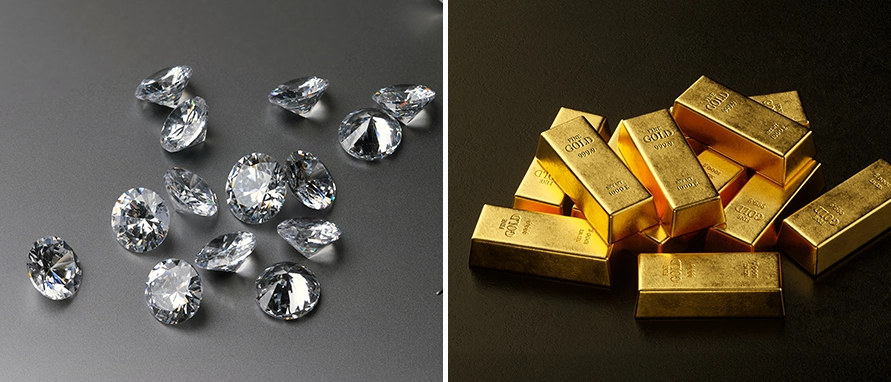
Table of Contents
Gold and diamonds are often bought for celebrations, and many buyers also expect them to hold value over time. That expectation is reasonable. The key point is that their value differs once you move from purchase to resale.
Gold is easier to track because there’s a visible benchmark price. Diamonds don’t have one universal “rate today”. Prices depend on the stone’s grade and the buyer, so the market is usually tracked through category indices such as the RapNet Diamond Index (RAPI™).
Compare the factors that shape real returns and resale, so you can make a clearer call on investing in diamonds vs gold.
Liquidity is about how quickly you can sell and how close the exit price is to the ‘going’ or current market price, which is why resale value of diamond vs gold often looks different in practice. Gold usually has the edge because pricing is more transparent and the market is deeper, while diamond resale is more dependent on the specific stone and buyer.
Gold prices are benchmarked and actively traded across OTC, futures, and ETFs, which supports smoother discovery. For diamonds, there is no one daily price for every stone, so resale quotes can differ across sellers.
With gold, the secondary market is large, which supports active buying and selling. With diamonds, resale is more fragmented and often runs through jewellers, dealers, or exchange programmes rather than a broad, standardised market.
With gold, standardisation helps because value is largely tied to weight and purity. With diamonds, value is more item-specific (cut, colour, clarity, carat and certification), so two similar-looking stones can exit at very different prices. For example, two similar-looking 1-carat diamonds can sell for very different amounts. A better cut and stronger colour and clarity grades, backed by a recognised certificate, usually attract higher bids, while a lower-graded stone is often discounted even if it looks similar at first glance.
A storehouse of value is not just “will it be worth something later”. It is also “will people agree on what it is worth when I need to sell it”. This is where standardisation and buyer depth matter.
Gold’s value is anchored to widely quoted benchmarks, and official demand adds an extra layer of support. Diamonds are more dependent on consumer demand cycles, and category pricing can soften when sentiment changes.
Gold’s “buyer base” is broader than retail, and India’s gold reserves climbed to a record 880 tonnes, with gold at 12.5% of FX reserves as of end-August 2025. Diamonds don’t have an equivalent reserve function, so the value story sits more in brand, rarity and buyer preference.
Gold can be held in formats that keep premiums lower than jewellery, which helps it behave more like a value holder. Diamonds can preserve value best when quality and certification are strong, but outcomes vary more by the exact stone.
Gold has less “style risk” because a gram is a gram, even if designs go out of fashion. Diamonds can face “category risk”, especially with lab-grown supply influencing expectations in parts of the market.
Stability is about what happens during uncertainty: currency swings, inflation worries, or risk-off phases. Both assets can hold value over time, but they respond to stress in different ways.
Gold often changes behaviour in stressed markets, and it can decouple and even turn inversely correlated during periods of stress. Diamonds do not have the same “stress hedge” pattern because pricing is more negotiated and buyer-led.
Gold has historically shown lower day-to-day volatility than major asset classes in long-run comparisons. Diamond prices can move unevenly across sizes and quality bands, so “stability” depends on what you own, not just the category.
Safety is not only a theft risk. It includes loss, damage, fraud risk, and how easily you can prove what you own. The ‘safe’ choice is usually the one you can verify and protect without stress.
Gold is simpler to re-check because purity and weight can be tested, though scams do exist. Diamonds lean more on trusted sellers and recognised certification to reduce disputes.
Both need secure storage, but gold is easier to document for lockers and insurance by weight and purity. Diamonds can be harder to insure correctly unless invoices and certificates are complete and consistent.
Jewellery adds lifestyle risk for both because daily wear increases loss and damage chances. Investment-friendly formats for either asset aim to limit handling and preserve condition.
Fungibility means one unit is interchangeable with another. Higher fungibility usually means simpler pricing and easier resale. Lower fungibility can still work, but outcomes depend more on the specific item.
Gold of the same purity is broadly comparable across sellers, which supports smoother resale. Two diamonds with the same carat can still be priced very differently because cut quality and grading details matter.
Gold’s interchangeability makes it easier to sell across cities using a common reference rate. Diamonds may sell best where there is a strong demand for your specific quality bracket and certificate type.
Gold can be divided and sold in smaller weights without changing the asset. Diamonds are less divisible in practice without altering what you own.
Purity affects value, trust, and resale. It also affects how much you may lose to uncertainty when you sell. The simpler the purity story, the smoother the exit tends to be.
Gold purity is easier to communicate (24K, 22K, 18K), so misunderstandings are fewer. Diamond “quality” is multi-factor, so buyers need clearer education and stronger paperwork to feel confident.
Hallmarking and a proper bill support gold trust, though you should still verify if you are buying from a new source. Diamond certificates help, but buyers may still inspect and negotiate based on what they see.
Long-term gains depend on entry price, holding costs, and exit price, not just what the asset “should” do. A good outcome usually comes from paying sensible premiums upfront and having a clear exit route later.
Gold returns can be diluted by jewellery premiums, so the format you choose matters as much as the metal itself. Diamonds can suffer from wide buy-sell spreads, so the deal and channel matter even more.
Gold jewellery can start with a headwind because making charges can range from 10-20% of the gold value, and GST is typically 3% on gold plus 5% on making charges. Diamonds don’t have “making charges” in the same way, but diamond jewellery is commonly shown at 3% GST, and the stone’s pricing can include retail margins you may not recover at resale.
Diamond outcomes are strongly shaped by selection (quality, certification, and purchase price discipline) and the resale channel used.
Gold tends to suit gradual accumulation and partial selling. Diamonds tend to suit selective purchases with longer holding horizons.
In both cases, the most reliable way to improve results is to control upfront premiums and keep documentation strong.
There isn’t a single “best” pick for everyone, which is why which is better, gold or diamond depends on what you value most. Gold generally suits investors who value clearer pricing and easier exit routes, while diamonds can suit those who are comfortable with quality checks, strong certification, and a longer holding approach where outcomes vary by the exact stone.
A practical next step is to keep the decision grounded in numbers and exit options. On Bajaj Markets, you can start by tracking live gold rates and then choose the route that matches your intent, whether that is digital gold or using a gold loan to unlock value without selling.
It usually comes down to how easy it is to sell at a fair price. Gold tends to be more predictable on resale, while diamonds can do well only when quality is high and the exit channel is strong.
Yes, but the amount can vary. It depends on the 4Cs (cut, colour, clarity and carat), the certificate, and where you sell it.
It varies by the stone’s quality and the market cycle, so there is no single percentage you can plan around. For context, the 1-carat RAPI™ rose 17.4% in 2021 but fell 23% in 2024.
Many jewellers do allow this through their exchange programme. The old gold is valued after purity checks, and you may still pay making charges, GST, or any price difference based on the jewellery you choose.



Academy by Bajaj Markets

 47202
47202

Navigate the tax maze with ease! Uncover Income Tax 101, demystify jargon with Terms for Beginners, and choose between Old or New Regimes.
 165541
Unlock the world of credit! From picking the perfect card to savvy loan management, navigate wisely.
 97880
97880
Money Management and Financial Planning covers personal finance basics, setting goals, budgeting...
 28605
28605
Explore the investment cosmos! From beginner's guides to sharp-witted strategies, explore India's treasure trove of options.
 18764
18764
Discover essential insights on various types of insurance in India.
 4584
4584
Welcome to Tech in Finance, where we explore the exciting intersection of technology and finance...












 Academy