Our Products
 Loans
Loans
 Cards
Cards
 Insurance
 Investment
 Stock Market
 Electronics Mall
 CIBIL Score
 Knowledge Centre
 Calculators
Our Services

 Do not call
 En
En
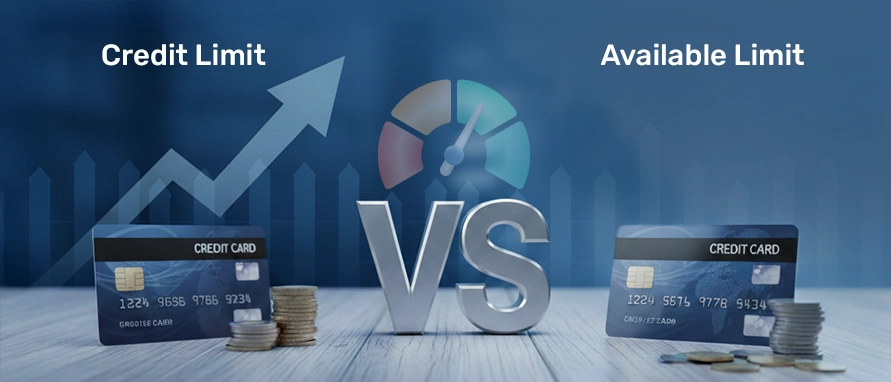
Your credit card includes two key figures: the credit limit and the available limit. While they sound similar, both affect your credit score in different ways. Understanding how available credit vs credit limit works helps you manage your cards more effectively and maintain a healthy credit profile.
In simple terms, your credit limit is the maximum amount your bank allows you to borrow on your card, while your available limit is what remains after you spend a portion of it. When your available limit drops too low compared to your total credit limit, your credit utilisation ratio rises and that can hurt your credit score.
Credit agencies like CIBIL in India track how much of your total credit you use every month. Keeping this usage under 30% is considered ideal for maintaining a strong credit score.
Your credit limit is the total borrowing capacity; the available limit is what remains.
High utilisation of available credit can negatively impact your credit score.
Keeping credit utilization below 30% of your credit limit is recommended because high utilisation can signal financial stress and negatively impact your score.
| Aspect | Credit Limit | Available Credit |
|---|---|---|
Definition |
The maximum amount a bank allows you to spend using your credit card. |
The amount of credit still available for use after making purchases or payments. |
Set By |
The issuing bank, based on income, credit score, and repayment history. |
Changes dynamically as you spend or make payments. |
Impact on Score |
Forms the base for calculating your credit utilisation ratio. |
Reflects your real-time spending behaviour that influences your credit score. |
Control |
Can be increased or decreased by the lender upon request or review. |
Controlled by how much you spend or repay each month. |
Understanding this table helps clarify the available credit vs total credit limit relationship and how both interact to shape your financial reputation.
In India, your CIBIL score plays a vital role in securing loans and credit cards. Lenders look at how you use your available limit relative to your total credit limit. If you consistently spend close to your limit, it may indicate financial dependency and risk.
For example, if your card limit is ₹1,00,000 and your available credit drops to ₹10,000 due to heavy usage, your utilisation ratio is 90% — which can harm your CIBIL score. On the other hand, keeping your usage below 30% signals financial discipline and improves your chances of getting future loans at better rates.
Knowing how your credit limit and available credit work together helps you stay in control of your finances. A good balance between the two shows responsible behaviour and builds trust with lenders.
Better score management: You can predict how spending affects your credit score.
Avoids rejection: Helps prevent loan or card rejection caused by high utilisation.
Improved planning: Allows better budgeting and repayment scheduling.
Healthy credit habits: Reinforces the importance of timely payments and low debt levels.
Several factors can change your available credit from month to month:
New purchases: Every transaction reduces your available limit.
Payments made: Paying off dues immediately restores your available credit.
Fees and interest: Annual charges or late fees temporarily reduce availability.
Credit limit changes: If your bank revises your total limit, your available credit adjusts automatically.
Tracking these factors helps you stay informed and avoid unnecessary surprises when using your card.
Myth 1: A higher credit limit always guarantees a better credit score.
Myth 2: Using your entire credit limit builds trust with lenders.
Myth 3: Paying only the minimum due keeps your credit health intact.
Myth 4: Frequently requesting limit increases never impacts your score.
Reality: These beliefs are misleading. What truly matters is responsible spending, timely repayments, and maintaining low credit utilisation.
No credit check loans are a great solution for borrowers who have been denied traditional credit or haven’t yet built a credit profile. With evolving digital lending practices, it’s now possible to access loans without credit check using income proofs, payment patterns, and other real-time indicators.
Whether you're new to borrowing or need instant cash, these loans offer a simplified way to get funds without the usual barriers. Just remember to check my credit score periodically and perform a credit report check to build your long-term credit health—even if it’s not a requirement today.
Many cardholders misuse their available credit without realising the impact. Common mistakes include:
Overspending: Frequently using more than 50% of the limit damages the CIBIL score.
Ignoring repayment dates: Late payments reduce available credit and increase interest costs.
Relying on minimum payments: Paying only the minimum due increases debt faster.
Not tracking spending: Without regular monitoring, it becomes harder to control utilisation.
Avoiding these mistakes helps you maintain both financial stability and a healthy credit profile.
Your credit limit is the total borrowing capacity assigned by your lender, while available credit is the amount currently left for spending after deductions from purchases or charges.
No. Your available credit can never exceed your total credit limit. It can only increase back to the full limit after you repay the outstanding balance.
Yes. Once your payment reflects in the account, the repaid amount restores your available credit immediately.
Yes. Annual fees or maintenance charges temporarily reduce your available credit until they are repaid in full.



Academy by Bajaj Markets

 47202
47202

Navigate the tax maze with ease! Uncover Income Tax 101, demystify jargon with Terms for Beginners, and choose between Old or New Regimes.
 165541
Unlock the world of credit! From picking the perfect card to savvy loan management, navigate wisely.
 97881
97881
Money Management and Financial Planning covers personal finance basics, setting goals, budgeting...
 28606
28606
Explore the investment cosmos! From beginner's guides to sharp-witted strategies, explore India's treasure trove of options.
 18764
18764
Discover essential insights on various types of insurance in India.
 4584
4584
Welcome to Tech in Finance, where we explore the exciting intersection of technology and finance...












 Academy