Our Products
 Loans
Loans
 Cards
Cards
 Insurance
 Investment
 Stock Market
 Electronics Mall
 CIBIL Score
 Knowledge Centre
 Calculators
Our Services

 Do not call
 En
En
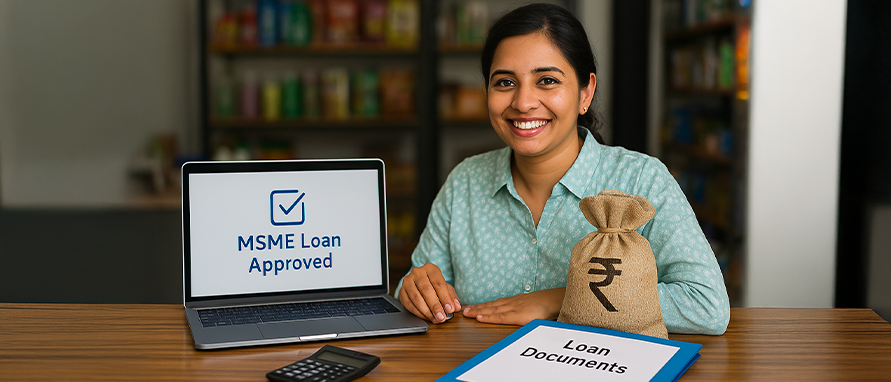
Micro, Small, and Medium Enterprises (MSMEs) are vital to India’s economy, driving employment and growth. Yet, many struggle to access timely funds. MSME funding helps businesses meet working capital needs, upgrade technology, and support expansion through tailored loans and government‑backed schemes.
In India, an MSME loan is a specialised credit facility designed to provide financial support to Micro, Small, and Medium Enterprises. These loans are offered by banks, NBFCs, and government-backed schemes to help businesses manage daily operations, expand infrastructure, or invest in new technology.
MSME loans are crucial for sectors with up to ₹50 Crore turnover and ₹10 Crore investment, helping to support business growth and cash flow management. Simply put, an MSME loan is a business loan for smaller enterprises that might not have easy access to traditional funding sources.
These loans are specifically designed to support small enterprises manage working capital efficiently. Key unique aspects of MSME loans include:
Collateral-Free/Unsecured: Many MSME loans (especially under schemes like CGTMSE) do not require pledging business assets, reducing risk for owners.
Fast Processing & Minimal Documentation: Designed for quick access to funds, often with approval within 2-7 days, reducing the time small businesses spend on administrative hurdles.
Competitive Interest Rates: MSME Loan interest rates are generally lower than standard business loans. Exact rates depend on the lender and your credit profile.
Tailored for Small Business Needs: Loans are customized for specific needs, such as working capital, machinery purchases, or expanding operations.
Government Support & Schemes: Many MSME loans are backed by government initiatives like MUDRA or CGTMSE. This makes them more accessible and offering lower interest rates compared to traditional business loans.
Flexible Repayment Tenure: Repayment options are tailored to match the cash flow cycles of small businesses, with tenures often ranging from 1 to 15 years.
Inclusive Financing: These loans are available to a wide range of enterprises, including small shopkeepers, startups, and new entrepreneurs.
In India, MSMEs are classified using a composite criterion of investment in plant and machinery (or equipment) and annual turnover. This classification can also help lenders determine business eligibility and loan terms.
| Category | Investment Limit | Annual Turnover Limit |
|---|---|---|
Micro |
Up to ₹2.5 Crores |
Up to ₹10 Crores |
Small |
Up to ₹25 Crores |
Up to ₹100 Crores |
Medium |
Up to ₹125 Crores |
Up to ₹500 Crores |
*This system, effective from 1 April 2025, applies equally to both manufacturing and service sectors.
Composite Nature: An enterprise must satisfy both criteria to remain in a category. If it exceeds either the investment or turnover limit for its current category, it is moved to the next higher category.
Excluded Turnover: While calculating annual turnover, export of goods or services is excluded to encourage global trade.
Unified Calculation: All units with the same Permanent Account Number (PAN) linked to different GSTINs are treated as a single enterprise for classification purposes.
Asset Valuation: Investment is calculated on a net investment basis (depreciated cost) as per Income Tax returns, excluding land, buildings, and furniture.
MSME loans serve several important purposes that help businesses grow and sustain themselves. Some common uses are given below:
Working Capital Management: MSMEs often need funds to handle daily expenses like salaries, rent, and inventory purchases. Loans help smooth out cash flow and keep operations running smoothly.
Business Expansion: Whether it’s opening a new branch, increasing production capacity, or entering new markets, MSME loans provide the capital needed for growth.
Technology Upgradation: Investing in new machinery, automation, or digital tools can improve efficiency and competitiveness. MSME loans make this possible.
Export Financing: MSMEs engaged in exports can use loans for pre-shipment and post-shipment finance, helping them manage international trade smoothly.
Debt Consolidation: Some businesses use MSME loans to repay existing debts, reducing financial burden and improving credit health.
Establishing New Units: These financing options can support entrepreneurs in setting up new startups or business units to grow their venture.
Meeting Statutory Obligations: MSME loans can help meet immediate needs like tax payments or employee salaries without interrupting operations.
MSME loans in India provide essential financing for small businesses, categorised as per their use. There are several types of MSME loans available, each suited for different business needs:
Term Loans: These are fixed-amount loans with a set repayment schedule. They can be ideal for long-term investments like buying machinery or expanding infrastructure.
Working Capital Loans: Designed to cover short-term operational expenses, these loans help businesses maintain smooth daily functioning.
Overdraft and Line of Credit: These facilities provide flexible access to funds up to a pre-approved limit. Plus, interest is charged only on the amount used.
Bill Discounting or Invoice Financing: MSMEs can sell their receivables (invoices) to lenders at a discount to get immediate cash flow.
Bank Guarantees: These are assurances provided by banks on behalf of MSMEs to secure contracts or payments.
Government-backed Loans: Schemes like the Pradhan Mantri Mudra Yojana (PMMY) offer loans up to ₹10 Lakhs to micro and small enterprises, often without collateral.
Asset-backed Loans: Loans secured by collateral such as property, machinery, or inventory fall under this category.
Specialised Loans for Women Entrepreneurs: Some lenders offer preferential terms and lower interest rates to support women-led MSMEs.
Understand the basic business, income, and credit requirements lenders use to assess MSME loan applications.
Must be a registered MSME (manufacturing or service sector)
Minimum business vintage typically between 1–3 years
Stable business income and cash flows
Eligible entity types include proprietorships, partnerships, LLPs, and private limited companies
Criteria may vary across banks, NBFCs, and government schemes
Keep essential KYC, business, and financial documents ready to ensure faster verification and loan processing.
PAN and Aadhaar of applicant/business owners
MSME registration certificate
Business address proof
Bank statements for the last 6–12 months
Income tax returns and financial statements
GST returns, if applicable
Details of existing loans or liabilities, if any
Follow the process to compare lenders, submit documents, and receive funds quickly.
Compare loan options based on interest rate, tenure, and eligibility
Fill out the online application form with basic business details
Upload required KYC and financial documents
Lender conducts verification and credit assessment
Receive loan approval and terms
Amount is disbursed directly to your business bank account
The Indian government plays a big role in supporting MSMEs through various loan schemes and credit guarantee programmes. These initiatives make it easier for MSMEs to access affordable finance, sometimes without collateral. Here are some key government-backed schemes and their key details that can help with your business:
PMEGP is a credit-linked subsidy scheme for setting up new micro-enterprises in the non-farm sector. It is implemented by KVIC at the national level and through KVIC directorates, KVIBs, DICs and banks at the state level.
CGTMSE gives collateral-free and/or third-party-guarantee-free credit guarantee cover to eligible MSE loans extended by member lending institutions. It is a guarantee mechanism only; it does not sanction loans or subsidies directly.
CGSSD, also called the Distressed Asset Fund–Subordinated Debt for Stressed MSMEs, supports MSMEs that are stressed, NPA, or close to NPA. The promoter can use the subordinate debt as equity support to improve liquidity and help revive the unit.
The SRI Fund is a Government of India fund-of-funds created to provide equity support to MSMEs with growth potential. Officially, it has a corpus of ₹50,000 Crores, with ₹10,000 Crores from the Government of India and the balance through private equity/venture capital funds.
Stand Up India facilitates bank loans of ₹10 Lakhs to ₹1 Crore to at least one SC/ST borrower and one woman borrower from each bank branch to set up a greenfield enterprise. The enterprise may be in manufacturing, services, trading, or agriculture-allied activities, and in non-individual cases, 51% ownership and control must be with an SC/ST or woman entrepreneur.
The Credit Linked Capital Subsidy Scheme (CLCSS) supports MSEs in upgrading plant and machinery through institutional finance. Eligible enterprises can receive a capital subsidy of up to 15% on approved credit for technology upgradation.
ZED Certification is a government initiative to promote Zero Defect Zero Effect practices among MSMEs and encourage better quality, productivity and sustainability. MSMEs registered on the Udyam portal are eligible, and the scheme offers certification-linked incentives and graded certification levels.
MSE-CDP supports cluster-based growth through Common Facility Centres and infrastructure development for industrial estates and flatted factory complexes. The scheme is open to groups of MSE clusters and state government agencies, with higher grant support for special-category regions and clusters with a higher share of women, micro, SC/ST, or village units.
ASPIRE is the Scheme for Promotion of Innovation, Rural Industry and Entrepreneurship, and it supports incubation and commercialisation of business ideas. Its stated goals are to create jobs, promote entrepreneurship, and strengthen MSME competitiveness through livelihood business incubators and related support.
PMS helps MSMEs access markets through trade fairs, exhibitions, vendor development programmes, packaging support, e-commerce adoption, and workshops. It is meant for manufacturing and service MSEs with a valid Udyam registration.
The IC Scheme is a demand-driven reimbursement scheme that supports eligible government institutions and industry associations in helping MSMEs participate in overseas exhibitions, trade fairs, buyer-seller meets, and international conferences or seminars. It also provides reimbursement support for airfare and space rent as per the scheme guidelines.
SFURTI is a cluster-based scheme for regenerating traditional industries and artisan clusters. It supports common facilities, skill upgradation, design and product improvement, packaging, and market development to make traditional clusters more competitive.
MSME loans are a lifeline for small and medium businesses, offering the funds needed to grow, innovate, and compete. With various loan types and government schemes available, MSMEs have more options than ever to secure the right financing.
Whether it’s managing daily expenses or investing in new technology, MSME loans provide the financial support these businesses need. Understanding what an MSME loan is and how it works can help entrepreneurs make informed financial decisions and unlock new opportunities.
|
|
MSME stands for Micro, Small, and Medium Enterprises. These are businesses classified based on their investment and turnover limits. They play a crucial role in the economy by generating employment and contributing to the country’s GDP.
Examples of MSMEs include small manufacturing units, local retail shops, family-run businesses, service providers like salons, restaurants, and consultancy firms. These enterprises vary widely but share common financial needs.
Yes, certain government schemes offer subsidies or collateral-free loans to MSMEs. For example, the CGTMSE scheme provides credit guarantees that reduce the risk for lenders, making loans more accessible and affordable.
Loan limits vary depending on the scheme and lender. For instance, CGTMSE offers loans up to ₹2 Crores without collateral, while MUDRA loans provide up to ₹10 Lakhs. Overall, MSME loans can range from small amounts to several crores.
Any business classified as a micro, small, or medium enterprise under government definitions can apply. However, they should meet the lender’s eligibility criteria, including business registration and financial health.
Yes, many MSME loans, especially those under government-backed schemes like CGTMSE and ECLGS, are available without collateral. This helps small businesses access funds without risking assets.



Academy by Bajaj Markets

 47202
47202

Navigate the tax maze with ease! Uncover Income Tax 101, demystify jargon with Terms for Beginners, and choose between Old or New Regimes.
 165541
Unlock the world of credit! From picking the perfect card to savvy loan management, navigate wisely.
 97881
97881
Money Management and Financial Planning covers personal finance basics, setting goals, budgeting...
 28606
28606
Explore the investment cosmos! From beginner's guides to sharp-witted strategies, explore India's treasure trove of options.
 18764
18764
Discover essential insights on various types of insurance in India.
 4584
4584
Welcome to Tech in Finance, where we explore the exciting intersection of technology and finance...












 Academy