Our Products
 Loans
Loans
 Cards
Cards
 Insurance
 Investment
 Stock Market
 Electronics Mall
 CIBIL Score
 Knowledge Centre
 Calculators
Our Services

 Do not call
 En
En
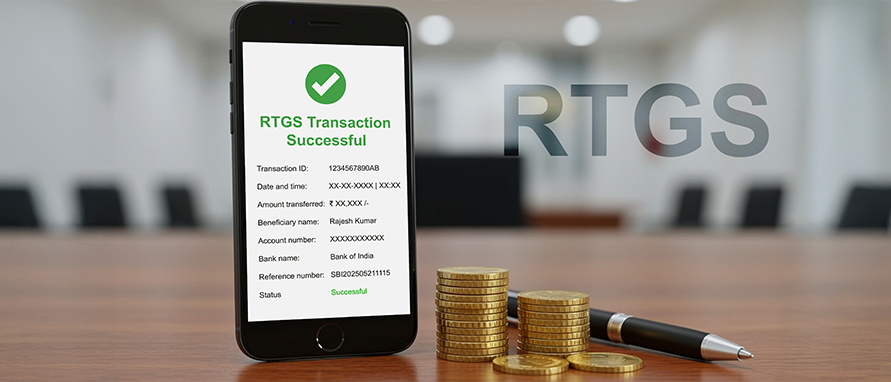
Table of Content
Real Time Gross Settlement (RTGS), commonly used for high‑value bank transfers, is a core payment system regulated by the Reserve Bank of India. It enables immediate and secure transfer of funds between banks without any waiting period.
RTGS is widely used for property purchases, business payments, and other large financial transactions where timing and certainty matter. Understanding how this system functions helps you choose the right transfer method and avoid delays or errors.
The RTGS full form is Real Time Gross Settlement. The term explains how transactions are processed. “Real time” means the transfer happens instantly. “Gross settlement” means each transaction is processed individually, without being grouped with others.
In simple terms, the RTGS meaning refers to a fund transfer system where money moves from one bank account to another immediately and irrevocably. Once processed, the transaction cannot be reversed. This makes RTGS suitable for time‑sensitive and high‑value payments that require final settlement without delay.
RTGS is operated and supervised by the Reserve Bank of India, which ensures standardised rules, system reliability, and settlement finality across participating banks.
An RTGS transfer is an electronic method of sending money between banks in India for large transaction amounts. It is commonly used when the transfer value is high and the recipient needs funds immediately.
An RTGS payment is settled directly between banks through the RBI’s central system. There is no clearing cycle or waiting window involved. This direct settlement reduces settlement risk and improves transaction certainty for both the sender and the receiver.
Banks offer RTGS through online banking, mobile banking, and branch channels. While the process may look similar to other digital transfers, RTGS differs because it prioritises speed, finality, and individual settlement over convenience for small amounts.
RTGS follows a structured process to ensure immediate and final settlement of high‑value transactions.
The steps involved are explained below:
1.Initiation of request
The sender submits an RTGS request through internet banking, mobile banking, or at a bank branch.
2.Verification by the sending bank
The bank checks the sender’s account balance and validates the beneficiary details.
3.Transmission to RBI system
Once verified, the transaction is sent to the Reserve Bank of India’s RTGS system.
4.Real‑time settlement
The RBI debits the sending bank’s account and credits the receiving bank’s account instantly.
5.Credit to beneficiary account
After settlement, the receiving bank credits the amount to the beneficiary’s account without delay.
RTGS has several features that distinguish it from other electronic fund transfer systems in India.
Transactions are settled immediately without waiting for a clearing cycle
Each transaction is processed individually, not combined with others
RTGS is designed primarily for large‑amount transfers
Once completed, the transfer is irrevocable
The platform is operated and overseen by the Reserve Bank of India
Most scheduled commercial banks in India support RTGS
RTGS can be initiated through internet banking, mobile banking, or bank branches
The Reserve Bank of India does not levy any charges for processing RTGS transactions. However, banks are allowed to decide whether they charge customers and how much they charge.
As a result, RTGS charges may vary depending on the bank, the transaction amount, and the channel used, such as online banking or branch submission.
Important points to note:
Many banks offer free RTGS transfers through online banking.
Branch‑initiated RTGS transactions may attract nominal fees.
Charges, if applicable, are disclosed by banks in their service schedules.
Since fee structures differ across banks, it is advisable to check the latest charges with your bank before initiating a high‑value transfer.
RTGS is available on a 24×7 basis, including weekends and bank holidays. This round‑the‑clock availability was introduced by the Reserve Bank of India to support uninterrupted high‑value payments.
Although the RTGS system itself runs continuously, customer transaction timings may vary by bank. Some banks process online RTGS requests instantly at all hours, while others may apply internal cut‑off times for certain channels.
Important points to note:
RTGS operates 24 hours a day, 7 days a week
Availability applies to online and branch‑based transfers
Actual credit time may depend on bank systems and beneficiary bank processing
For urgent transfers outside regular banking hours, online RTGS is generally the most reliable option.
RTGS can be initiated through online banking or by visiting a bank branch. The steps are straightforward, but accuracy is critical due to the irreversible nature of the transaction.
Log in to your bank’s internet or mobile banking platform
Add the beneficiary using correct bank and account details
Select RTGS as the transfer mode
Enter the transfer amount and confirm the transaction
Authenticate using the required security method
Visit your bank branch during working hours
Fill out the RTGS request form with beneficiary details
Submit the form along with valid identification, if required
The bank processes the transfer through the RTGS system
Once the transaction is processed, the amount is credited to the beneficiary’s account within a short time, subject to correct details and system availability.
Accurate information is essential when initiating an RTGS transaction, as transfers are processed instantly and cannot be reversed once settled.
The sender must provide the following details:
Beneficiary name as per bank records
Beneficiary account number
Beneficiary bank name and branch
IFSC code of the beneficiary branch
Transfer amount (minimum ₹2 Lakhs)
Sender’s account details, if submitting the request at a branch
For online transfers, these details are added while registering the beneficiary. For branch‑based transfers, the same information is entered in the RTGS request form.
Even a minor error, such as an incorrect account number or IFSC code, can delay or misroute the transaction. Verifying details before confirmation is therefore critical.
RTGS offers several advantages for individuals and businesses dealing with large‑value transactions where speed and certainty are important.
Key benefits include:
Funds are transferred in real time without waiting for clearing cycles
RTGS is suitable for large payments such as property purchases or business settlements
Once processed, the transfer is final, reducing counter‑party risk
The system operates under Reserve Bank of India regulation, ensuring reliability and standardisation
Transfers can be initiated at any time, including weekends and holidays
RTGS, NEFT, and IMPS are all electronic fund transfer systems in India, but they serve different purposes based on transaction value, urgency, and settlement method.
Here are the key differences:
Feature |
RTGS |
NEFT |
IMPS |
Settlement type |
Real‑time, individual |
Deferred, batch‑based |
Real‑time |
Minimum amount |
₹2 Lakhs |
No minimum |
No minimum |
Maximum amount |
No RBI cap |
No RBI cap |
Bank‑defined limits |
Processing speed |
Immediate |
Periodic batches |
Immediate |
Availability |
24×7 |
24×7 |
24×7 |
Typical use |
Large‑value transfers |
Regular transfers |
Small, urgent transfers |
RTGS is best suited for high‑value payments where settlement certainty is critical. NEFT works well for routine transfers that are not time‑sensitive. IMPS is commonly used for instant, low‑value transfers between individuals.
Understanding these differences helps users choose the most appropriate transfer method based on urgency, amount, and convenience.
RTGS should be used when the transaction amount is high and the transfer must be completed without delay. Its real‑time and irreversible nature makes it suitable for situations where payment certainty is essential.
RTGS is commonly used in the following scenarios:
Property purchases, where large sums must be credited on the same day
Business or corporate payments, such as vendor settlements
High‑value investments, including securities or fixed‑asset purchases
Urgent financial obligations, where delays could cause penalties or disputes
For smaller amounts or routine transfers, NEFT or IMPS may be more practical. RTGS is most effective when speed, finality, and value outweigh the need for flexibility.
RTGS stands for Real Time Gross Settlement. It refers to a fund transfer system where transactions are processed individually and settled instantly between banks.
An RTGS payment is a high‑value electronic fund transfer made between banks in real time. Once processed, the amount is credited to the beneficiary without delay.
In an RTGS transaction, the sending bank sends the payment request to the RBI system after verification. The RBI settles the amount instantly between banks, after which the beneficiary bank credits the account.
RTGS offers real‑time processing, individual settlement of transactions, high‑value transfer support, settlement finality, 24×7 availability, and RBI‑regulated operations.
The minimum amount required for an RTGS transaction is ₹2 Lakhs per transfer, as prescribed by the Reserve Bank of India.
RTGS transactions may be free or chargeable, depending on the bank. Many banks offer free RTGS through online channels, while branch‑based requests may attract nominal fees.
Yes, RTGS is available 24 hours a day, 7 days a week, including weekends and bank holidays. Processing speed may still depend on individual bank systems.
To do RTGS online, log in to your bank’s internet or mobile banking platform, add the beneficiary with correct details, select RTGS as the transfer mode, enter the amount, and confirm the transaction.
RTGS requires the beneficiary’s name, account number, bank name, branch, IFSC code, and transfer amount. Incorrect details can lead to delays or failed transactions.
RTGS is faster because transactions are settled immediately. NEFT processes transactions in batches, which may cause short delays.
RTGS should be used for large‑value and time‑critical payments, such as property transactions, business settlements, or urgent high‑amount transfers.
No, RTGS transactions cannot be cancelled once processed. Since settlement happens instantly, reversals are not possible after completion.


Most Viewed

Academy by Bajaj Markets

 47202
47202

Navigate the tax maze with ease! Uncover Income Tax 101, demystify jargon with Terms for Beginners, and choose between Old or New Regimes.
 165541
Unlock the world of credit! From picking the perfect card to savvy loan management, navigate wisely.
 97880
97880
Money Management and Financial Planning covers personal finance basics, setting goals, budgeting...
 28605
28605
Explore the investment cosmos! From beginner's guides to sharp-witted strategies, explore India's treasure trove of options.
 18764
18764
Discover essential insights on various types of insurance in India.
 4584
4584
Welcome to Tech in Finance, where we explore the exciting intersection of technology and finance...












 Academy