Our Products
 Loans
Loans
 Cards
Cards
 Insurance
 Investment
 Stock Market
 Electronics Mall
 CIBIL Score
 Knowledge Centre
 Calculators
Our Services

 Do not call
 En
En
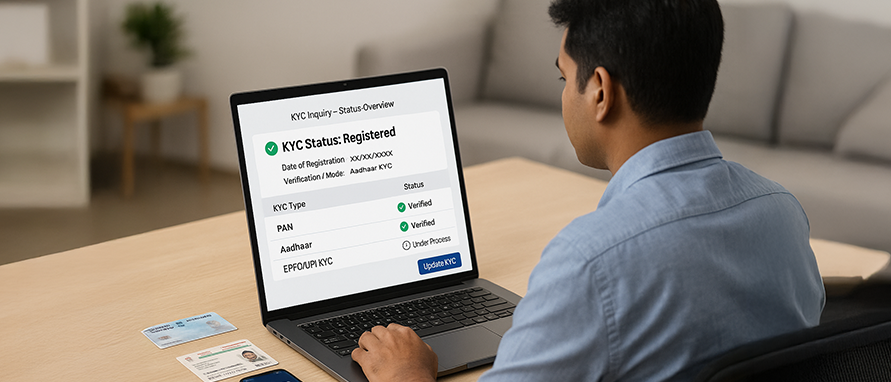
Learn how to check your KYC status online, understand different KYC status types, and resolve pending verification issues easily.
Staying updated with your KYC status is essential for anyone accessing banking, investment, or digital financial services in India. Whether you are opening a bank account, investing in mutual funds, or carrying out high‑value transactions, a verified KYC record ensures seamless access across institutions. With SEBI‑registered (Securities and Exchange Board of India) KRAs centralising customer verification data, individuals can now check KYC status online within seconds through bank portals or KRA websites.
KYC status refers to the stage and outcome of your identity verification process carried out by a SEBI‑registered KYC Registration Agency (KRA). When you submit documents like PAN, Aadhaar, address proof, and photograph, the KRA reviews and verifies them before assigning a status such as ‘Validated’, ‘Registered’, ‘On‑Hold’, or ‘Rejected’. This status informs financial institutions whether you are fully compliant and eligible to use services like banking, trading, and investing. KYC records maintained by KRAs are shared across intermediaries, meaning you do not need to complete KYC repeatedly once verified.
Your KYC verification status directly impacts your financial accessibility and compliance. Here’s why it matters:
SEBI and the Prevention of Money Laundering Act mandate KYC for opening bank accounts, investing, or accessing financial services. It ensures all customer identities are properly authenticated before transactions occur. Maintaining an updated KYC record also helps avoid service restrictions imposed by financial institutions.
Proper KYC helps prevent identity theft, money laundering, and financial fraud. It strengthens the overall security framework of banks and intermediaries by reducing the risk of unauthorised access. By confirming the legitimacy of users, the system protects both institutions and customers from potential misuse.
A correct KYC status ensures uninterrupted banking, investment onboarding, and faster processing. Many platforms automatically verify KYC before enabling services, so a valid status speeds up approvals. Timely KYC completion also ensures there are no delays in executing new financial transactions.
Once validated, your KYC record becomes visible across all KRAs and financial institutions. This eliminates the need for repeating verification every time you engage with a new intermediary. Centralised KYC also enhances consistency and reliability across the entire financial ecosystem.
You can check your KYC status through two primary routes, namely your bank portal or any SEBI‑registered KRA website. Here’s a closer look:
Most banks allow customers to verify their bank’s KYC status through their net banking platform. Although steps differ slightly across banks, the general process is:
Banks draw this information from the central KRA database, ensuring accuracy across platforms.
SEBI‑registered KRAs offer the simplest way to check your KYC status online using your PAN. Official KRAs include:
Steps to check KYC status on a KRA website:
The portal displays statuses such as Validated, Registered, On‑Hold, or Rejected.
Using PAN is the most widely used method to check your KYC status, since PAN is the primary identifier used by KRAs.
You can check it by:
Visiting any KRA portal such as CVL KRA, CAMS KRA, NDML KRA, or KFintech KRA.
Selecting the PAN‑based KYC Inquiry option.
Entering your PAN and CAPTCHA.
You may also check using the CDSL Ventures Limited KYC inquiry tool, widely used by brokers and financial institutions.
KRA systems assign one of several KYC statuses, each indicating where you stand in the verification process:
Your information and documents have been fully verified, and you can use all financial services without restrictions. Common for mutual fund and demat users.
Your record exists in the system but may not meet the latest SEBI requirements for full validation. You can use existing services but may need an update for new investments.
Some discrepancies exist, such as incorrect documents, mismatched details, unverified mobile/email, or PAN–Aadhaar linking issues. Action is required.
Your KYC was invalid or incomplete, and re‑submission is required.
No KYC record exists for your PAN in any KRA database. Fresh KYC must be completed.
Your documents have been successfully verified by the CVL Mutual Fund ecosystem.
A pending, ‘under process’, or ‘on hold’ KYC status means your KRA is still verifying your documents or has detected issues that require action. Here’s what to do:
Check the reason on the KRA portal. Common triggers include mismatched documents, unverified email/phone, or incomplete submission.
Correct document errors by uploading updated PAN, Aadhaar, or address proof through the bank or intermediary.
Complete PAN–Aadhaar linking if the system shows a mismatch.
Re‑submit KYC via online modes such as Aadhaar OTP e‑KYC or video KYC for faster processing.
After corrections, your KYC verification status typically updates within a few days.
Addressing issues promptly ensures your financial transactions remain smooth and uninterrupted.
KYC status checks can be done online by visiting the website of the KYC Registration Agency (KRA) and entering your PAN card number. In case you did not use your PAN card to register, you can use a combination of your name, date of birth in the specified format, and the exempt category to check your KYC status.
If you have applied for a KYC update, you can check the KYC status by using your PAN Card number on the website of the KYC Registration Agency. However, do remember that the KYC update may take five to seven days to process.
If you have applied for eKYC, you can visit the website of the financial institution through which you initiated Aadhaar-based eKYC. You then have to log in with your credentials, and use your Aadhaar number to check the Aadhaar eKYC status.
You can easily find the KYC form online on any mutual fund website, or you can get it offline from a broker.
You can easily update your KYC status on the KYC online portal. You can log in and update the latest documents you need to change information like your name or your registered address.
You can check your KYC status for investing in mutual funds on the KRA website. You will mandatorily need a PAN card as part of your KYC documents to invest in mutual funds.
The KYC method helps institutions like banks or other financial institutions verify your identity. You will have to comply with KYC regulations to open any kind of bank account or partake in other activities like investing in mutual funds.
KYC status indicates whether your identity verification has been accepted, registered, or flagged by a SEBI‑registered KRA. It shows if you are compliant and eligible to access financial services or if corrections or re‑verification are required to complete the process.
Checking your KYC status ensures you remain compliant and can use financial services without restrictions. Invalid or pending KYC can delay investments, block new transactions, or limit access to accounts. Regular checks help prevent errors and avoid disruptions caused by incomplete verification.
To check KYC status online, visit any SEBI‑registered KRA website, select the KYC status inquiry option, enter your PAN, complete the CAPTCHA, and submit. The system will instantly display your verification status, including registration dates and the KRA managing your record.
Yes. PAN is the primary identifier for KYC verification across KRAs. Enter your PAN on any KRA portal’s inquiry page, complete CAPTCHA verification, and instantly view your KYC status, making it the fastest and most widely used method.
Common KYC status types include Validated, Registered, On‑Hold, Rejected, Not Available, and CVL MF Verified. Each reflects the stage of verification, highlighting whether your documents are accepted, pending correction, or missing in KRA records.
To update pending KYC, check the reason on your KRA portal, correct issues such as document mismatches or unverified contact details, update PAN–Aadhaar linkage if required, and re‑submit documents online. Status typically updates after the discrepancies are resolved.
KYC verification usually takes 2 to 10 days depending on the submission method and KRA processing time. Aadhaar OTP‑based or video KYC may complete faster, while full document verification can take slightly longer before your status gets updated.




 47201
47201

Navigate the tax maze with ease! Uncover Income Tax 101, demystify jargon with Terms for Beginners, and choose between Old or New Regimes.
 165300
Unlock the world of credit! From picking the perfect card to savvy loan management, navigate wisely.
 97872
97872
Money Management and Financial Planning covers personal finance basics, setting goals, budgeting...
 28591
28591
Explore the investment cosmos! From beginner's guides to sharp-witted strategies, explore India's treasure trove of options.
 18763
18763
Discover essential insights on various types of insurance in India.
 4583
4583
Welcome to Tech in Finance, where we explore the exciting intersection of technology and finance...












 Academy