Our Products
 Loans
Loans
 Cards
Cards
 Insurance
 Investment
 Stock Market
 Electronics Mall
 CIBIL Score
 Knowledge Centre
 Calculators
Our Services

 Do not call
 En
En
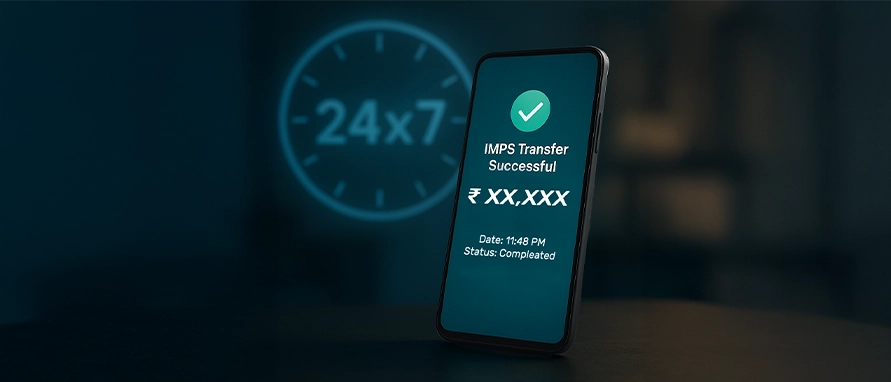
IMPS stands for Immediate Payment Service and, as the name suggests, facilitates immediate payments to banks, individuals, or merchant remittances.
In some cases, banks may impose restrictions. These restrictions may be on time or the amount you can transfer after a stipulated time (generally after banking hours). Some banks may even have restrictions on when you can add a beneficiary.
This automatically restricts the IMPS timings, as you cannot transfer funds if the recipient is not added as a beneficiary. However, some banks offer the IMPS facility wherein you do have to add the recipient as a beneficiary. In this case, the IMPS timings to process the transaction are among the quickest, as it takes a few seconds if all the details are accurate and up to date.
You can and should confirm the IMPS timings of your bank to ensure that you can process it on time without any delay. You can check the IMPS timings either on the bank’s website, by contacting customer care, or by visiting the branch.
IMPS time limit differs with different banks. While IMPS payment transfer time is the quickest mode of transfer we have as of now. Banks have placed certain limitations to ensure safe and secure transactions. The limitation is either imposed on IMPS timings by reducing the number of hours IMPS could be used. For example, some banks impose restrictions to use IMPS only between 8 AM and 8 PM. While other types of restrictions are imposed by reducing the amount that could be transferred after the regular hours. For example, SBI allows you to transfer up to Rs. 2 Lakhs between 8 AM to 8 PM but allows you to transfer up to only Rs. 40,000 from 8 PM to 8 AM. So, you need to check with your bank to be aware of their IMPS time limit, service charges, and IMPS transaction limit.
| Bank | What Bank says | Business caveat |
|---|---|---|
State Bank of India (SBI) |
Offers 24x7 IMPS availability across net banking, mobile apps, and YONO platforms. |
New beneficiaries face a 4-hour activation cooling period; standard transaction limits scale up to ₹5 Lakh daily. |
HDFC Bank |
Full 24x7 infrastructure processing on all 365 days of the year, including retail holidays. |
The default maximum transfer cap sits at ₹5 Lakh per day via online channels, subject to user profile configurations. |
ICICI Bank |
Instant fund settlements accessible round-the-clock via iMobile Pay and Internet Banking. |
Newly added payees have a cumulative transaction limit of ₹50,000 within the first 24 hours of registration. |
Axis Bank |
Seamless, unrestricted IMPS service running 24x7 without fixed time barriers. |
Beneficiary activation requests submitted after 8:00 PM are queued and processed only after 8:00 AM the following day. |
Kotak Mahindra Bank |
Round-the-clock payment system processing transfers immediately upon confirmation. |
Net banking users face safety limits during late-night hours to mitigate potential online security threats. |
When transferring funds online in India, you can choose between four major payment channels based on your transaction size, urgency, and convenience. The table below compares IMPS, NEFT, RTGS, and UPI across key operational parameters:
| Payment method | Typical use | Process Time | Limits and charges | Note |
|---|---|---|---|---|
IMPS (Immediate Payment Service) |
Urgent, instant small-to-medium retail payments. |
Instant (Real-time), available 24x7x365. |
Upper limit of ₹5 Lakh per transaction. Nominal charges up to ₹20 depending on the bank slab. |
Requires the recipient's bank account number and IFSC, or Mobile Number and MMID. Managed by NPCI. |
NEFT (National Electronic Funds Transfer) |
Regular bills, vendor payments, and non-urgent transfers. |
Batch-wise settlements every half-hour, available 24x7x365. |
No minimum or maximum limits set by RBI. Generally free online; nominal fees apply at physical bank branches. |
Transactions can sometimes take 30 minutes to 2 hours to clear depending on batch processing cycles. |
RTGS (Real-Time Gross Settlement) |
High-value business transactions, property buys, or large capital transfers. |
Instant (Real-time), gross settlement basis, available 24x7x365. |
Minimum transaction value is ₹2 Lakh; no upper limit. Usually free online; branch transactions attract tiered charges. |
Designed purely for large-ticket transfers where funds are processed individually instead of in batches. |
UPI (Unified Payments Interface) |
Daily micro-payments, peer-to-peer transfers, and routine merchant checkouts. |
Instant (Real-time) via mobile applications, available 24x7x365. |
Standard daily cap of ₹1 Lakh (up to ₹5 Lakh for specific categories like education/medical). Free of cost. |
Safest and fastest retail option; works via a Virtual Payment Address (VPA) without sharing bank account details. |
In general, there is no time limit as such. However, certain banks impose certain IMPS time limits to reduce fraudulent activities. Either they reduce the IMPS fund transfer time to 12 hours a day or reduce the amount that could be transferred during the night. The time limit depends on individual banks.
IMPS payment transfer time is only a few seconds.
The transaction takes only a few seconds to be completed on any day of the year, it is the same on Sundays as well as on any other holidays. Thus, the IMPS clearing time of the transaction is just seconds even on Sundays.
When an IMPS transaction fails or times out, do not panic. Check your bank account to see if the money has been debited. If it is not, then do the transaction after some time. If it is debited, wait for a minimum of two working days. The money will either be credited back to your account or will be credited to the beneficiary’s account. If not, contact your bank’s customer care and they will assist you.
To initiate an IMPS transfer, you need either the recipient’s Account Number and IFSC (for account-to-account transfers) or their Registered Mobile Number and MMID (for mobile-to-mobile transfers). Additionally, you will need the beneficiary's full name to confirm and register their profile before sending the funds.
Receiving money via IMPS is entirely free, but sending money varies by bank. Many public and private sector banks offer free IMPS transfers when processed online through net banking or mobile apps. However, some lenders charge a nominal fee ranging from ₹2 to ₹20 (plus 18% GST) depending on the transaction slab, especially for requests initiated physically at a bank branch.



Academy by Bajaj Markets

 47202
47202

Navigate the tax maze with ease! Uncover Income Tax 101, demystify jargon with Terms for Beginners, and choose between Old or New Regimes.
 165541
Unlock the world of credit! From picking the perfect card to savvy loan management, navigate wisely.
 97881
97881
Money Management and Financial Planning covers personal finance basics, setting goals, budgeting...
 28606
28606
Explore the investment cosmos! From beginner's guides to sharp-witted strategies, explore India's treasure trove of options.
 18764
18764
Discover essential insights on various types of insurance in India.
 4584
4584
Welcome to Tech in Finance, where we explore the exciting intersection of technology and finance...












 Academy