Our Products
 Loans
 Cards
 Insurance
 Investment
 Stock Market
 Electronics Mall
 CIBIL Score
 Knowledge Centre
 Calculators
Our Services

 Do not call
 En
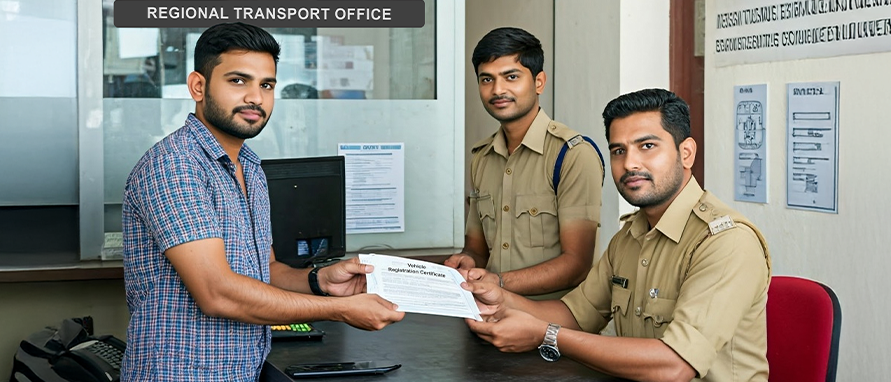
Learn how to transfer bike ownership in India, including the required documents, applicable fees, eligibility conditions, and the step-by-step process for updating vehicle ownership records.
If you're in India and planning to buy a used bike, the most crucial step is completing the two-wheeler ownership transfer online or offline through your local RTO. This transfer, handled at your local Regional Transport Office (RTO), is essential for everything from getting new insurance for your second-hand vehicle to avoiding future legal issues. The following sections will guide you through this important process.
Two-wheeler ownership transfer refers to the process of updating the Registration Certificate (RC) of a vehicle with the details of the new owner.
Ownership update: Vehicle registration records are modified to reflect the buyer’s details after sale or transfer.
Legal responsibility: The new owner becomes responsible for compliance, penalties, and usage of the vehicle.
Record validation: The change is registered with the RTO (Regional Transport Office) to ensure official recognition.
This process ensures that the transfer of ownership of vehicle records is documented properly.
Ownership transfer becomes necessary in multiple situations involving a change in vehicle ownership.
Sale of vehicle: Ownership must be transferred when a used bike is purchased from another individual.
Gift transfer: Vehicles transferred as gifts require ownership changes in official records.
Owner’s death: Legal heirs must transfer ownership after the death of the registered owner.
Inter-state transfer: Movement of a vehicle to another state may require ownership updates with new registration details.
These cases define when bike ownership transfer must be completed.
The transfer of ownership of a two-wheeler is subject to certain eligibility requirements to ensure that the transaction is legally valid and properly recorded with the Regional Transport Office (RTO).
Valid Ownership Documents: The seller must possess valid vehicle ownership documents, including the Registration Certificate (RC), to initiate the transfer process.
Identity and Address Proof: Both the buyer and seller are generally required to provide valid identity and address proof documents as prescribed by the RTO.
No Outstanding Legal Restrictions: The vehicle should not be subject to legal disputes, theft reports, or restrictions that may prevent the transfer of ownership.
NOC for Inter-State Transfers: A No Objection Certificate (NOC) may be required if the vehicle is being transferred from one state or RTO jurisdiction to another.
Loan Clearance Requirement: If the vehicle is under a loan or hypothecation arrangement, the lender's approval or a hypothecation termination certificate may be required before the transfer.
Valid Insurance Coverage: The vehicle should have an active motor insurance policy, which must be transferred to the new owner's name following the ownership transfer.
Applicable Tax Compliance: Any outstanding road tax or other applicable vehicle-related dues should be cleared before the transfer is completed.
Submission of Prescribed Forms: The buyer and seller must submit the required ownership transfer forms and supporting documents to the concerned RTO within the prescribed timeline.
It is extremely important to be aware of the list of documents that you need to submit to initiate the bike ownership transfer. To avoid delays, always verify your bike ownership transfer form requirements at your local RTO. This will not only speed up the process, but will also reduce the chances of rejection. Check out the list of the required documents below:
Registration Certificate (RC)
Every vehicle is required to be registered with an RTO, which would provide the owner with a Registration Certificate (RC). The RC comprises several details regarding the owner and the vehicle in question.
Pollution Certificate (PUC)
As the name itself signifies, a Pollution Certificate is a document that certifies that the bike meets all the emissions and pollution control criteria laid out by the transport authorities.
Insurance Certificate
Every vehicle is mandatorily required to possess a valid insurance policy as per the Motor Vehicles Act, 1988. An insurance certificate is a mandatory document that you should produce to be able to effect the bike ownership transfer.
Sales Receipt
When you purchase a used bike, the seller is required to give you a sales receipt specifying the bike transfer price. It is a signed document that acts as a confirmation of the sale.
Proof of Identity
You would also have to submit a copy of your identity proof. This can be anything from your PAN card or Aadhaar card to your driving licence or passport.
Proof of Address
You will also need to provide proof of your address. Your Aadhaar card, passport, electricity bill, and utility bill are all accepted address proofs.
Road Tax Certificate
A road tax certificate is a document that serves as proof of road tax payment and needs to be submitted along with the other documents.
Form 28
In the case of inter-state bike ownership transfers, you would have to produce a No Objection Certificate (NOC) in Form 28 from the RTO of the state from which you wish to transfer the bike.
Form 29
Two copies of Form 29, which is essentially a notice of the transfer of ownership of the bike, have to be submitted with the RTO.
Form 30
And finally, another two copies of Form 30, which acts as a confirmation of Form 29, are also required to be submitted.
Passport-size photographs
Provide passport-size photographs that need to be submitted.
No-Objection Certificate
An NOC from the original RTO is required if the transfer is carried out to another state.
In the case of the death of a bike’s owner, the legal heir is supposed to transfer the bike onto his name. Here’s a quick look at the additional documents that you would have to submit along with the ones above to effect the bike ownership transfer.
Death certificate of the owner of the bike
Form 30 and 31, duly signed by the transferee
Succession certificate
No Objection Certificate
Self-attested copy of the bike insurance policy
Copy of the transferee’s PAN card or Form 60
Seller’s signature identification
Vehicle verification on Form 20
The bike ownership transfer cost includes processing, smart card, and sometimes hypothecation removal charges. Your bike owner transfer charges will depend on factors such as whether the vehicle is under finance or being moved inter-state.
RTO Charges
The bike transfer fees that RTOs levy are quite affordable, ranging from just ₹30-35 depending on the state where you take the transfer.
Smart Card Charges
Nowadays, RTOs all over the country are providing registration certificates in the form of a smart card. The charges for the smart card are set at Rs. 200.
Processing Fee
Expect a standard RTO processing fee ranging from ₹150 to ₹500 for the ownership transfer depending on state/vehicle class.
Road Tax (Inter-state)
If the bike is moved to a new state, an additional road tax will apply, calculated based on its age, model, and the new state's specific regulations.
Hypothecation Removal Charges
If the bike was financed, removing hypothecation from the RC after the bike loan (the lender's claim on the vehicle) is a necessary part of the transfer process and might involve an additional fee. It's wise to confirm the exact amount with your RTO or a professional to avoid unexpected costs.
The bike ownership transfer online process is simple and user-friendly through the Parivahan portal. If you’re wondering how to transfer bike ownership online, the necessary steps are given below-
Step 1: Begin by navigating to the official Parivahan Sewa website- https://vahan.parivahan.gov.in
Step 2: Select the ‘Online Service’ option to proceed with vehicle-related transactions
Step 3: Choose the state where you currently reside or where the vehicle is registered to continue
Step 4: Provide the bike's latest Registration Number as prompted.
Step 5: From the available services, choose the ‘Ownership Transfer’ option.
Step 6: Input your phone number and the bike's chassis number for identification.
Step 7: A One-Time Password (OTP) will be sent to your registered mobile device for security verification. Enter the received OTP accurately to finalise the verification process.
Step 8: Click ‘Show Details’ to view and confirm the bike's information.
Step 9: Proceed to make the required online payment for the transfer fee.
Step 10: Download and save the payment receipt for your records and future reference.
Transferring bike ownership offline is a simple, direct process. Here's a quick overview of the steps involved:
Step 1: Download or collect the specific application forms required for the ownership transfer (e.g., Form 29, Form 30).
Step 2: Fill out all sections of the application forms accurately and thoroughly.
Step 3: Personally submit the completed forms along with all other mandatory documents (like the original RC, insurance, ID/address proofs, etc.) to the relevant Regional Transport Office (RTO).
Step 4: Immediately make the required ownership transfer fee payment at the RTO counter.
Step 5: Upon successful processing and verification, the RTO will issue the updated Registration Certificate (RC) in the new owner's name.
After the bike ownership is transferred to your name, you must also update the insurance policy.
Inform Insurer Quickly: Notify your insurer about the ownership change within 14 days, as per IRDAI guidelines. Failing to do so can result in claim rejections.
Submit Documents: You'll need to provide documents like your new bike registration (RC), the original insurance papers, your ID and address proof, and the sales receipt.
Get New Policy: Once documents are submitted, the insurer will issue a new policy certificate in your name.
Inform RTO (Optional but Recommended): It's wise to inform your RTO after receiving your new insurance policy.
Once the insurance is transferred, you can either keep the same insurer or buy a new policy when your current one expires.
Bike ownership transfer applications may be rejected if the submitted documents, vehicle records, or application details do not meet the requirements prescribed by the Regional Transport Office (RTO).
Incomplete Documentation: Missing forms, declarations, or supporting documents can lead to rejection of the application.
Mismatch in Details: Discrepancies in the names, addresses, vehicle details, or signatures of the buyer and seller may delay or prevent approval.
Pending Hypothecation: Ownership transfer may not be processed if the vehicle loan remains active and the hypothecation has not been removed.
Outstanding Dues: Unpaid road tax, traffic challans, or other vehicle-related liabilities may result in the application being rejected.
Invalid or Expired Documents: Applications supported by expired insurance policies, invalid identity proofs, or outdated records may not be accepted.
Legal or Ownership Disputes: Vehicles involved in ownership disputes, theft investigations, or legal proceedings may not be eligible for transfer.
Failure to Obtain Required NOC: Inter-state transfers may be rejected if the prescribed No Objection Certificate (NOC) has not been obtained.
Incorrect Application Submission: Errors in application forms or submission through the wrong jurisdiction may require the application to be resubmitted.
Two-wheeler ownership transfers must comply with the procedures and requirements prescribed under the Motor Vehicles Act and the regulations of the relevant Regional Transport Office (RTO).
Timely Transfer Application: The ownership transfer application should be submitted within the prescribed timeline following the sale of the vehicle.
Mandatory RC Update: The Registration Certificate (RC) must be updated to reflect the details of the new owner after the transfer is approved.
Transfer of Insurance Policy: The vehicle's insurance policy should be transferred to the new owner's name to maintain valid coverage.
Compliance with RTO Procedures: All prescribed forms, declarations, and supporting documents must be submitted as required by the concerned RTO.
NOC for Inter-State Transfers: A No Objection Certificate may be required when the vehicle is transferred to another state or RTO jurisdiction.
Clearance of Outstanding Dues: Applicable taxes, penalties, and other vehicle-related dues should be cleared before the transfer process is completed.
Loan and Hypothecation Compliance: Financed vehicles may require lender approval and removal of hypothecation before ownership can be transferred.
Accurate Information Submission: All details provided in the application must match the vehicle records and supporting documents to avoid delays or rejection.
The transfer of bike ownership is a critical legal step that you must do as soon as you purchase a used motorcycle or a scooter. Understanding how to change bike ownership correctly saves you from legal complications. Delaying the transfer may lead to fines or complications in claim settlement or legal liabilities, especially in case of accidents. To avoid paying extra bike ownership transfer charges, complete the procedure within the stipulated RTO timelines.
If you’re interested in purchasing a new insurance plan, simply head to Bajaj Markets’s website. Over there, you can browse through an extensive list of bike insurance providers and plans, compare them with one another, and choose the one that best fits your needs and requirements. Don’t wait any further and get started with selecting the right insurance plan!
Disclaimer: The fees and process may vary by state or union territory. Always consult your nearest RTO or visit https://vahan.parivahan.gov.in for the most accurate and up-to-date information.
Yes, transferring bike ownership is mandatory after purchasing a used vehicle, as it updates official records and ensures that legal responsibility, penalty liabilities, and compliance obligations are moved from the previous owner to the new registered owner.
Yes, bike ownership transfer involves a fee that typically includes RTO charges, smart card fees, and processing costs, which may vary depending on the state, vehicle condition, and whether additional services like hypothecation removal are required.
Yes, ownership can be transferred to a legal heir in case of the owner’s death, subject to submission of documents such as the death certificate, succession proof, and transfer forms required by the Regional Transport Office.
Yes, a No Objection Certificate is required when the bike is being transferred from one state to another, as it confirms that the original RTO has no objection to transferring the vehicle registration to a different jurisdiction.
Yes, the bike insurance policy must be transferred to the new owner along with ownership change, as insurance coverage needs to reflect the current registered owner to ensure validity of claims and compliance with regulatory requirements.
Yes, ownership transfer can be initiated, but the existing two wheeler loan must either be closed or formally transferred with lender approval, as hypothecation clearance is required before completing the ownership update process.
The two wheeler ownership transfer process generally takes a few days to a few weeks, depending on document verification, RTO processing timelines, and whether additional requirements such as loan closure or inter-state transfer are involved.




 47203

Navigate the tax maze with ease! Uncover Income Tax 101, demystify jargon with Terms for Beginners, and choose between Old or New Regimes.
 165541
Unlock the world of credit! From picking the perfect card to savvy loan management, navigate wisely.
 97884
Money Management and Financial Planning covers personal finance basics, setting goals, budgeting...
 28606
Explore the investment cosmos! From beginner's guides to sharp-witted strategies, explore India's treasure trove of options.
 18764
Discover essential insights on various types of insurance in India.
 4584
Welcome to Tech in Finance, where we explore the exciting intersection of technology and finance...












 Academy