Our Products
 Loans
Loans
 Cards
Cards
 Insurance
 Investment
 Stock Market
 Electronics Mall
 CIBIL Score
 Knowledge Centre
 Calculators
Our Services

 Do not call
 En
En
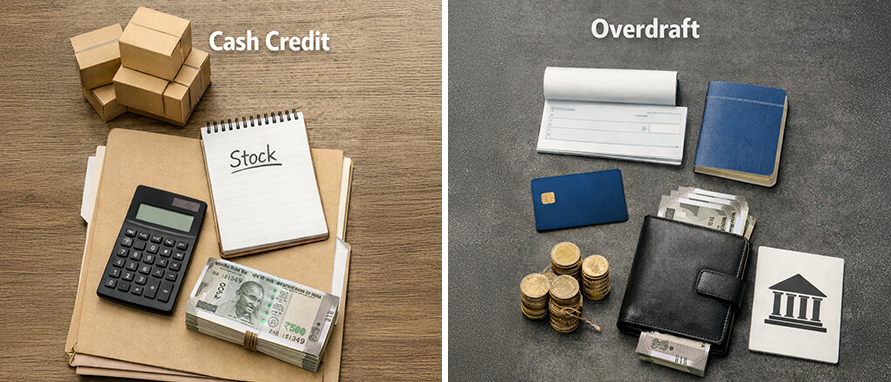
Table of Contents
Business owners and salaried individuals alike often seek quick cash to bridge financial gaps. This is often fulfilled through the modes of cash credit and overdraft facility. Both of these provide availability of extra funds to cover financial requirements. While both allow borrowing beyond the existing funds, they are designed for different circumstances and borrower profiles.
Financial marketplaces like Bajaj Markets help borrowers understand such financial products clearly and make informed decisions based on their usage patterns.
Cash credit is like a revolving line of credit tied to your business current account, sanctioned as a lump sum you draw against as needed. It allows borrowers to withdraw funds up to a pre-approved limit to meet day-to-day operational requirements such as purchasing raw materials, paying suppliers, or managing inventory cycles.
Under a cash credit loan facility, interest is charged only on the amount actually used, not on the entire sanctioned limit. The borrowing limit is usually determined based on the borrower’s stock, receivables, and overall business turnover. Since it is closely linked to business operations, banks often require collateral such as inventory, receivables, or property.
Overdraft loan comes in when your account balance dips below zero, up to a pre-approved limit, acting as a safety net rather than a dedicated facility. It is commonly offered to salaried individuals, self-employed professionals, and businesses with regular account inflows.
Overdrafts are typically linked to a current or savings account and are used to manage short-term liquidity mismatches. Interest is charged only on the overdrawn amount and for the duration it remains unpaid. Charges apply daily or monthly on the negative balance, usually higher than cash credit rates since it's more flexible. Depending on the type of overdraft, it may be secured (against fixed deposits, property, or insurance policies) or unsecured, based on the borrower’s credit profile and income stability.
It is vital to bring out the differences between cash credit vs overdraft facilities. Although both facilities offer flexible access to funds, their purpose, structure, and eligibility criteria differ significantly. The table below outlines the key differences to help borrowers clearly understand which option suits their needs better.
| Basis of Comparison | Cash Credit | Overdraft |
|---|---|---|
Primary Purpose |
Working capital for business operations |
Short-term liquidity management |
Eligible Borrowers |
Businesses, traders, MSMEs |
Individuals, professionals, businesses |
Account Type |
Separate cash credit account |
Linked to savings or current account |
Limit Determination |
Based on stock, receivables, turnover |
Based on income, account history, or collateral |
Collateral Requirement |
Usually required |
May be secured or unsecured |
Interest Calculation |
On amount utilised |
On overdrawn amount |
Usage Flexibility |
Business expenses only |
Flexible personal or business use |
Review Frequency |
Periodic review by bank |
Typically annual or ongoing |
Cash credit edges out for businesses needing reliable funds at better terms, while overdraft shines for quick personal buffers with neither being a one-size-fits-all. Understanding these differences helps borrowers avoid misuse, reduce interest costs, and maintain healthier cash flows. Assess your cash patterns and security position before choosing either of the modes. Additionally, financial marketplaces like Bajaj Markets let you compare options from top lenders hassle-free.
An overdraft allows you to withdraw more money than what is available in your bank account, up to a fixed limit, and interest is charged only on the excess amount used. Credit, in a broader sense, usually refers to loans or credit lines where funds are disbursed separately and repaid through EMIs or structured repayments. Overdrafts are more flexible and suited for short-term needs, while traditional credit products are better for planned expenses.


Most Viewed


 47202
47202

Navigate the tax maze with ease! Uncover Income Tax 101, demystify jargon with Terms for Beginners, and choose between Old or New Regimes.
 165541
Unlock the world of credit! From picking the perfect card to savvy loan management, navigate wisely.
 97881
97881
Money Management and Financial Planning covers personal finance basics, setting goals, budgeting...
 28606
28606
Explore the investment cosmos! From beginner's guides to sharp-witted strategies, explore India's treasure trove of options.
 18764
18764
Discover essential insights on various types of insurance in India.
 4584
4584
Welcome to Tech in Finance, where we explore the exciting intersection of technology and finance...












 Academy