Our Products
 Loans
Loans
 Cards
Cards
 Insurance
 Investment
 Stock Market
 Electronics Mall
 CIBIL Score
 Knowledge Centre
 Calculators
Our Services

 Do not call
 En
En
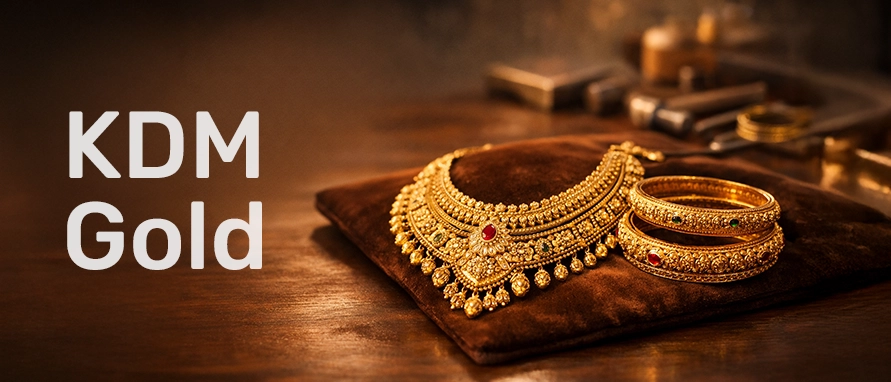
Understand what KDM gold means, the history it holds, why it was banned in India, and what safer alternatives are available today.
Earlier Cadmium was used in soldering gold jewellery to maintain 22K or 916 purity during the making process. This gold alloy is called KDM gold. It was widely accepted in the Indian market for many years. However, health concerns and updated regulations changed its usage. Knowing the in-depth detail of KDM gold helps buyers clearly identify the type and purity of gold jewellery being purchased.
KDM gold is a type of gold jewellery made using cadmium in the soldering process to join different parts of an ornament. In this method, the composition was typically around 92% gold and 8% cadmium. This gold alloy helped jewellers assemble detailed designs, including stone setting work, without affecting overall weight or finish.
The use of cadmium solder allowed a smooth bond between gold components. However, cadmium is a hazardous metal. Due to health hazard concerns and regulatory action under updated hallmarking rules, the Bureau of Indian Standards (BIS) restricted this process to ensure better safety and purity assurance for buyers in the gold jewellery market.
Before modern safety regulations, KDM gold was the preferred variant for many artisans. Its wide acceptance in the jewellery store was based on several technical advantages, such as:
Traditional gold solder (a mix of gold and copper) often lowered the overall purity of the jewellery ornament significantly below the 22K standard. KDM gold allowed for a 92% purity level, ensuring the purity assurance of the piece remained high.
The process of using cadmium as a solder was favoured because it has a much lower melting point than other alloys. This made the soldering of intricate designs easier without risking damage to the main gold alloy.
Using this specific system allowed the jeweller to create a seamless appearance. It provided the necessary strength for complex designs while maintaining the yellow shine of the gold jewelry.
For a long time, this method was the most reliable way to make high-purity 22-karat gold ornaments that met buyers’ quality expectations without using bulky or lower-quality joining materials.
The use of cadmium-soldered gold jewellery, commonly referred to as KDM gold, evolved over time as a jewellers’ technique rather than a formal hallmark standard. Early jewellery making often relied on traditional soldering alloys where copper or silver was used, but these could lower the purity when remelting the ornament. To maintain the inherent purity of high-karat gold while making intricate designs, cadmium alloys (with gold) were adopted by many workshops because cadmium’s lower melting point allowed clean joins without deforming the metal.
The Bureau of Indian Standards (BIS) first restricted KDM gold in 1999 via IS 1417 Clause 6.2, prohibiting its hallmarking. It was banned in January 2017 (per the 2016 IS 1417 revision) due to cadmium’s toxicity, which can cause lung damage and cancer from inhaled fumes. Following this, BIS mandated the use of safer zinc or silver solders, effectively ending all legal KDM gold production in India.
The prohibition of KDM is a regulatory action driven by the Central Government to ensure public safety. While it was once a standard joining alloy, the following factors led to its official ban in India:
The present status of KDM in India is shaped by updated safety regulations and mandatory hallmarking norms.
KDM gold is no longer permitted for manufacturing or sale in the organised jewellery market due to the ban on cadmium-based soldering practices.
Jewellers are required to sell only BIS hallmarked gold that meets purity standards and carries a valid HUID (Hallmark Unique Identification) number for traceability.
Buyers are now more informed about purity verification and safety standards, leading to reduced demand for cadmium-soldered jewellery.
The industry has largely transitioned to cadmium-free soldering alloys, ensuring compliance with the updated BIS norms and the improved safety norms for artisans.
The availability of KDM in present times is influenced by regulatory changes and safety standards implemented across India.
You will not find new KDM gold in the organised market today because the (BIS) has strictly banned its production and sale due to health risks.
KDM gold refers to jewelry soldered using cadmium, a toxic metal that poses serious respiratory risks to artisans and skin irritation for some wearers.
While you may still own old KDM jewelry, it is legally obsolete for new retail; any jeweler selling new KDM is likely bypassing safety norms.
Current regulations mandate that all hallmarked jewelry must be cadmium-free, replaced by safer soldering alloys like zinc or copper to ensure consumer safety and purity.
The mandatory hallmarking of gold is legally enforced under Section 14 and Section 16 of the Bureau of Indian Standards (BIS) Act, 2016. These regulations mandate that jewelers in notified districts can only sell hallmarked gold jewelry of 14, 18, 20, 22, 23, and 24 carats, verified with a unique 6-digit HUID. Gold hallmarking has been implemented in phases to ensure standardised purity verification across districts, such as:
The initiative launched in 256 districts where at least one Assaying and Hallmarking Centre (AHC) was already operational.
The government added 32 more districts to the list, bringing the total coverage to 288 districts.
An additional 55 districts were included, raising the total to 343 districts.
The mandate expanded to 18 more districts, reaching a total of 361 districts.
The most recent expansion added 12 districts, bringing the current total to 373 districts nationwide.
With KDM gold discontinued, several safer and more standardised alternatives are now available for both jewellery buyers and investors.
This is the most reliable alternative, representing 22-karat gold that uses safe, cadmium-free solders and bears the official BIS logo for guaranteed purity.
For those looking for a gold investment without the hassle of physical storage or soldering issues, digital gold offers 24K purity that is insured and easily liquidated.
These are superior financial alternatives that track the price of gold without any making charges, impurities, or the risks associated with physical KDM gold.
For diamond-studded or intricate daily-wear jewelry, 18K hallmarked gold provides much higher durability than KDM-era pieces while maintaining a standardised, transparent resale value across the country.
As cadmium is identified as hazardous, safer alternatives are now used in jewellery manufacturing.
Zinc is widely used as a replacement for cadmium in gold soldering. It provides adequate bonding strength while reducing toxic exposure during the manufacturing process.
Copper-based alloys are also used to maintain structural stability and purity consistency in gold jewellery. These alloys support compliance with hallmarking standards.
Modern solder mixtures are specifically formulated to meet safety norms while preserving the colour and strength of the jewellery piece. These compositions align with the current regulatory guidelines.
Choosing BIS hallmarked gold over KDM gold offers various benefits, which includes the following:
BIS hallmarked gold carries an official seal that certifies its purity (such as 916 for 22K), offering a reliable verification of gold content and fineness.
Unlike traditional KDM jewellery, BIS hallmarked gold does not involve cadmium in soldering, reducing health risks and ensuring compliance with modern safety norms.
Hallmarked gold typically retains higher resale value because its purity and compliance are officially recognised and documented.
The hallmark includes identifiable marks from a certified Assay centre and jeweller, helping buyers trace and verify authenticity, which is not possible with KDM pieces that are not hallmarked.
No, 916 hallmarked gold is considered better because it ensures guaranteed purity and safety for non-toxic solders, whereas KDM uses unsafe cadmium, which is now obsolete and legally banned.
KDM gold is banned because cadmium fumes are highly toxic, posing severe respiratory and kidney risks to artisans, while also failing to meet modern BIS safety and purity standards.
No, KDM gold is not considered safe. The cadmium used in the soldering process is a known carcinogen that endangers jewelers during manufacturing.
No, KDM cannot be hallmarked under the current BIS norms because official regulations strictly prohibit the use of cadmium, requiring all certified jewellery to be entirely cadmium-free for consumer safety.
You can identify KDM gold by checking for the KDM stamp on older pieces. However, since it lacks the mandatory 6-digit HUID and BIS logo, it is best verified by a jeweler.


Most Viewed

Academy by Bajaj Markets

 47202
47202

Navigate the tax maze with ease! Uncover Income Tax 101, demystify jargon with Terms for Beginners, and choose between Old or New Regimes.
 165541
Unlock the world of credit! From picking the perfect card to savvy loan management, navigate wisely.
 97880
97880
Money Management and Financial Planning covers personal finance basics, setting goals, budgeting...
 28605
28605
Explore the investment cosmos! From beginner's guides to sharp-witted strategies, explore India's treasure trove of options.
 18764
18764
Discover essential insights on various types of insurance in India.
 4584
4584
Welcome to Tech in Finance, where we explore the exciting intersection of technology and finance...












 Academy