Our Products
 Loans
Loans
 Cards
Cards
 Insurance
 Investment
 Stock Market
 Electronics Mall
 CIBIL Score
 Knowledge Centre
 Calculators
Our Services

 Do not call
 En
En
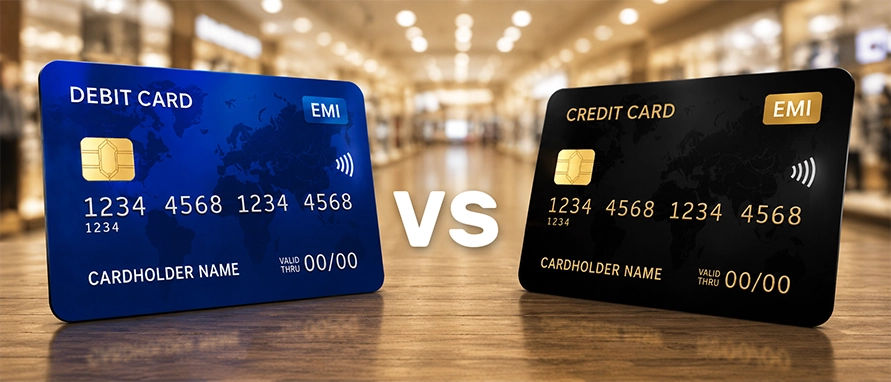
Understanding credit card EMI vs debit card EMI helps in assessing how purchases can be split into instalments using different payment sources. While both options convert transactions into monthly payments, the structure, eligibility, and repayment mechanics differ across credit card EMI and debit card EMI.
A credit card EMI allows a transaction to be converted into smaller monthly instalments, which are billed in the credit card statement. The total amount is repaid over a selected tenure.
Here’s how it typically works:
Conversion of purchase: transaction split into instalments
A purchase made using a credit card can be converted into EMI on credit card, either at the time of payment or after the transaction is completed.
Interest rates and charges: structured pricing model
Standard credit card EMI options may carry interest rates, often ranging between 12% to 24% per annum, depending on the issuer and tenure.
No-cost EMI options: selective merchant partnerships
Some merchants offer no-cost EMI, where the interest component may be adjusted through discounts rather than being charged separately.
Flexible tenure: multiple repayment durations
Repayment tenure generally ranges from 3 to 24 months, allowing adjustments based on transaction value and repayment preference.
Billing through credit statement: integrated repayment system
Each instalment appears in the monthly credit card statement, forming part of the bill due for that cycle.
This structure defines how an EMI on a credit card works within a credit-based framework.
A debit card EMI allows purchases to be converted into instalments, where repayments are directly debited from a savings account linked to the card.
To understand how EMI on debit card works, here are the key elements:
Direct account deduction: instalments from savings balance
In a debit card EMI, the instalment amount is automatically deducted from the linked savings account each month.
Pre-approved eligibility: bank-defined limits
Access to EMI on a debit card typically requires a pre-approved limit from the bank, based on account history and transaction activity.
Lower or zero interest options: simplified cost structure
Many debit card EMI options may come with low or zero interest, depending on merchant offers and bank tie-ups.
Limited merchant availability: restricted usage network
Unlike credit card EMIs, debit card EMI vs credit card EMI shows that debit EMIs are usually available only with select merchants.
Shorter tenure range: defined repayment options
Repayment periods are often shorter, commonly ranging between 3 to 12 months.
This structure highlights how an EMI on a debit card differs in terms of funding source and availability.
When comparing credit card EMI vs debit card EMI, the differences become clearer across multiple parameters. Each option functions differently in terms of funding, eligibility, and repayment.
Here is a simplified comparison:
| Basis | Credit Card EMI | Debit Card EMI |
|---|---|---|
Source of funds |
Credit line |
Savings account |
Interest rates |
May apply (or no-cost EMI) |
Often lower or zero |
Merchant availability |
Wider acceptance |
Limited to select merchants |
Eligibility |
Credit card required |
Pre-approved bank limit needed |
Tenure |
3–24 months |
Typically shorter (3–12 months) |
Credit score impact |
Reflected in credit usage |
No direct credit impact |
Credit score impact |
Reflected in credit usage |
No direct credit impact |
Rewards |
Eligible in some cases |
Usually not applicable |
To further understand this difference between credit card EMI and debit card EMI, consider:
Funding source: credit vs account balance
A credit card EMI uses a credit limit, while a debit card EMI deducts directly from available account funds over time.
Accessibility: broader vs restricted usage
In a debit card EMI vs credit card EMI scenario, credit cards offer wider merchant acceptance compared to debit-based EMI availability.
Impact on credit profile: involvement of credit systems
Using EMI on a credit card may reflect in credit utilisation, whereas EMI on a debit card typically does not involve credit reporting.
This comparison outlines the functional difference across both EMI types.
A credit card EMI brings certain features that align with credit-based spending, along with some limitations based on usage patterns.
Here are the key aspects:
Wide acceptance: availability across multiple merchants
Transactions using credit card EMI are supported across a broader merchant network, including online and offline platforms.
Flexible tenure: extended repayment timelines
Options for longer repayment durations allow larger transactions to be spread over time.
Reward integration: points or cashback eligibility
Some transactions converted into EMI on credit card may still earn reward points depending on issuer policies.
Interest applicability: added cost in standard EMI
Non–no-cost EMI transactions may include interest charges, increasing the overall payment amount.
Credit utilisation impact: usage linked to limit
Converting purchases into EMIs uses a portion of the credit limit, which may reflect in overall utilisation levels.
These factors define the usability and structure of credit card EMI.
A debit card EMI works differently as it is linked directly to the savings account, which affects both usage and flexibility.
Here’s how it is typically structured:
No credit involvement: direct account linkage
A debit card EMI does not rely on a credit line, as repayments are made directly from the savings account.
Lower cost structure: limited or zero interest offers
In many cases, EMI on a debit card may have lower interest or no-cost EMI options depending on the offer.
Simple eligibility: based on bank-defined approval
Access depends on pre-approved limits rather than credit card ownership.
Restricted availability: fewer merchant partnerships
The availability of debit card EMI is generally limited compared to credit card EMI options.
Account balance dependency: ongoing deduction requirement
Sufficient balance is needed each month to support automatic deductions under EMI on a debit card.
These points highlight how debit EMI differs in terms of structure and accessibility.
The comparison between credit card EMI vs debit card EMI depends on how each option aligns with the transaction type and repayment structure.
Here’s how they are generally positioned:
Credit card EMI: suited for larger purchases and flexibility
A credit card EMI may be relevant where higher ticket transactions and longer repayment tenure are required.
Debit card EMI: aligned with direct payment structure
A debit card EMI may be used where direct bank account deductions and limited tenure are preferred.
No-cost EMI availability: depends on merchant and issuer
Both options may offer no-cost EMI in specific scenarios, influencing the overall cost comparison.
Usage pattern difference: credit-based vs balance-based
The choice between credit card EMI vs debit card EMI is often linked to whether the transaction is funded through credit or savings.
This outlines how both EMI options differ without defining one as universally preferable.
Ans: A debit card EMI may be interest-free in certain cases where merchants offer no-cost EMI options; however, this depends on the bank, transaction value, and specific offer terms applicable at the time of purchase.
Ans: A credit card EMI can impact the credit score indirectly, as it influences credit utilisation and repayment behaviour, both of which are factors considered in calculating a borrower’s credit profile.
Ans: Not all transactions are eligible for EMI conversion on a credit card, as eligibility depends on transaction value, merchant category, and issuer-defined criteria for converting purchases into instalments
Ans: No-cost EMI removes the visible interest component by adjusting it through discounts, while regular EMI includes interest charges added to instalments over the repayment period.
Ans: The choice between credit card EMI and debit card EMI for purchasing a phone depends on factors such as available offers, repayment tenure preference, and whether the transaction is funded through credit or savings.



Academy by Bajaj Markets

 47202
47202

Navigate the tax maze with ease! Uncover Income Tax 101, demystify jargon with Terms for Beginners, and choose between Old or New Regimes.
 165541
Unlock the world of credit! From picking the perfect card to savvy loan management, navigate wisely.
 97881
97881
Money Management and Financial Planning covers personal finance basics, setting goals, budgeting...
 28606
28606
Explore the investment cosmos! From beginner's guides to sharp-witted strategies, explore India's treasure trove of options.
 18764
18764
Discover essential insights on various types of insurance in India.
 4584
4584
Welcome to Tech in Finance, where we explore the exciting intersection of technology and finance...












 Academy