Our Products
 Loans
 Cards
 Insurance
 Investment
 Stock Market
 Electronics Mall
 CIBIL Score
 Knowledge Centre
 Calculators
Our Services

 Do not call
 En
Understand gold's chemical behaviour and valency. Read our easy guide on gold's atomic number 79, its unreactive noble metal properties, and how purity affects gold loan valuation.
Gold is best known for its lustre, rarity, and value as jewellery and an investment asset but its chemical behaviour is just as fascinating. At the heart of how gold interacts with other elements lies its valency, a core chemical property that determines how gold bonds, forms compounds, and behaves in different environments. Understanding the valency of gold not only helps explain why this metal is so resistant to corrosion, but also sheds light on its uses in jewellery, electronics, and medicine. It also plays an indirect role in how gold's purity is assessed, which matters if you're evaluating gold jewellery for gold purity or considering it as collateral.
Valency is one of the foundational concepts in chemistry, helping explain how and why atoms combine with one another to form compounds. It essentially describes an atom's combining capacity of how many electrons it can gain, lose, or share during a chemical reaction. For gold, understanding valency requires looking closely at its electron configuration and how its electrons behave under different chemical conditions.
Valency refers to the combining capacity of an atom, based on the number of electrons it can lose, gain, or share while forming chemical bonds with other atoms. It's essentially a measure of how "reactive" or "combinable" an element is. Elements with a completely filled outer electron shell tend to have low or no valency, since they don't need to bond with other atoms to become stable, while elements with incomplete outer shells actively seek to bond to achieve a more stable configuration.
Valency is typically determined by examining an atom's electron configuration, specifically the arrangement of valence electrons in its outermost shell. Many elements follow the octet rule, which states that atoms tend to gain, lose, or share electrons in order to have eight electrons in their outermost shell, mimicking the stable configuration of noble gases. However, transition metals like gold don't always follow this rule neatly, since they can have multiple stable electron arrangements, resulting in more than one possible valency.
Gold has an atomic number of 79, meaning it has 79 protons and, in its neutral state, 79 electrons distributed across multiple electron shells. Its unique electron configuration, ending in a single 6s electron alongside a filled 5d shell, is what gives gold its distinctive chemical behaviour, including its characteristic valencies and its resistance to typical reactivity patterns seen in other metals. The electron arrangement also plays an important role in determining the metal’s physical and chemical properties. In addition to its atomic structure, factors such as the purity of gold influence its durability, colour, and suitability for jewellery and investment purposes.
Gold primarily exhibits two common valencies:
+1 valency, where gold loses one electron, forming what is known as the aurous state
+3 valency, where gold loses three electrons, forming what is known as the auric state
While these are the most commonly observed oxidation states, gold can occasionally display other less common valencies under specific chemical conditions, though +1 and +3 remain by far the most stable and widely studied.
The aurous state (+1) and auric state (+3) represent gold's two primary oxidation states, each with distinct chemical properties and stability levels.
Aurous state (Au⁺): Less common and generally less stable in aqueous solutions, often tending to disproportionate into metallic gold and the auric form
Auric state (Au³⁺): More commonly encountered and relatively more stable, forming the basis of many well-known gold compounds
Stability factor: The auric state's greater stability is one reason it's more frequently observed in gold chemistry and industrial applications
Despite having defined valencies, gold is remarkably unreactive compared to most other metals. This is a big part of why gold has been prized throughout history it doesn't corrode, tarnish, or degrade easily, even after centuries of exposure to air and moisture.
Gold's low reactivity comes down to its classification as a noble metal. Noble metals have a high ionization energy, meaning it takes a significant amount of energy to remove electrons from their atoms, and a relatively low electron affinity, meaning they don't readily gain electrons either. This combination makes gold highly resistant to oxidation and reaction with common elements like oxygen and water, unlike more reactive metals such as iron or copper.
While gold is largely unreactive, it does react under specific chemical conditions, revealing its valency in the process. One of the most well-known examples is its reaction with aqua regia, a highly corrosive mixture of nitric acid and hydrochloric acid, which is one of the few substances capable of dissolving gold. This reaction forms gold compounds where gold typically exhibits its +3 (auric) oxidation state. Various other gold compounds, formed under controlled laboratory or industrial conditions, similarly showcase gold's +1 and +3 oxidation states.
Gold's specific valency and resulting chemical stability make it valuable across a range of industries, each leveraging different aspects of its chemical behaviour.
| Industry | Application | Relevant Property |
|---|---|---|
Metallurgy |
Alloying with other metals for jewellery and industrial use |
Stable valency states, corrosion resistance |
Electronics |
Connectors, circuit boards, and plating |
High conductivity, resistance to oxidation |
Medicine |
Drug delivery systems, diagnostic tools, treatments |
Biocompatibility of gold compounds and nanoparticles |
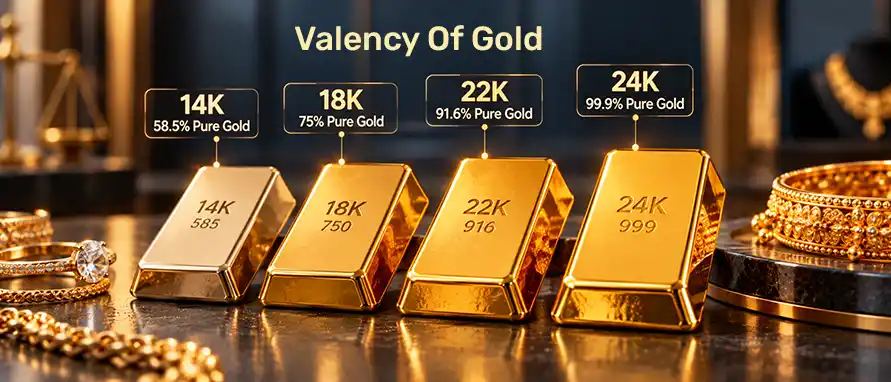
In jewellery-making, gold's chemical stability allows it to be alloyed with other metals like copper, silver, or zinc without losing its core properties. This is why gold purity is measured in carats the karat value indicates what proportion of the alloy is pure gold, with the remainder made up of other metals added primarily for durability rather than for altering gold's fundamental chemical behaviour.
Gold's excellent conductivity, combined with its resistance to corrosion, makes it a valuable material in electronics manufacturing. It's commonly used in connectors, circuitry, and plating for components that require long-term reliability, since gold doesn't oxidise or degrade the way many other conductive metals do over time.
Beyond jewellery and electronics, gold's chemical properties have found valuable applications in medicine and catalysis. Gold nanoparticles are increasingly used in targeted drug delivery systems due to their biocompatibility and ability to be functionalised for specific medical treatments. Gold compounds also serve as effective catalysts in various chemical reactions, owing to their unique electronic properties. This chemical versatility is part of why gold holds such deep importance in Indian culture valued not just for its beauty, but for the many practical roles it plays.
While valency is a chemistry concept, it has a real, practical connection to gold's role as a financial asset. Gold's chemical stability, a direct result of its valency and unreactive nature is precisely what allows it to retain its value and purity over long periods without degrading. This is why gold, unlike many other materials, can be reliably assessed, hallmarked, and valued even decades after it was first minted or crafted into jewellery.
Gold's stable chemical nature makes it a dependable form of collateral for lenders offering gold loans. Since gold doesn't corrode or lose purity over time, lenders can accurately assess its value through standard purity testing methods, offering greater transparency in the loan process. This chemical reliability is part of why gold-backed loans remain a straightforward and trusted borrowing option.
Gold most commonly exhibits two valencies: +1 (the aurous state) and +3 (the auric state). Of these, the +3 valency is more frequently observed and tends to be more chemically stable.
Gold is considered a noble metal because of its high resistance to reactivity and corrosion. Its high ionization energy and stable electron configuration mean it doesn't easily react with oxygen, moisture, or most common chemicals, allowing it to retain its lustre over time.
Gold's valency contributes to its overall chemical stability, which translates into excellent conductivity and strong resistance to oxidation. This makes gold a reliable choice for electronic connectors and circuitry that need to maintain consistent performance over long periods.
Yes, gold's oxidation state can shift between +1 and +3 depending on the surrounding chemical environment, such as during reactions with strong acids like aqua regia. However, in its natural metallic form such as in jewellery gold remains chemically stable and doesn't spontaneously change its valency. This same chemical stability is also a key factor lenders consider when assessing gold loan eligibility.
Aurous gold refers to gold in its +1 oxidation state, which is less common and less stable, while auric gold refers to gold in its +3 oxidation state, which is more frequently observed and relatively more stable in gold compounds.
Gold's valency underpins its chemical stability, which is what allows it to be alloyed with other metals without degrading over time. This stability is central to how gold purity is measured in carats, directly influencing the overall value and durability of gold jewellery.


Most Viewed

Academy by Bajaj Markets

 165542

Unlock the world of credit! From picking the perfect card to savvy loan management, navigate wisely.
 97890
Money Management and Financial Planning covers personal finance basics, setting goals, budgeting...
 28606
Explore the investment cosmos! From beginner's guides to sharp-witted strategies, explore India's treasure trove of options.
 47203
Navigate the tax maze with ease! Uncover Income Tax 101, demystify jargon with Terms for Beginners, and choose between Old or New Regimes.
 18764
Discover essential insights on various types of insurance in India.
 4584
Welcome to Tech in Finance, where we explore the exciting intersection of technology and finance...












 Academy