Our Products
 Loans
 Cards
 Insurance
 Investment
 Stock Market
 Electronics Mall
 CIBIL Score
 Knowledge Centre
 Calculators
Our Services

 Do not call
 En
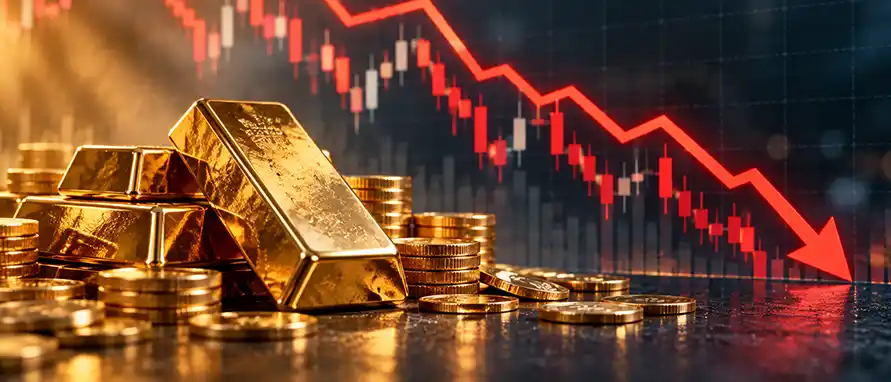
Explore the factors that could influence whether gold prices may fall, including economic conditions, global events, market trends, and changes in investor sentiment.
Gold prices move in response to a combination of global economic conditions, investor behaviour, currency movements, and domestic market factors. While gold is often viewed as a store of value during periods of uncertainty, there are situations where prices may decline. Understanding the factors that influence gold prices can help explain why market participants frequently ask whether gold will fall and what may affect future price trends.
Gold prices can decline when market conditions reduce demand for safe-haven assets or increase the attractiveness of alternative investments. Changes in interest rates, currency movements, inflation expectations, and global economic conditions can all contribute to lower gold prices.
A fall in the international gold price, a stronger US Dollar Index (DXY), reduced investment demand, or improving economic sentiment may put pressure on gold prices. Domestic factors such as changes in the USD-INR exchange rate, import costs, and local demand can also influence the gold rate today in India.
Several factors may contribute to a decline in gold prices. These influences often work together and can affect both global and domestic gold markets.
Higher Interest Rates: Rising interest rates can increase the appeal of interest-bearing investments compared to gold, which does not generate regular income.
Stronger US Dollar: Since gold is generally priced in US dollars, a stronger dollar can make gold more expensive for international buyers, potentially reducing demand.
Improving Economic Conditions: During periods of economic growth and market stability, investors may shift funds from safe-haven assets such as gold to equities and other investments.
Lower Inflation Expectations: Gold is often viewed as an inflation hedge. If inflationary pressures ease, demand for gold may decrease.
Changes in Gold Demand and Supply: Variations in jewellery demand, central bank purchases, mining output, and investment demand can affect pricing.
Reduced Geopolitical Uncertainty: Gold demand may decline if geopolitical tensions, financial market volatility, or economic uncertainty subside.
Future gold prices depend on a range of factors, including inflation trends, central bank policies, currency movements, economic growth, and investor sentiment. Because these factors can change frequently, predicting the exact direction of gold prices remains difficult.
Gold price forecasts often consider interest rate expectations, market sentiment, global economic conditions, and demand from consumers, central banks, and investors. While periods of price correction can occur, future movements depend on evolving market conditions rather than a single factor.
Gold prices tend to experience downward pressure during periods when economic confidence improves and investors seek higher-yielding assets. Certain market environments have historically been associated with lower gold prices.
Interest Rate Hiking Cycles: Gold may face pressure when central banks, including the US Federal Reserve, raise interest rates.
Strengthening US Dollar: A stronger US Dollar Index (DXY) can influence global gold demand.
Strong Equity Market Performance: Investors may allocate more funds toward equities and growth-oriented assets.
Reduced Market Uncertainty: Demand for safe-haven assets may decline during stable economic periods.
Lower Inflation Expectations: Reduced concern about inflation can lessen demand for gold as an inflation hedge.
Gold prices have historically experienced periods of decline followed by recovery. Market conditions continually evolve, and a falling trend does not necessarily indicate a permanent direction.
Several factors may contribute to a gold price recovery:
Renewed Safe-Haven Demand: Economic uncertainty and geopolitical risks can increase investor demand for gold.
Rising Inflation: Higher inflation levels may encourage investors to seek assets perceived as stores of value.
Interest Rate Changes: Expectations of lower interest rates can support gold prices.
Central Bank Buying: Increased gold purchases by central banks may contribute to market demand.
Bull Market Cycles: Gold has experienced multiple recovery phases throughout its market history.
Monitoring gold prices regularly can help individuals understand market movements and identify broader trends.
Some commonly used sources and tools include:
Indian Bullion and Jewellers Association (IBJA): Provides benchmark gold pricing references in India.
Multi Commodity Exchange (MCX): Offers gold futures pricing and trading information.
Gold Price Charts: Historical and real-time price charts can highlight short-term and long-term movements.
Market and Economic Updates: Inflation, interest rates, and currency movements frequently influence gold markets.
Jewellery and Bullion Market Trends: Demand patterns may provide additional insights into price movements.
Historical gold prices are often analysed to identify recurring patterns and market behaviour. While past performance does not determine future results, long-term trends can provide context for market movements.
Economic Crisis Periods: Gold has often gained attention during times of financial uncertainty.
Inflationary Phases: Historical periods of higher inflation have sometimes coincided with stronger gold demand.
Interest Rate Cycles: Changes in monetary policy have frequently influenced gold market performance.
Technical Analysis: Traders may use historical gold price charts, trend lines, and indicators to assess market conditions.
Market Sentiment Trends: Investor behaviour and confidence levels can affect price direction.
Gold loan amounts are generally linked to the market value of the pledged gold. As a result, changes in gold prices may influence the valuation of pledged jewellery and loan eligibility.
Impact on Gold Valuation: Lower gold prices may reduce the assessed value of pledged gold.
Loan-to-Value (LTV) Considerations: Eligible loan amounts can be affected by changes in gold valuation.
Collateral Value Changes: Fluctuations in market prices may influence the value of pledged assets.
Borrower Decisions: Changes in gold prices can affect decisions related to borrowing against gold.
Individuals considering a gold loan may review current gold prices and lender policies before applying.
A decline in gold prices may create opportunities for individuals looking to purchase gold jewellery, coins, bars, or other forms of physical gold. Lower prices can reduce acquisition costs, although future price movements remain uncertain.
Buyers often compare prevailing market rates, making charges, purity levels, and long-term requirements before making a purchase. The impact of lower prices may differ depending on whether the purchase is for personal use, gifting, or investment purposes.
A decline in gold prices can lead to several misconceptions about the market. However, short-term price movements do not always reflect broader market trends. Understanding the factors that influence gold prices can help distinguish between temporary fluctuations and long-term market developments.
Some common myths about falling gold prices include:
A fall in gold prices means the gold market is weakening: A temporary decline in prices does not necessarily indicate a long-term downturn in the gold market.
Gold prices only move upwards over time: Gold prices can experience short-term corrections even during periods of long-term growth.
Lower prices indicate a drop in demand: Gold prices are influenced by several factors, including global economic conditions, interest rates, currency movements, and investor sentiment—not demand alone.
Gold loses its safe-haven appeal when prices fall: Gold may continue to be considered a safe-haven asset during periods of economic or geopolitical uncertainty, even if prices fluctuate in the short term.
A price decline means prices will continue to fall: Short-term movements do not necessarily indicate the future direction of gold prices, as market conditions can change over time.
Gold prices may move higher or lower depending on factors such as inflation, interest rates, global economic conditions, currency movements, and investor sentiment. Future price movements cannot be predicted with certainty, as market conditions and economic developments continually evolve.
Government policies can influence gold prices through import duties, taxation, regulatory measures, and trade-related decisions. Changes affecting gold imports, Goods and Services Tax (GST), or foreign exchange markets may contribute to fluctuations in domestic gold prices.
Yes, gold prices have experienced multiple recovery phases following periods of decline. Factors such as increased investment demand, stronger safe-haven buying, higher inflation, changing interest rates, and shifts in market sentiment can contribute to a price recovery.
Yes, inflation can influence gold prices because gold is often viewed as a hedge against inflation. Rising inflation may increase demand for gold among investors seeking to preserve purchasing power, although other market factors can also affect pricing.
A stronger US dollar can place pressure on gold prices because gold is typically traded in US dollars globally. When the dollar strengthens, gold may become more expensive for international buyers, which can affect demand and pricing.
Gold prices fluctuate due to changes in international gold prices, demand and supply conditions, currency movements, inflation expectations, interest rates, geopolitical developments, and investor sentiment. Global market activity and economic data releases can also impact daily price movements.
Yes, interest rates are among the key factors influencing gold prices. Higher interest rates can increase the attractiveness of interest-bearing financial instruments, while lower rates may support demand for gold as an alternative asset.
Gold prices in India are influenced by international gold rates as well as domestic factors such as import duties, Goods and Services Tax (GST), transportation costs, local demand, and movements in the USD-INR exchange rate.


Most Viewed

Academy by Bajaj Markets

 165542

Unlock the world of credit! From picking the perfect card to savvy loan management, navigate wisely.
 97888
Money Management and Financial Planning covers personal finance basics, setting goals, budgeting...
 28606
Explore the investment cosmos! From beginner's guides to sharp-witted strategies, explore India's treasure trove of options.
 47203
Navigate the tax maze with ease! Uncover Income Tax 101, demystify jargon with Terms for Beginners, and choose between Old or New Regimes.
 18764
Discover essential insights on various types of insurance in India.
 4584
Welcome to Tech in Finance, where we explore the exciting intersection of technology and finance...












 Academy