Our Products
 Loans
Loans
 Cards
Cards
 Insurance
 Investment
 Stock Market
 Electronics Mall
 CIBIL Score
 Knowledge Centre
 Calculators
Our Services

 Do not call
 En
En
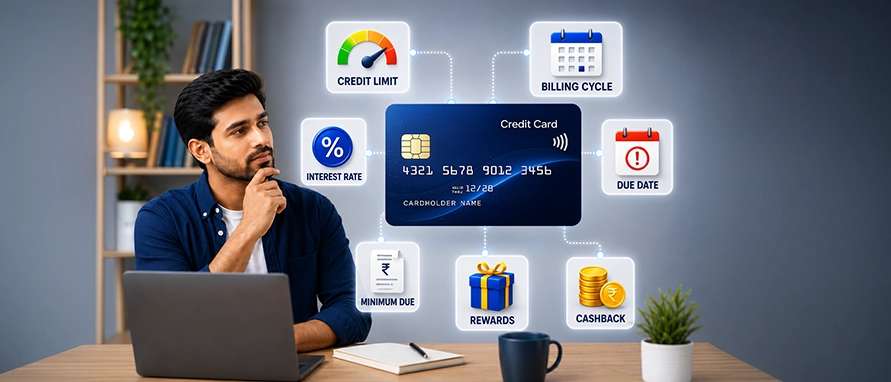
Confused by credit card jargon? This comprehensive glossary demystifies essential credit card terminology, from APR and credit limits to reward points and fees. Master the credit card lingo to make smarter financial decisions and maximise your card benefits.
Credit card terminology refers to the specialised language and jargon used by banks, financial institutions, and credit card issuers to describe the features, charges, rewards, and conditions associated with credit card accounts. This jargon landscape can be overwhelming for new users, with terms like APR, grace period, revolving credit, and cashback appearing frequently on statements and applications. Understanding credit card terms is crucial for anyone looking to use credit cards responsibly and avoid costly mistakes.
For first-time cardholders, credit card basics form the foundation of financial literacy. Without grasping these concepts, users may inadvertently incur finance charges, miss payment deadlines, or fail to maximise rewards. The terminology also impacts credit scores, as payment behaviour, credit utilisation, and account management directly influence creditworthiness. By familiarising yourself with credit card terminology, you gain the confidence to compare offers, negotiate better terms, and use your card as a powerful financial tool rather than a source of debt. This glossary covers everything from credit card basics to advanced concepts, ensuring you're equipped to navigate the complex world of credit cards with ease.
Understanding the fundamental terms on your credit card statement is essential for managing your account effectively. Below are the key credit card basics you need to know:
APR represents the annual interest rate charged on outstanding balances that aren't paid in full by the due date. It includes both the interest rate and certain fees, providing a comprehensive measure of borrowing cost. In the UK, credit card companies must legally disclose APR so you can compare different offers. The APR can vary based on your credit worthiness, with better credit scores typically securing lower rates.
Your card's maximum spending capacity. This includes your purchases, cash advances, and fees. Going over this can lead to declined transactions and over-limit fees.
Available credit is the remaining amount you can spend after accounting for current balances, pending transactions, and reserved amounts. It's calculated by subtracting your outstanding balance from your credit limit. Monitoring available credit helps you avoid hitting your limit and maintain a healthy credit utilisation ratio.
The due date is the deadline by which you must make your minimum payment to avoid late fees and penalty interest. This date is typically 21–25 days after your statement date. Setting up automatic payments or calendar reminders ensures you never miss your due date, protecting your credit score.
The absolute smallest amount you must pay to keep your account active and avoid late fees (usually 2% to 5% of your total balance).
Note: Paying only this will keep you in debt longer, as interest will still pile up on the remaining balance.
Total amount due represents the full outstanding balance on your statement, including purchases, cash advances, fees, and accrued interest. Paying the total amount due by the due date avoids finance charges and maximises your grace period benefit.
The statement date marks the end of your billing cycle. On this date, your credit card issuer generates a statement summarising all transactions, fees, and charges from the past month. Your billing cycle typically spans 30 days, and the statement date determines when your available credit resets.
Finance charges are interest fees applied to your outstanding balance when you don't pay the total amount due by the due date. They're calculated based on your APR and the average daily balance during the billing cycle. Avoiding finance charges requires paying your full balance within the grace period.
A grace period is the interest-free window between your statement date and due date, typically 21–25 days. During this time, purchases made won't accrue interest if you pay the total amount due by the due date. Grace periods apply only to purchases, not cash advances or balance transfers, which accrue interest immediately.
Credit card rewards can save you a lot of money, but only if you know how the system works. Here is a breakdown of the essential rewards terminology you need to know to maximize your returns.
The standard currency of most loyalty programs. You earn points for every rupee spent, which can later be traded for gift cards, merchandise, or statement credits. Value tip: In India, a point is typically worth between ₹0.25 and ₹1.
The most straightforward reward type. You get a direct percentage of your spending credited back to your card bill or bank account (e.g., spending ₹10,000 at a 5% cashback rate gets you ₹500 back). Just watch out for monthly caps on how much you can earn.
A travel-focused rewards currency. You earn miles on everyday purchases—and extra miles on flights—which can be redeemed for free plane tickets, cabin upgrades, or hotel stays. Miles usually offer a higher value, ranging from ₹0.50 to ₹2 each.
A massive upfront reward (points, miles, or cashback) given to new cardholders. To unlock it, you usually need to hit a specific spending target in your first 30 to 90 days (e.g., Spend ₹50,000 in your first 3 months to get 10,000 bonus points).
Specific spending areas where your card gives you accelerated rewards. For example, a card might offer "10X points" on dining and online shopping, but only "1X points" on everything else.
The fun part—exchanging your accumulated points or miles for actual rewards. Pro tip: Points often have a higher value when redeemed through the bank's dedicated travel portal rather than as direct statement cashback.
A rolling 12-month period that starts on the exact day your card was issued. This is different from a calendar year (Jan–Dec). Your card issuer uses this timeline to track your annual fee waivers, reward expirations, and complimentary airport lounge limits.
Credit card fees can significantly impact your overall cost of borrowing. Here's what you need to know:
The annual fee is the yearly charge for maintaining your credit card account. It varies by card, ranging from ₹499 for entry-level cards to ₹10,000+ for premium offerings. Many cards offer annual fee waivers if you spend a threshold amount during the anniversary year, making them effectively free with regular use.
The joining fee is a one-time charge applied when you first activate your credit card. It's typically equivalent to the annual fee and may be waived during promotional offers. Some premium cards charge higher joining fees (₹5,000–₹10,000) but offer substantial welcome bonuses to offset the cost.
Finance charges are interest fees applied to outstanding balances not paid in full by the due date. They're calculated using your APR and the average daily balance method, typically ranging from 2.5%–3.5% per month (30%–42% APR). Avoiding finance charges requires paying the total amount due within the grace period.
A cash advance fee is charged when you withdraw cash from your credit card via ATM or bank counter. It's typically 2.5%–3% of the transaction amount (minimum ₹500) plus immediate interest accrual at a higher rate than purchases. Cash advances should be avoided unless absolutely necessary due to high costs.
The over-limit fee is charged when your spending exceeds your credit limit. In the UK and many jurisdictions, this fee is only applied if you've opted into over-limit coverage. Modern cards typically decline transactions exceeding the limit rather than charging fees, but persistent over-limit behaviour may trigger penalties.
A late payment fee is charged when you fail to make the minimum amount due by the due date. Fees range from ₹500–₹1,300 depending on the outstanding balance. Late payments also trigger penalty APRs (higher interest rates) and negatively impact your credit score, making timely payments crucial.
The foreign transaction fee, also called forex markup, is charged on international transactions in foreign currencies. It's typically 2%–3.5% of the transaction amount and covers currency conversion costs. Premium cards often offer lower forex fees (1%–2%) or none at all for frequent travellers.
Beyond basic terminology, these advanced concepts help experienced users optimise their credit card strategy:
Revolving credit allows you to carry forward an outstanding balance from one month to the next while making minimum payments. Unlike charge cards requiring full payment, revolving credit offers flexibility but incurs finance charges on the remaining balance. Understanding revolving credit helps you manage cash flow while avoiding excessive interest costs.
A balance transfer involves moving an outstanding balance from one credit card to another, often to secure a lower interest rate. Many cards offer 0% APR on balance transfers for 6–18 months, enabling debt repayment without interest. However, balance transfer fees (typically 2%–3% of the transferred amount) apply, so calculate total costs before switching.
A secured credit card requires a cash deposit as collateral, which typically becomes your credit limit. Designed for individuals with poor or no credit history, secured cards help build credit through responsible usage. After 12–18 months of on-time payments, issuers may upgrade you to an unsecured card and return your deposit.
A card network (Visa, Mastercard, RuPay, American Express) facilitates transactions between merchants, banks, and cardholders. Networks determine acceptance, security protocols, and additional benefits like fraud protection. While the network doesn't set interest rates, it influences where your card is accepted globally and what perks you receive.
A complimentary add-on card is an additional card issued under your primary account for family members, typically at no extra cost. Add-on cards share your credit limit and billing cycle, with all charges appearing on your primary statement. Many premium cards offer multiple free add-ons, making them valuable for families managing household expenses together.
Card churning involves repeatedly applying for credit cards to capture welcome bonuses, then cancelling or downgrading before annual fees apply. This strategy requires excellent credit management, as frequent applications generate hard inquiries and can temporarily lower your score. Card churning is advanced and risky for those prone to overspending.
A loan against card (also called an EMI conversion or card loan) converts portions of your credit limit into a fixed-term loan with monthly EMI repayments. Interest rates are typically 12%–18% per annum, lower than standard credit card interest. This feature provides flexibility for large purchases but reduces available credit for everyday spending.
Grasping credit card terminology isn't just about avoiding confusion—it directly impacts your financial health and credit score. Understanding credit card basics helps you make informed decisions about which cards to choose, how to use them responsibly, and when to avoid costly fees.
When you comprehend terms like APR, grace period, and credit utilisation, you can strategise your spending to maximise rewards while minimising interest costs. For instance, paying the total amount due within the grace period eliminates finance charges entirely. Knowing your credit limit and available credit helps maintain a healthy credit utilisation ratio (ideally below 30%), which significantly influences your credit score.
Understanding fees and charges prevents unexpected expenses, while grasping rewards terminology ensures you don't miss opportunities to earn and redeem points effectively. Most importantly, responsible credit card usage—paying on time, staying within limits, and avoiding unnecessary debt—builds a strong credit history, opening doors to better loans, lower interest rates, and improved financial opportunities. Mastering credit card terminology empowers you to use credit cards as powerful financial tools rather than sources of debt.
APR (Annual Percentage Rate) is the annual interest rate charged on outstanding balances that aren't paid in full by the due date. It includes both the interest rate and certain fees, providing a comprehensive measure of borrowing cost. Credit card companies must legally disclose APR so you can compare different offers.
The billing date (or statement date) marks the end of your billing cycle when your statement is generated. The due date is typically 21–25 days after the billing date and is the deadline for making your minimum payment to avoid late fees and interest charges.
With revolving credit, you don't have to pay your entire bill at once. Unlike a charge card, it lets you carry a balance into the next month by paying just the minimum due. It’s highly flexible, but remember: carrying a balance means you'll pay interest on whatever is left over.
The minimum amount due is the smallest payment you must make by the due date to keep your account in good standing, typically 2–5% of your total outstanding balance plus fees and interest. Paying only the minimum avoids late fees but incurs finance charges on the remaining balance.
A grace period is the interest-free window between your statement date and due date, typically 21–25 days. During this time, purchases won't accrue interest if you pay the total amount due by the due date. Grace periods apply only to purchases, not cash advances or balance transfers.



Academy by Bajaj Markets

 47201
47201

Navigate the tax maze with ease! Uncover Income Tax 101, demystify jargon with Terms for Beginners, and choose between Old or New Regimes.
 165300
Unlock the world of credit! From picking the perfect card to savvy loan management, navigate wisely.
 97876
97876
Money Management and Financial Planning covers personal finance basics, setting goals, budgeting...
 28591
28591
Explore the investment cosmos! From beginner's guides to sharp-witted strategies, explore India's treasure trove of options.
 18763
18763
Discover essential insights on various types of insurance in India.
 4583
4583
Welcome to Tech in Finance, where we explore the exciting intersection of technology and finance...












 Academy