Our Products
 Loans
Loans
 Cards
Cards
 Insurance
 Investment
 Stock Market
 Electronics Mall
 CIBIL Score
 Knowledge Centre
 Calculators
Our Services

 Do not call
 En
En
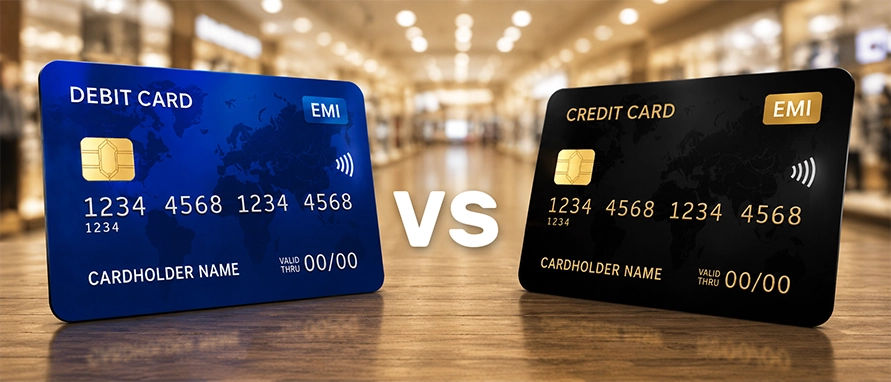
Table of Contents
Torn between debit card EMI and credit card EMI for your next big purchase? This guide breaks down how each option works, compares interest rates, eligibility, fees, and tenure, and helps you decide which EMI route suits your financial situation best.
Credit card EMI is a facility that allows you to convert a large purchase into smaller, fixed monthly instalments using your existing credit card. Instead of paying the full amount upfront, the purchase value is split across a chosen tenure typically 3 to 24 months and billed to your credit card account each month.
The key characteristic of credit card EMI is that it draws from your available credit limit. When you opt for EMI on a purchase, the total transaction amount is blocked from your credit limit, and it is gradually restored each month as you repay instalments.
Credit card EMI is widely available in India and can be availed in three ways — at the point of sale, via the bank's mobile app or net banking after a purchase, or through Easy EMI offers on e-commerce platforms such as Amazon, Flipkart, and Myntra.
Here is what makes credit card EMI worth knowing:
Credit card EMI is best suited for those who already hold a credit card with sufficient available limit and want the flexibility to spread repayment without liquidating savings.
Debit card EMI is a relatively newer facility that allows eligible bank customers to make purchases on EMI using their debit card, without needing a credit card. Unlike credit card EMI, which draws from a credit limit, debit card EMI is backed by a pre-approved loan or credit line that the bank extends based on the customer's savings account history, salary credits, and overall banking relationship.
In practice, the bank analyses your account behaviour such as average monthly balance, salary inflows, and transaction patterns — and pre-approves an EMI limit for eligible customers. When you opt for a debit card EMI at checkout, the purchase amount is disbursed from this pre-approved limit, and the EMIs are automatically debited from your linked savings or salary account each month on a fixed date.
Key things to know about debit card EMI:
Debit card EMI bridges the gap for credit-card-averse customers or those who have not yet built a credit history.
Here is a side-by-side comparison of debit card EMI vs credit card EMI across the most important dimensions:
| Dimension | Debit Card EMI | Credit Card EMI |
|---|---|---|
Eligibility |
Pre-approved by bank based on account history |
Requires an active credit card with sufficient limit |
Credit Score Required |
Generally not required (some banks may check) |
Yes — a good credit score is needed to hold a credit card |
Limit |
Based on pre-approved loan amount from the bank |
Based on available credit card limit |
Interest Rate |
12%–24% p.a. (varies by bank) |
12%–24% p.a.; Easy EMI available on select purchases |
Processing Fee |
₹199–₹1,000 (varies by bank and amount) |
₹99–₹500 or 1%–2% of transaction value |
Tenure |
3–24 months |
3–24 months |
Repayment |
Auto-debited from savings/salary account |
Added to monthly credit card bill |
CIBIL Impact |
May be reported as a loan |
Affects credit utilisation ratio |
Foreclosure |
Allowed; foreclosure charges apply |
Allowed; prepayment fee typically 1%–3% |
Easy EMI |
Rarely available |
Widely available via e-commerce platforms |
Credit card EMI requires you to already hold a credit card which itself requires a reasonable CIBIL score (typically 700 and above) and income proof. Debit card EMI, on the other hand, is extended by the bank based on your relationship with them salary credits, average balance, and account tenure making it accessible to customers without a credit card.
With credit card EMI, your spending power is capped by your available credit limit on the card. If your limit is ₹1 Lakh and you have ₹30,000 already utilised, only ₹70,000 is available for EMI conversion. With debit card EMI, the bank pre-approves a separate credit line that does not affect your savings account balance directly, though repayments are debited from it monthly.
Both options attract broadly similar interest rates ranging from 12% to 24% per annum depending on the bank, tenure, and product category. However, Easy EMI (where the interest is borne by the merchant or brand) is far more widely available on credit card EMI, particularly during festive sales on e-commerce platforms.
Both EMI types attract a one-time processing fee. For credit card EMI, this is typically ₹99 to ₹500, or a percentage of the transaction value. Debit card EMI processing fees vary by bank but are generally in the ₹199 to ₹1,000 range. Always factor this into the total cost of borrowing.
Both options offer comparable tenure flexibility — typically 3, 6, 9, 12, 18, or 24 months. Shorter tenures attract lower total interest outgo; longer tenures reduce the monthly EMI burden.
Both debit card EMI and credit card EMI allow early repayment, but foreclosure charges apply. Credit card EMI foreclosure fees are typically 1%–3% of the outstanding principal. Debit card EMI foreclosure terms vary by bank — check the fine print before committing.
Credit card EMI can be availed through three main routes, each suited to different purchase scenarios.
When making a purchase at a retail store or on an e-commerce platform, select the EMI option at checkout. You will be prompted to choose your bank, card, and preferred tenure. The total purchase amount is billed as an EMI to your credit card, and the first instalment appears on your next statement. Easy EMI options, where available, are displayed at this stage.
If you missed the EMI option at checkout, most banks allow you to convert a recent credit card transaction into EMI within 30 days of the purchase date. Log in to your bank's mobile app or net banking portal, navigate to the credit card section, select the eligible transaction, choose a tenure, and confirm. The remaining balance is then restructured into monthly instalments.
Banks and card networks frequently offer pre-approved EMI plans on selected merchant categories consumer electronics, healthcare, travel, and more. These offers appear in your bank app, via SMS, or at merchant POS terminals. Accepting one converts the purchase directly into an EMI plan without any additional documentation.
In all cases, the EMI amount is added to your monthly credit card statement. Paying the full statement amount each month (including the EMI portion) ensures no additional interest beyond the agreed EMI interest rate.
Debit card EMI operates through a pre-approved credit line that the bank sets up for eligible customers, independent of a credit card.
Step 1 — Pre-approval: The bank analyses your savings or salary account — looking at average monthly balance, salary inflows, and transaction patterns — and extends a pre-approved EMI limit. You may be notified via SMS, the bank's app, or net banking.
Step 2 — Checking your limit: Log in to your bank's mobile app or net banking and navigate to the offers or loans section. Your pre-approved debit card EMI limit and eligible tenures will be displayed.
Step 3 — Purchase at checkout: When shopping online or at select offline stores, choose the EMI option at checkout and select debit card EMI. Enter your debit card details and OTP. The purchase is processed using your pre-approved limit.
Step 4 — Monthly auto-debit: The EMI amount, inclusive of interest, is automatically debited from your linked savings or salary account on a fixed date each month for the chosen tenure.
Key points to remember:
The total cost of an EMI plan goes beyond the interest rate — processing fees, GST on fees, and foreclosure charges all add to the effective cost. Here is a bank-wise overview of indicative rates:
| Bank / Card Issuer | Interest Rate (p.a.) | Processing Fee |
|---|---|---|
HDFC Bank |
12%–18% |
₹199–₹499 |
SBI Card |
14%–20% |
₹99–₹499 |
Kotak Mahindra Bank |
14%–24% |
₹199–₹500 |
Note: Easy EMI is available on select purchases where the merchant or brand subsidises the interest. Always verify the effective rate at checkout.
| Bank | Interest Rate (p.a.) | Processing Fee |
|---|---|---|
HDFC Bank |
13%–18% |
₹299–₹999 |
SBI |
14%–18% |
₹199–₹500 |
Kotak Mahindra Bank |
15%–24% |
₹299–₹999 |
Rates are indicative and subject to change. Always confirm with your bank before availing the facility.
Choosing between the two depends on your financial profile, the purchase value, and your credit situation.
You hold an active credit card with sufficient available limits.
An Easy EMI offer is available — this is the lowest-cost borrowing option.
You want the purchase to contribute positively to your credit history (when managed well).
The product is available exclusively on credit card EMI at checkout.
You prefer a longer repayment window with minimal upfront cost.
You do not hold a credit card or your credit limit is insufficient for the purchase.
You are uncomfortable taking on credit card debt or want to avoid credit card bills.
You have been pre-approved by your bank for debit card EMI — check your bank app.
The purchase is urgent and you do not want to exhaust your credit card limit.
You are new to credit and have not yet built a CIBIL score.
The total interest and fees make the product significantly more expensive than alternatives.
You can comfortably afford to pay in full without straining your cash flow.
A personal loan or BNPL (Buy Now, Pay Later) option offers a better effective rate.
In terms of credit card EMI vs debit card EMI cost efficiency, Easy credit card EMI wins hands down when available. For those without a credit card, debit card EMI is a practical, accessible alternative.
Credit card EMI converts a purchase using your credit card's available limit into monthly instalments. Debit card EMI uses a pre-approved credit line offered by your bank, with repayments auto-debited from your savings or salary account. Credit card EMI requires a credit card; debit card EMI does not.
Not necessarily. Credit card EMI is generally better when an Easy EMI offer is available, as it reduces the effective borrowing cost to zero. Debit card EMI is a better option for those who do not hold a credit card or prefer not to use their credit limit.
Debit card EMI interest rates in India typically range from 12% to 24% per annum, depending on the bank, the loan amount, and the repayment tenure. A processing fee of ₹199 to ₹999 (plus 18% GST) also applies. Confirm rates with your bank before opting in.
Most banks do not require a minimum credit score to offer debit card EMI eligibility is primarily based on your savings or salary account history with the bank. However, some banks may run a soft credit check. Debit card EMI is generally a good option for those with a limited or no credit history.
Log in to your bank's mobile app or net banking portal and navigate to the credit card section. Most banks display EMI-eligible transactions and pre-approved EMI offers within the app. You can also check at the point of sale at partner merchants, or call your bank's credit card customer care helpline to enquire about eligibility for a specific transaction amount.


Most Viewed

Academy by Bajaj Markets

 47201
47201

Navigate the tax maze with ease! Uncover Income Tax 101, demystify jargon with Terms for Beginners, and choose between Old or New Regimes.
 165300
Unlock the world of credit! From picking the perfect card to savvy loan management, navigate wisely.
 97876
97876
Money Management and Financial Planning covers personal finance basics, setting goals, budgeting...
 28591
28591
Explore the investment cosmos! From beginner's guides to sharp-witted strategies, explore India's treasure trove of options.
 18763
18763
Discover essential insights on various types of insurance in India.
 4583
4583
Welcome to Tech in Finance, where we explore the exciting intersection of technology and finance...











 Academy