Our Products
 Loans
 Cards
 Insurance
 Investment
 Stock Market
 Electronics Mall
 CIBIL Score
 Knowledge Centre
 Calculators
Our Services

 Do not call
 En
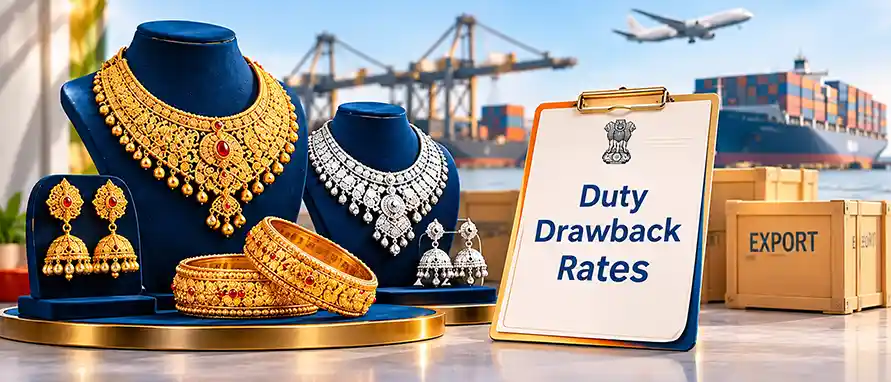
Table of Contents
The government has reduced duty drawback rates on gold and silver jewellery exports with effect from 15 October 2026 under Ministry of Finance Notification No. 85/2026-Customs (N.T.). The duty drawback rate for gold jewellery and parts thereof (tariff item 711301) has been cut by 3.1% to ₹1,794.11 per gram from ₹1,851.99, while the rate for silver jewellery and certain silver articles has been reduced by around 9% to ₹26,859.02 per kg from ₹29,501.09.
These revised duty drawback rates on jewellery exports come after the government more than doubled the rates in July 2026 to support exporter competitiveness. The latest adjustment reflects changes in gold and silver prices and the corresponding impact on import-duty calculations.
The Ministry of Finance revised the duty drawback rates for specified jewellery export categories with effect from 15 October 2026 under Notification No. 85/2026-Customs (N.T.). The current rates remain substantially higher than the levels that prevailed before the July 2026 revision:
| Product | Unit | Before July 2026 | After July 2026 Hike | From 15 Oct 2026 | Change |
|---|---|---|---|---|---|
Gold jewellery and parts (711301) |
Per gram |
₹773.17 |
₹1,851.99 |
₹1,794.11 |
-3.10% |
Silver jewellery and parts (711302) |
Per kg |
₹14,990.66 |
₹29,501.09 |
₹26,859.02 |
-8.96% |
Articles made of silver (711401) |
Per kg |
₹14,990.66 |
₹29,501.09 |
₹26,859.02 |
-8.96% |
Source: Notification No. 85/2026-Customs (N.T.), effective 15 October 2026.
Under the duty drawback scheme in India, exporters can claim a refund of customs duties paid on imported inputs used in the manufacture of export goods. For jewellery exporters, these inputs may include gold, silver, platinum, gemstones, and other materials used in producing export jewellery.
The scheme operates under Section 75 of the Customs Act, 1962 and the Customs and Central Excise Duties Drawback Rules, 2017. Under the All Industry Rate (AIR) system, drawback is prescribed as a fixed rupee amount for specific tariff items rather than as a percentage of export value.
Key points to know:
Duty drawback is intended to refund eligible duties paid on imported inputs used in exported jewellery
AIR rates are notified separately for different tariff items
The notified rate is typically expressed on a per gram or per kilogram basis for jewellery products
The drawback amount is generally calculated as: AIR × quantity exported
Exporters may be eligible to claim alternative drawback mechanisms where applicable under the Drawback Rules
The reduction in duty drawback rates in October 2026 is widely linked to changes in the duty incidence on imported gold and silver used in jewellery exports. Since All Industry Rates (AIR) are notified as fixed rupee amounts per gram or kilogram rather than as a percentage of export value, they are periodically revised to reflect changes in precious metal prices and the corresponding import duty burden. Industry reports indicate that lower duty incidence following movements in gold and silver rate led to the latest downward revision in drawback rates.
Before the October revision, the government had sharply increased drawback rates through Notification No. 64/2026-Customs (N.T.) issued on 16 July 2026. The revision followed the increase in gold import duty from 6% to 15% in May 2026 and was intended to better reflect the higher duty incidence on imported inputs used by exporters.
Key changes included:
Gold jewellery drawback rates increased from ₹773.17 per gram to ₹1,851.99 per gram in July 2026.
Silver jewellery and silver article rates increased from ₹14,990.66 per kg to ₹29,501.09 per kg.
Even after the October 2026 reduction, the gold drawback rate of ₹1,794.11 per gram remains more than twice the pre-July rate.
The current silver drawback rate of ₹26,859.02 per kg also remains substantially above the pre-July level of ₹14,990.66 per kg.
In short, the October cut reduced the July-enhanced rates but did not reverse them to their pre-July levels, leaving exporters with drawback rates that are still significantly higher than those available during the first half of 2026.
The latest jewellery export duty changes in India reduce the drawback refund available to exporters for eligible gold and silver jewellery shipments. While the revision lowers the benefit per gram or kilogram exported, its overall impact will depend on global demand, export orders, and exporters' cost structures. Silver exporters are likely to see a greater effect because the reduction in silver-related drawback rates is larger than that for gold.
Key implications include:
Lower drawback refunds per gram of gold jewellery and per kilogram of silver jewellery exported.
Potential margin pressure for exporters if the reduction cannot be offset through pricing or operational efficiencies.
Higher effective export costs due to lower reimbursement of duties on imported inputs.
Silver jewellery exporters face a larger reduction, with drawback rates reduced by nearly 9%.
The overall impact may remain manageable if international demand for Indian jewellery exports remains healthy.
Despite periodic revisions, the duty drawback mechanism remains one of the key export benefits for gold and silver jewellery manufacturers and exporters in India. By reimbursing eligible duties paid on imported inputs, the scheme helps improve export competitiveness and working capital management.
Key benefits include:
Improved cash flow through the refund of eligible duties paid on imported inputs.
Lower effective input costs for export-oriented jewellery manufacturers.
More competitive export pricing in international markets.
Support for small and medium exporters, who may be more sensitive to input costs and duty changes.
Reduced duty burden on raw materials used in the manufacture of export jewellery.
The duty drawback scheme continues to be an important component of India's jewellery export ecosystem by helping exporters recover a portion of their input-related costs.
Duty drawback is one of several measures available under the broader jewellery export incentives India framework. It helps exporters recover eligible duties paid on imported inputs used in manufacturing export products. Alongside drawback benefits, jewellery exporters may also receive support through schemes and trade facilitation measures administered by the Government of India and industry bodies such as the Gem & Jewellery Export Promotion Council (GJEPC), which serves as the export promotion council for the sector. Exporters should always refer to the latest notifications and scheme guidelines to determine eligibility and benefits.
Despite strong export potential, jewellery exporters in India continue to face a number of operational and market-related challenges. Changes in drawback rates, shifting global demand, and fluctuations in precious metal prices can all influence export competitiveness.
Key challenges include:
Global tariff and trade-policy uncertainty that can affect export demand.
Fluctuating overseas demand across key export markets.
Volatility in gold and silver prices, which impacts input costs and pricing decisions.
Supply-chain disruptions that may affect sourcing, production, or shipment schedules.
Frequent policy changes, including the July 2026 drawback hike and the October 2026 revision, which can affect cost planning and forecasting.
The duty drawback rate for gold jewellery and parts thereof (tariff item 711301) is ₹1,794.11 per gram, effective from 15 October 2026 under Notification No. 85/2026-Customs (N.T.).
The duty drawback rate for silver jewellery and parts thereof (tariff item 711302) and articles made of silver (711401) is ₹26,859.02 per kg from 15 October 2026.
The revised rates came into effect on 15 October 2026 through Notification No. 85/2026-Customs (N.T.) issued by the Ministry of Finance.
All Industry Rates (AIR) are notified as fixed rupee amounts per gram or kilogram rather than as a percentage of export value. As gold and silver prices change, along with the customs duty incidence on imported inputs, the government may revise drawback rates to better reflect the actual duty burden borne by exporters.
Eligible exporters of jewellery products covered under the drawback schedule can claim duty drawback, subject to prescribed conditions under the Customs and Central Excise Duties Drawback Rules, 2017. The claim is generally filed through the export shipping bill, and the relevant export and customs documentation must be submitted electronically through the customs system.
The latest duty drawback rates can be verified through official notifications issued by the Central Board of Indirect Taxes and Customs (CBIC) and published on the CBIC portal. Exporters should always refer to the latest government notification before calculating drawback claims.
The applicable drawback rate generally depends on the rate in force on the relevant export date under the Drawback Rules. Exporters should verify the applicable provisions and shipment dates with customs authorities or their customs advisors before filing a claim.
Yes. In certain cases, exporters may apply for a brand rate or special brand rate under the Drawback Rules if the notified All Industry Rate does not adequately compensate for the actual duties borne on imported inputs. Eligibility is subject to the conditions prescribed under the applicable rules.
Not always. The applicable drawback treatment depends on the relevant tariff classification, product description, and conditions specified in the drawback schedule. Exporters dealing in studded jewellery should review the latest schedule and customs notifications to determine the applicable rate and valuation methodology.
Duty drawback claims are generally processed electronically after export and customs verification. Once approved, the refund is credited directly to the exporter's registered bank account. The actual processing time can vary depending on documentation, verification requirements, and customs procedures.
Duty drawback and RoDTEP (Remission of Duties and Taxes on Exported Products) are separate export benefit mechanisms. Duty drawback refunds eligible duties paid on imported inputs, while RoDTEP is designed to reimburse certain embedded taxes and duties not otherwise refunded. Exporters should verify the latest scheme rules and product-wise eligibility before claiming both benefits on the same shipment.



Academy by Bajaj Markets

 0

Unlock the world of credit! From picking the perfect card to savvy loan management, navigate wisely.
 0
Money Management and Financial Planning covers personal finance basics, setting goals, budgeting...
 0
Explore the investment cosmos! From beginner's guides to sharp-witted strategies, explore India's treasure trove of options.
 0
Navigate the tax maze with ease! Uncover Income Tax 101, demystify jargon with Terms for Beginners, and choose between Old or New Regimes.
 0
Discover essential insights on various types of insurance in India.
 0
Welcome to Tech in Finance, where we explore the exciting intersection of technology and finance...












 Academy