Our Products
 Loans
 Cards
 Insurance
 Investment
 Stock Market
 Electronics Mall
 CIBIL Score
 Knowledge Centre
 Calculators
Our Services

 Do not call
 En
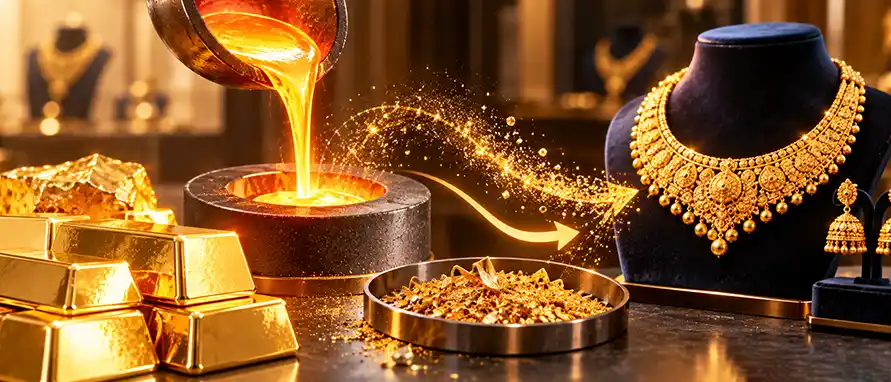
Table of Contents
Gold Wastage Explained: Calculation, Benchmark Rates, and Buyer Guide
When you buy gold jewellery, the price you pay isn't just about the weight of gold and its making charges. There's another component that often goes unnoticed until you read the fine print of your invoice: gold wastage. This charge can significantly affect the final price you pay, yet many buyers don't fully understand how it's calculated or why it exists. This guide breaks down everything you need to know about gold wastage percentage, from the jewellery making process to the final billing, so you can make informed decisions the next time you shop for gold.
Gold wastage percentage refers to the small amount of gold that is lost during the jewellery crafting process. When a jeweller shapes raw gold into intricate designs, some material is inevitably lost through melting, cutting, filing, and polishing. This loss is quantified as a percentage of the gold's original weight and is passed on to the customer as part of the final bill.
Think of it this way: if a jeweller starts with 10 grams of gold to make a piece, the finished product might weigh only 9.5 grams once all the crafting is done. The 0.5 grams that vanished during the process is the wastage, and jewellers charge for it because they've genuinely spent that material even though it doesn't end up in your final piece.
Understanding gold wastage matters because it directly impacts the extra cost you pay above the base gold rate. Without transparency around this charge, buyers can end up paying more than necessary or falling for inflated wastage percentages that don't reflect genuine crafting losses.
Here's why it's worth paying attention to:
It adds a real cost on top of the market price of gold, sometimes amounting to a significant sum depending on the design.
Wastage percentages vary widely between jewellers, so comparing across sellers helps you avoid overpaying.
Asking for transparency in billing protects you from unscrupulous practices where wastage is inflated beyond actual crafting losses.
Knowing this concept empowers you to negotiate better terms, especially for high-value purchases.
The wastage charges are calculated as a percentage of the gold's weight and added directly to the jewellery price. This means two pieces with identical gold weight but different designs can have noticeably different final prices, purely because of variation in wastage charges. For buyers, this makes it essential to check the wastage percentage before finalising a purchase, since it can meaningfully shift the total amount payable, independent of the prevailing gold rate.
Calculating gold wastage percentage is straightforward once you know the two key numbers involved: the initial weight of gold used and the final weight of the finished piece. The difference between these two figures, expressed as a percentage of the initial weight, gives you the wastage calculation.
Jewellers typically weigh the raw gold before crafting begins and then weigh the completed piece. The gap between these weights represents the material lost to melting, shaping, and polishing.
The standard formula used for this calculation is:
Wastage Percentage = [(Initial Weight − Final Weight) / Initial Weight] × 100
For example, if a jeweller starts with 20 grams of gold and the final piece weighs 18.4 grams after crafting, the gold lost is 1.6 grams. Applying the formula:
Wastage Percentage = (1.6 / 20) × 100 = 8%
This means an 8% wastage charge would be added on top of the base gold price for that piece. If you're planning to use your gold jewellery as collateral down the line, understanding how weight and purity are assessed can also help you estimate borrowing potential using a Gold Loan Eligibility Calculator.
Several factors influence how much wastage occurs during the jewellery-making process. Understanding these can help you gauge whether the wastage percentage quoted to you is reasonable.
Design complexity: intricate patterns naturally involve more material loss than simple designs.
Craftsmanship: the skill level of the artisan working on the piece affects how efficiently gold is used.
Gold purity: the karat of gold used can influence how much material is lost during shaping.
Tools and techniques: modern, precision-based methods tend to reduce wastage compared to traditional handcrafting.
Intricate designs with fine filigree work, embossing, or multiple small components typically result in higher wastage compared to simple designs like plain bangles or bands. This is because detailed work requires more cutting, filing, and polishing, all of which shave off small amounts of gold. Skilled craftsmen can minimise this loss to some extent through careful technique, but complex designs will almost always carry a higher wastage percentage than minimalist ones.
The purity of the gold used also plays a role in wastage levels. 24K gold, being nearly pure, is softer and more malleable, which can make it prone to different handling losses compared to 22K gold, which is alloyed with other metals like copper or silver for added strength. The alloy composition affects how the metal behaves during melting and shaping, which in turn influences the wastage percentage applied. If you'd like to understand how purity levels are graded and what they mean for jewellery quality, this guide on the Purity of Gold offers a detailed breakdown.
While some wastage is unavoidable, there are ways buyers and jewellers alike can work to keep it to a minimum.
Choose jewellers who employ skilled craftsmen with proven expertise in efficient gold handling.
Opt for designs that don't require excessive intricate detailing if minimising cost is a priority.
Ask jewellers whether they use advanced tools that reduce material loss during crafting.
Encourage or ask about recycling gold scraps, a practice where leftover gold particles from the crafting process are collected and reused, reducing overall waste and cost.
Maintaining your gold jewellery well after purchase also helps preserve its value over time. For more on this, see these Tips for Gold Jewelry Maintenance.
Modern jewellers increasingly rely on precision equipment to reduce wastage during manufacturing. Techniques like laser cutting allow for exact shaping with minimal material loss, while digital scales ensure accurate weighing at every stage of production. This combination of technology helps jewellers keep wastage percentages lower and more consistent, which ultimately benefits customers through fairer pricing.
Before finalising any gold jewellery purchase, always ask for a detailed jeweller's invoice that separates the cost of gold, making charges, and wastage charges individually. A transparent breakdown of costs allows you to verify that the wastage percentage applied is reasonable for the type of design you're buying.
Be cautious of jewellers who are reluctant to itemise these charges or who bundle everything into a single lump sum, as this can sometimes conceal hidden charges. Comparing invoices from a few different jewellers for similar designs can also give you a sense of what a fair wastage percentage looks like in the current market.
Normal gold wastage usually ranges from 3% to 20%, depending on the jewellery type and design complexity. Plain jewellery generally has lower wastage, while intricate pieces may have higher wastage. Learn more about the Importance of Gold Jewelry in Indian culture.
Generally, wastage charges usually do not apply to gold coins because they have standard designs. However, making charges may apply depending on the seller.
Get the gold’s purity and net weight checked by a trusted buyer to avoid unnecessary deductions. Instead of selling, you may also explore Gold Loan options.
No, jewellery-making wastage does not directly apply to gold loans. Lenders assess the gold’s purity and net weight after excluding stones and other non-gold materials.



Academy by Bajaj Markets

 47203

Navigate the tax maze with ease! Uncover Income Tax 101, demystify jargon with Terms for Beginners, and choose between Old or New Regimes.
 165541
Unlock the world of credit! From picking the perfect card to savvy loan management, navigate wisely.
 97881
Money Management and Financial Planning covers personal finance basics, setting goals, budgeting...
 28606
Explore the investment cosmos! From beginner's guides to sharp-witted strategies, explore India's treasure trove of options.
 18764
Discover essential insights on various types of insurance in India.
 4584
Welcome to Tech in Finance, where we explore the exciting intersection of technology and finance...












 Academy