Our Products
 Loans
Loans
 Cards
Cards
 Insurance
 Investment
 Stock Market
 Electronics Mall
 CIBIL Score
 Knowledge Centre
 Calculators
Our Services

 Do not call
 En
En
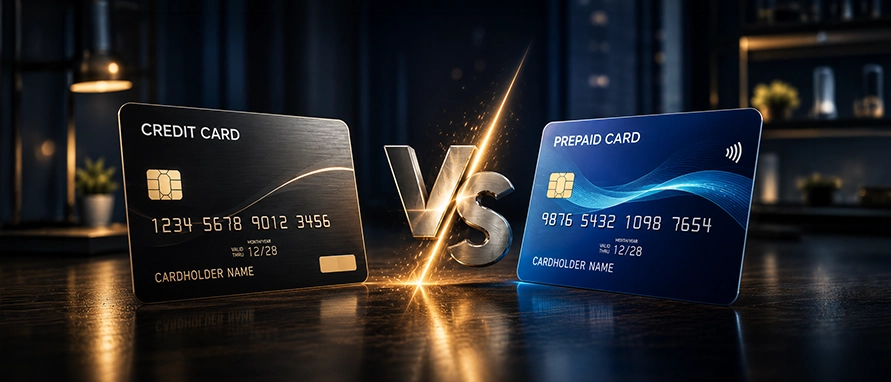
Table of Contents
Choosing between a credit card and a prepaid card depends on your financial goals, spending habits, and eligibility. This guide breaks down how each card works, the key differences, and which one suits your needs — so you can make the right choice with confidence.
A credit card is a financial instrument issued by a bank or financial institution that allows you to borrow money up to a pre-approved credit limit and make purchases on credit. When you use a credit card, you are not spending your own money and are borrowing from the card issuer, with an obligation to repay the amount later.
Every month, the bank sends you a statement summarising your transactions. You can either pay the full outstanding amount by the due date in which case no interest is charged — or pay the minimum amount due and carry the remaining balance forward. If you choose to carry a balance, the bank levies interest, typically ranging from 24% to 48% per annum in India, depending on the issuer and card type.
Credit cards are issued based on your creditworthiness — primarily your CIBIL score, income, and employment status. Most banks require a minimum monthly income of ₹15,000–₹25,000 and a CIBIL score of 700 or above for standard credit cards.
Beyond borrowing convenience, credit cards come with a range of benefits:
Under the RBI Master Direction on Credit Cards (2022), issuers must provide a Key Fact Statement (KFS) disclosing all fees before card issuance — ensuring transparency for cardholders.
A prepaid card is a payment instrument that you load with money before using it. Unlike a credit card, there is no credit facility involved — you can only spend what you have preloaded onto the card. Once the balance is exhausted, the card cannot be used until it is topped up again.
Prepaid cards are issued as Prepaid Payment Instruments (PPIs) regulated by the RBI. They are not linked to a bank account and do not require a credit check or proof of income, making them accessible to a much wider population — including students, homemakers, freelancers, and individuals without a formal credit history.
You can load funds onto a prepaid card via bank transfer, UPI, net banking, debit card, or cash at certain outlets. Under RBI guidelines, full-KYC prepaid cards can hold a maximum balance of up to ₹2 Lakhs, while minimum-KYC cards have a lower spending cap of around ₹10,000 per month.
Prepaid cards are widely used for:
Importantly, the RBI mandates that prepaid cards must be loaded using your own funds — either cash, debit card, or electronic transfer. Loading credit from a credit line onto a prepaid card is not permitted.
Understanding the credit card vs prepaid card distinction goes beyond the obvious. Here is a detailed look at how they differ across key dimensions.
A credit card lets you borrow money from the card issuer up to your approved credit limit. You spend now and repay later. A prepaid card, by contrast, uses money you have already loaded onto it — there is no borrowing involved. You spend only what you have preloaded.
Credit cards require you to meet the bank's eligibility criteria — typically a minimum income, a stable employment record, and a good CIBIL score (usually 700+). Prepaid cards have minimal eligibility requirements. Full-KYC prepaid cards require basic identity and address proof, while minimum-KYC cards can be issued with even fewer formalities. No income proof or credit score is needed.
With a credit card, the bank generates a monthly statement and you must repay at least the minimum amount due by the due date. Failure to do so attracts late fees and interest charges. A prepaid card has no monthly bill — since you spend your own preloaded funds, there is nothing to repay.
Credit cards charge interest — typically 2%–4% per month (24%–48% per annum) — on any unpaid balance carried beyond the payment due date. Prepaid cards never attract interest, as there is no credit extended and no repayment obligation.
Credit cards are significantly ahead when it comes to rewards. Most credit cards offer reward points, cashback, air miles, lounge access, fuel surcharge waivers, dining discounts, and purchase protection. Prepaid cards offer limited or no rewards, though some co-branded prepaid cards may offer minimal cashback.
Using a credit card responsibly — paying bills on time and keeping utilisation low — actively builds your credit score. Prepaid card usage has no impact on your credit score whatsoever, since no credit is extended and no repayment is reported to credit bureaus.
Prepaid cards enforce strict spending limits since you cannot spend beyond your loaded balance. Credit cards offer a higher and more flexible spending ceiling but require self-discipline to avoid overspending and debt accumulation.
Choosing between a prepaid vs credit card comes down to your financial situation, goals, and spending behaviour. Here is a practical use-case map:
The eligibility gap between a credit card and a prepaid card is significant. Here is a clear comparison:
When it comes to rewards and benefits, credit cards hold a clear and decisive advantage over prepaid cards in the credit card and prepaid card debate.
Credit Card Rewards:
Prepaid Card Rewards:
The verdict is clear: if maximising value through rewards is a priority, a credit card — used responsibly — will always outperform a prepaid card. However, for those who cannot access credit cards, prepaid cards remain a practical and safe alternative for daily spending.
A credit card lets you borrow money up to a credit limit and repay it later, often with interest. A prepaid card lets you spend only the money you have preloaded onto it — no borrowing, no repayment, and no interest involved.
It depends on your needs. A prepaid card is better for strict budget control, accessibility without income proof, and zero debt risk. A credit card is better for rewards, credit building, emergency access to funds, and purchase protection. Neither is universally superior.
No. Prepaid card transactions are not reported to credit bureaus. Using a prepaid card — no matter how frequently — has no impact on your CIBIL score or credit history.
Yes, most full-KYC prepaid cards allow cash withdrawals at ATMs, subject to daily limits and applicable ATM fees set by the issuer. Minimum-KYC prepaid cards may not support cash withdrawals.
A prepaid card is best suited for students, first-time earners, freelancers, individuals without income proof, travellers using forex cards, and anyone who wants to manage a fixed spending budget without the risk of debt.


Most Viewed

Academy by Bajaj Markets

 47201
47201

Navigate the tax maze with ease! Uncover Income Tax 101, demystify jargon with Terms for Beginners, and choose between Old or New Regimes.
 165300
Unlock the world of credit! From picking the perfect card to savvy loan management, navigate wisely.
 97872
97872
Money Management and Financial Planning covers personal finance basics, setting goals, budgeting...
 28591
28591
Explore the investment cosmos! From beginner's guides to sharp-witted strategies, explore India's treasure trove of options.
 18763
18763
Discover essential insights on various types of insurance in India.
 4583
4583
Welcome to Tech in Finance, where we explore the exciting intersection of technology and finance...












 Academy