Our Products
 Loans
Loans
 Cards
Cards
 Insurance
 Investment
 Stock Market
 Electronics Mall
 CIBIL Score
 Knowledge Centre
 Calculators
Our Services

 Do not call
 En
En
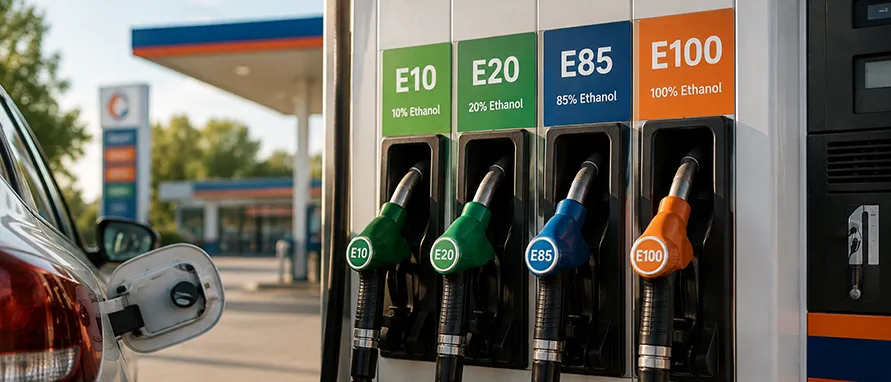
Table of Contents
As the global automotive industry shifts towards cleaner energy and lower emissions, biofuel integration has become a major priority. Ethanol-blended fuels ranging from low-ratio mixtures like E10 and E20 to high-concentration blends like E85 and pure E100 are transforming traditional transport networks.
Understanding what these fuel codes mean, how they differ in energy output, and which engines support them helps vehicle owners make informed decisions at the pump while supporting energy independence and lower carbon footprints.
Ethanol-blended fuel is a mixture of conventional unleaded petrol and bio-ethanol. Bio-ethanol is a plant-based, renewable alcohol derived from the fermentation of starch and sugar crops such as sugarcane, maize, corn, and agricultural waste biomass.
The primary goal of ethanol blending is to reduce dependence on finite fossil fuels, cut toxic tailpipe emissions, and lower crude oil import bills. Because ethanol naturally contains approximately 35% oxygen by weight, blending it into petrol promotes more complete fuel combustion inside internal combustion engines.
The letter "E" stands for Ethanol, while the accompanying number indicates the percentage volume of bio-ethanol blended into the fuel. The remaining percentage represents conventional unleaded petrol.
| Fuel Type | Bio-Ethanol Content | Petrol Content | Fuel Classification | Primary Purpose / Target |
|---|---|---|---|---|
E10 |
10% |
90% |
Standard Blend |
Mass transition fuel; universally compatible with most petrol engines built after 2000. |
E20 |
20% |
80% |
Moderate Blend |
Current mainstream national standard in India; requires material-compliant engines. |
E85 |
51% to 85% |
15% to 49% |
High-Ethanol Blend |
Designed exclusively for Flex-Fuel Vehicles; widely used in the US and Europe. |
E100 |
100% |
0% |
Pure Hydrous Biofuel |
Hydrous ethanol fuel used in dedicated flex-fuel platforms, pioneered in Brazil. |
While all four fuels serve as internal combustion fuels, their chemical compositions lead to notable differences in performance, fuel consumption, emissions, and engine requirements:
| Parameter | E10 | E20 | E85 | E100 |
|---|---|---|---|---|
Octane Rating (RON) |
-93 RON |
-95 RON |
100 to 105 RON |
-108 RON |
Energy Content (vs Petrol) |
-97% energy |
-93–95% energy |
-70–75% energy |
-65% energy |
Mileage Drop Expectation |
1% to 2% |
3% to 6% |
25% to 35% |
35% to 40% |
Exhaust Carbon Reduction |
Moderate |
|
Extremely High |
Maximum Fossil Carbon Reduction |
Engine Technology Needed |
Standard ICE |
E20 Material Compliant |
Flex-Fuel Vehicle |
Dedicated Flex-Fuel / E100 Engine |
Adopting ethanol-blended petrol provides vital strategic, economic, and environmental advantages:
Vehicle compatibility depends largely on when your car or two-wheeler was manufactured and how its fuel system was engineered:
Older cars and two-wheelers were engineered for pure petrol or E10 blends. While they can run on E20 without immediate engine breakdown, long-term exposure to E20 in unrated engines may cause faster wear on rubber fuel seals and a slight drop in mileage.
Modern production vehicles (such as BS6 Phase 2 compliant models in India) feature factory-fitted anti-corrosive fuel lines, coated fuel tanks, and re-tuned Electronic Control Units specifically built to handle E20 petrol safely.
Flex-Fuel Vehicles are equipped with ethanol sensors and adaptive engine software capable of running on any combination of petrol and ethanol, from E20 up to E85 or E100 automatically.
The "E" represents bio-ethanol, and the number denotes the percentage volume of ethanol mixed with unleaded petrol. E10 has 10% ethanol, E20 has 20%, E85 has up to 85%, and E100 is pure 100% bio-ethanol fuel.
The key differences lie in their blend ratios, energy density, and vehicle compatibility. E10 and E20 are standard commercial fuels for everyday vehicles, whereas E85 and E100 contain significantly higher ethanol concentrations meant only for Flex-Fuel Vehicles.
E10 delivers slightly better fuel mileage due to higher energy density per litre. However, E20 is environmentally cleaner, offers a higher octane rating, and reduces national crude oil imports more effectively.
All modern vehicles manufactured from April 2023 onwards (BS6 Phase 2) are certified for E20. Older vehicles can run on E20, but prolonged use in non-compliant engines may cause minor wear on rubber fuel lines over time.
E85 is used in specially engineered Flex-Fuel Vehicles. It is widely available in markets like the United States and Europe as a cheaper, high-octane, low-emission alternative to pure petrol.
No, standard petrol vehicles cannot run on E100 fuel. Using E100 in a conventional engine will cause starting failures, severe fuel system corrosion, and poor combustion. Only dedicated E100 flex-fuel engines can use pure ethanol.
Yes. Because ethanol carries less energy per litre than petrol, higher blends reduce mileage slightly around 3–6% for E20 and 25–35% for E85.
Yes, ethanol-blended fuel is completely safe when used in engines designed or certified by the manufacturer for that specific blend level.
Brazil is the global leader in E100 and flex-fuel adoption, while the United States, Canada, and parts of Europe extensively use E85. India is also expanding its flex-fuel ecosystem alongside its national E20 rollout.
E20 petrol (20% ethanol blend) is the primary commercial fuel currently available nationwide across retail stations in India.


Most Viewed

Academy by Bajaj Markets

 47202
47202

Navigate the tax maze with ease! Uncover Income Tax 101, demystify jargon with Terms for Beginners, and choose between Old or New Regimes.
 165541
Unlock the world of credit! From picking the perfect card to savvy loan management, navigate wisely.
 97881
97881
Money Management and Financial Planning covers personal finance basics, setting goals, budgeting...
 28606
28606
Explore the investment cosmos! From beginner's guides to sharp-witted strategies, explore India's treasure trove of options.
 18764
18764
Discover essential insights on various types of insurance in India.
 4584
4584
Welcome to Tech in Finance, where we explore the exciting intersection of technology and finance...












 Academy