Our Products
 Loans
Loans
 Cards
Cards
 Insurance
 Investment
 Stock Market
 Electronics Mall
 CIBIL Score
 Knowledge Centre
 Calculators
Our Services

 Do not call
 En
En
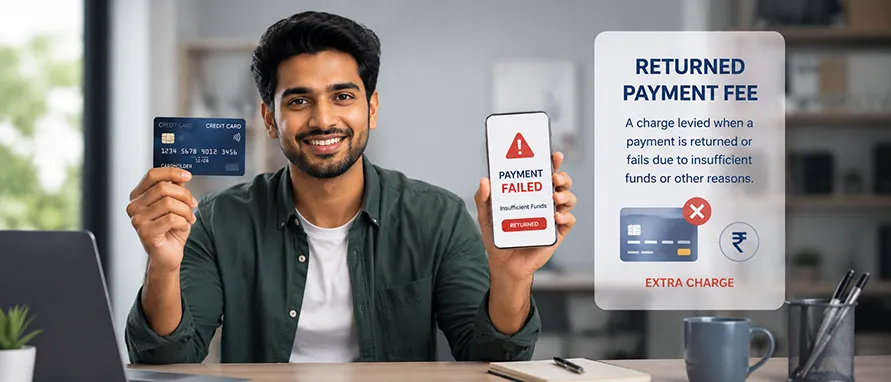
Table of Contents
A returned payment fee is charged when your credit card bill payment does not go through, usually because your bank rejects the transaction. It is fundamentally different from a late fee, where one is triggered by a failed payment attempt, while the other is charged when you miss the due date entirely. Failing to clear this transaction promptly can lead to dual penalties and extra interest charges on your outstanding balance.
Furthermore, repetitive bounced payments can negatively impact your banking relationship and raise red flags regarding your credit risk. Understanding how this fee operates is the first step toward safeguarding both your credit health and your wallet.
A returned payment fee is a penalty charged by a credit card issuer when a payment sent toward your card account is returned unpaid. This can happen when you try to pay through a bank transfer, cheque, ECS, auto-debit, or another linked payment method, but the payment fails to clear. In simple terms, the returned payment fee on a credit card is the extra charge applied because the payment could not be successfully collected.
This fee is not the same as a late payment fee. A late fee applies when you do not pay at least the minimum amount by the due date. A returned payment fee applies even when you tried to pay on time, but the transaction was rejected. That means you may face both fees in some cases if the failed payment is not fixed quickly and the minimum due remains unpaid. Credit card issuers may also label this as a returned payment fee, dishonored payment fee, or NSF (Non-Sufficient Funds) fee, depending on the bank and the payment method.
Banks and card issuers penalise failed transactions to recover administrative expenses, cover processing costs, and manage increased collection risks. While it can be frustrating to face a penalty when you actively attempt to clear your dues, the system treats any unsuccessful transaction as unpaid. Understanding the root causes can help you prevent these unexpected charges.
Here are the primary reasons why a returned payment fee is charged:
In India, the returned payment fee on a credit card usually falls in the range of ₹100 to ₹550, plus GST, depending on the bank and card type. Some lenders charge a flat amount, while others may charge a percentage of the unpaid amount subject to a minimum fee. The exact amount is always mentioned in the card’s terms and conditions, and it can vary across banks, premium cards, and payment channels.
This credit card return payment fee may be charged in addition to any late fee, finance charges, or interest if the minimum amount due is not paid by the deadline. Since banks can revise charges, the best practice is to check the fee schedule in the card agreement or your monthly statement before setting up autopay. In many cases, the fee is applied immediately after the payment is returned, and it may appear on the next billing cycle.
Avoiding a returned payment fee is entirely manageable with a little proactive planning. By taking a few preventative steps, you can ensure your credit card payments clear smoothly every month, saving you from unnecessary penalties and potential credit damage.
Here are the most effective ways to avoid a returned payment fee on your credit card:
If your payment is returned, the issuer treats it as unpaid. A returned payment fee may be added to your account, and if the minimum due remains unpaid, a late fee or interest may also follow. You should correct the payment issue quickly and make a fresh payment to avoid further charges.
In India, the returned payment fee is commonly around ₹100 to ₹550 plus GST, though the exact amount depends on the bank and card type. Some issuers use a flat fee, while others may apply different charges based on the payment method or account status. Always check the card’s fee schedule.
Yes, sometimes the bank may waive the fee, especially for a first-time mistake, a technical failure, or a situation where the error was clearly not the customer’s fault. Waiver approval is discretionary, so it depends on the issuer’s policy and your account history. A polite request through customer care often helps.
A returned payment fee itself does not directly lower your score, but the underlying missed payment can. If the failed payment leads to a missed due date or overdue balance, it may be reported and can hurt your credit profile. So the bigger risk is the unpaid bill, not just the fee.
The returned payment fee is charged when your payment attempt fails and bounces back unpaid. The late payment fee is charged when you do not pay the required amount by the due date. In some cases, both can apply if the failed payment is not fixed in time.


Most Viewed

Academy by Bajaj Markets

 47201
47201

Navigate the tax maze with ease! Uncover Income Tax 101, demystify jargon with Terms for Beginners, and choose between Old or New Regimes.
 165300
Unlock the world of credit! From picking the perfect card to savvy loan management, navigate wisely.
 97872
97872
Money Management and Financial Planning covers personal finance basics, setting goals, budgeting...
 28591
28591
Explore the investment cosmos! From beginner's guides to sharp-witted strategies, explore India's treasure trove of options.
 18763
18763
Discover essential insights on various types of insurance in India.
 4583
4583
Welcome to Tech in Finance, where we explore the exciting intersection of technology and finance...












 Academy