Our Products
 Loans
Loans
 Cards
Cards
 Insurance
 Investment
 Stock Market
 Electronics Mall
 CIBIL Score
 Knowledge Centre
 Calculators
Our Services

 Do not call
 En
En
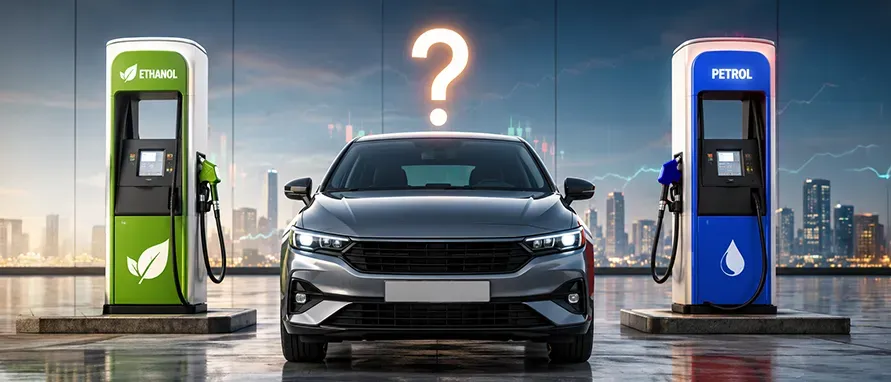
Choosing the right petrol for car ownership models today involves navigating a shifting landscape of alternative energy options. As fuel retail stations transition to include distinct environmental choices, drivers frequently face a crucial decision: ethanol fuel vs petrol. Understanding how these blends impact long-term operational health, structural efficiency, and running budgets is vital to maintaining your vehicle's peak engine lifecycle.
Ethanol fuel is a plant-derived renewable biofuel chemically classified as ethyl alcohol ($C_2H_5OH$). Unlike conventional petrol for car propulsion which is refined from finite fossil crude oil reserves through fractional distillation ethanol is produced by fermenting the natural starches and sugars found in agricultural feedstocks. Common resources include sugarcane juice, heavy molasses, corn, and organic biomass.
The fundamental difference lies in their chemical architecture: ethanol contains built-in oxygen molecules that assist the combustion process, allowing it to burn more cleanly and fully than pure unblended petrol. However, because it originates from harvested crops, its physical properties alter how energy is stored and distributed inside your combustion chamber.
To make it usable in daily transport, ethanol is blended with standard petrol at specific volumes. The "E" prefix denotes the percentage of ethanol present in the mix:
E5: Comprises 5% ethanol and 95% petrol.
E10: Comprises 10% ethanol and 90% petrol.
E20: Comprises 20% ethanol and 80% petrol, which serves as the primary commercial fuel grade across India.
E85: A high-level blend consisting of 85% ethanol and 15% petrol, strictly reserved for specialised Flex-Fuel Vehicles (FFVs).
| Feature | Conventional Petrol | Pure Ethanol Fuel (E100) |
|---|---|---|
Primary Source |
Fossil Crude Oil |
Agricultural Crops (Corn/Sugarcane) |
Chemical Formula |
Complex Liquid Hydrocarbons ($C_nH_{2n+2}$) |
Ethyl Alcohol ($C_2H_5OH$) |
Oxygen Content |
Near Zero |
~34.7% by weight |
Natural Octane Rating |
87 – 91 |
~113 |
Vaporisation Cool Down |
Standard |
Roughly twice as much as petrol |
Evaluating ethanol vs petrol reveals distinct mechanical trade-offs. While ethanol presents clear environmental and performance advantages, conventional petrol retains an edge regarding raw volumetric energy content.
The table below breaks down how these two fuels compare across the most critical parameters:
| Performance Metric | Conventional Petrol | Ethanol Blends (e.g., E20) |
|---|---|---|
Energy Density |
High (~34.2 MJ/L) |
Lower (~24 MJ/L for pure ethanol) |
Octane Rating |
Standard (87 - 91) |
High (Increases with blend level) |
Tailpipe Carbon Emissions |
Higher baseline output |
Significantly lower carbon monoxide |
Fuel Economy (Mileage) |
Baseline Standard |
~7% drop on E20; up to 30% on E85 |
Renewability |
Non-Renewable (Finite) |
100% Renewable Biofuel |
Engine Cool-Down Effect |
Baseline |
Twice as cooling when vaporised |
Petrol contains more chemical energy per litre than ethanol. Pure ethanol provides about one-third less energy than standard petrol. Because of this lower energy density, cars running on high-ethanol blends like E85 require a larger volume of fuel to cover the same driving range as unblended petrol.
Ethanol features a substantially higher natural octane rating (~113) than regular petrol (87-91). A higher octane rating allows ethanol for car applications to resist knocking (premature detonation) under pressure. This enables engines to run with higher compression ratios, delivering smoother operation and enhanced thermal efficiency.
When it comes to ethanol vs petrol emissions, biofuels burn much cleaner. Because ethanol contains built-in oxygen molecules, it promotes complete combustion inside the engine cylinders. This significantly curtails dangerous tailpipe pollutants, cutting down on carbon monoxide, hydrocarbons, and particulate matter (soot).
The financial impact of the ethanol vs petrol price dynamic is felt most in daily running costs. While ethanol blends are typically cheaper per litre at the pump due to lower production costs and tax incentives, the accompanying drop in mileage means your car consumes more fuel over time. As a result, the actual cost per kilometre often balances out to be highly competitive with regular petrol.
The primary concern when analysing ethanol vs petrol price dynamics is fuel economy. Ethanol holds a roughly 33% lower volumetric energy density than pure petrol. As a direct result, engines running on blended fuel must burn a greater volume of liquid to generate identical combustion forces.
For daily commuters, this translates to a noticeable drop in mileage. If your vehicle runs on a standard E20 blend, you can expect an approximate 7% drop in fuel efficiency compared to running on pure petrol. On high-level variations like E85, the mileage penalty can reach up to 25% to 30%. However, if an engine's architecture is explicitly optimised and strengthened for higher ethanol blends from the factory floor, the increased thermal efficiency and superior octane power can help recover some of this lost economy.
When analyzing ethanol vs petrol emissions, biofuels emerge as a significantly cleaner choice for urban air quality and global climate goals.
Traditional petrol relies on a linear carbon path, extracting fossil reserves from underground and releasing that sequestered carbon directly into the atmosphere upon combustion. Conversely, ethanol operates on a circular, closed-loop system. The crops harvested for production such as sugarcane and maize actively absorb carbon dioxide ($\text{CO}_2$) via photosynthesis while growing. This green absorption offsets a major portion of the fuel's ultimate exhaust output, giving pure ethanol an approximate 30% lower lifecycle carbon footprint compared to conventional petrol.
The physical composition of the fuel dictates what comes out of the exhaust pipe. Because ethanol contains roughly 34.7% oxygen by weight, it promotes complete combustion inside the engine cylinders.
When comparing standard E20 fuel (the 20% ethanol blend common at Indian pumps) against pure, unblended petrol, the environmental benefits are immediate:
Carbon Monoxide (CO): E20 reduces tailpipe carbon monoxide emissions by up to 50% in two-wheelers and roughly 30% in four-wheelers.
Hydrocarbons (HC): Hydrocarbon emissions drop by approximately 20% compared to pure petrol, drastically lowering the formation of urban smog.
Particulate Matter: The extra oxygen reduces the output of dark soot and fine particulate matter, leading to cleaner breathable air in congested cities.
While large-scale biofuel farming requires careful land and water management, switching from pure petrol to ethanol blends drastically cuts down toxic tailpipe emissions and greenhouse gases on a daily basis.
Before filling up with elevated ethanol concentrations, verified compatibility with your vehicle's mechanical components is vital.
In India, vehicles compliant with BS6 Phase 2 emission norms (manufactured from April 2023 onwards) feature fuel lines, injectors, and engine calibrations designed to tolerate E20 blends safely. However, running high-ethanol fuel through an older, un-optimised fuel delivery system can trigger severe internal issues.
Because ethanol is highly hygroscopic, it naturally absorbs moisture from the surrounding air. When a vehicle sits idle for an extended period, phase separation can occur—causing the fuel and water to split into separate layers inside the petrol tank. This damp mix can cause fuel water contamination, degrading engine performance. Furthermore, ethanol is corrosive to older rubber components, causing standard seals, gaskets, and flexible fuel lines to dry out, crack, and leak over time.
The core difference between e10 and e5 petrol centers on the biofuel volume concentration. E5 contains up to 5% ethanol, making it safe for almost all modern and classic petrol engines without modification. E10 increases that concentration to 10%. While any conventional car can generally run on low-level blends of E10 or less without upgrading fuel equipment, the higher moisture affinity of E10 demands closer monitoring in classic vehicles.
When breaking down the economic structure of ethanol vs petrol price figures, it helps to distinguish pump cost from real-world utility.
Price per Litre: In isolation, pure ethanol is cheaper to produce domestically than importing expensive crude oil. Consequently, the government prices E20 fuel slightly below premium, unblended alternatives to encourage adoption.
The Efficiency Offset: Because E20 incurs a ~7% mileage penalty, your engine requires more fuel to cover the same distance. If the retail pump discount on an ethanol blend does not exceed this efficiency drop, your net expenditure per kilometre may end up equal to or higher than pure petrol.
Flex-Fuel Advantage: Dedicated Flex-Fuel Vehicles can alternate dynamically between standard petrol, E85, or any intermediate blend without incurring incremental vehicle acquisition costs, making them a highly cost-effective alternative fuel option.
| Pros (Advantages) | Cons (Disadvantages) |
|---|---|
100% Renewable Resource: Formed from sustainable biomass, reducing long-term fossil fuel reliance. |
Lower Volumetric Mileage: Delivers fewer miles per gallon due to lower overall energy density. |
Higher Octane Rating: Minimizes engine knocking and provides twice the in-cylinder cooling effect. |
Corrosive Nature: Risks damaging non-optimized rubber seals and metallic fuel system components. |
Cleaner Tailpipe Profile: Produces fewer net greenhouse gases and lower carbon monoxide levels. |
Moisture Absorption: Prone to phase separation if the vehicle remains parked for long periods. |
Supports Local Agriculture: Boosts regional farming economies and cuts crude import bills. |
Infrastructure Demands: Requires dedicated, corrosion-proof storage and supply equipment. |
The ideal option depends on your vehicle's manual. E20 is a 20% ethanol blend optimized for modern, eco-conscious transport and price efficiency. IndianOil's XP95 is a premium 95-octane petrol designed to enhance performance and fuel economy in high-compression engines. If you drive an older vehicle or prioritize performance without a mileage drop, XP95 is generally preferred; for daily commutes in a compliant car, E20 offers a cleaner profile.
The prominent disadvantages include a ~7% to 30% reduction in fuel economy (depending on the blend ratio), its tendency to absorb atmospheric moisture (leading to phase separation), and its corrosive effects on older rubber fuel lines, seals, and non-treated metal fuel tanks.
Engines require heavy modification to handle high ethanol contents like E85 or E100. Because ethanol is highly corrosive and has different combustion characteristics, vehicles must feature robust fuel pumps, hardened valves, and specialized ECU mapping to manage the distinct fuel-to-air ratios safely.
E20 will not damage an engine that is factory-certified as E20-compliant (such as modern BS6 Phase 2 vehicles). However, if used continuously in older legacy cars, the solvent properties of the ethanol can dry out gaskets, degrade standard fuel systems, and cause fuel line blockages.
In terms of raw energy per volume, ethanol is less efficient, delivering roughly 33% less energy than petrol. However, from a thermal and combustion standpoint, it burns more cleanly and fully, offering twice the vaporization cooling effect to help manage high-compression engine configurations.
The primary difference between e10 and e5 petrol is the concentration of biofuel. E5 petrol consists of 5% ethanol and 95% regular petrol, while E10 contains 10% ethanol and 90% petrol. Most conventional vehicles on the road can safely handle E10 without requiring any upgrades.
Ethanol only damages engines that lack the proper structural engineering to handle it. In non-compliant powertrains, its high moisture absorption can trigger inner corrosion, and its chemical properties can eat away at non-adapted plastic and rubber fuel components.
Yes, the per-litre cost of ethanol fuel blends is typically lower at the pump than unblended premium options. However, due to the associated mileage drop, the total cost per kilometre remains closely competitive with standard petrol.



Academy by Bajaj Markets

 47201
47201

Navigate the tax maze with ease! Uncover Income Tax 101, demystify jargon with Terms for Beginners, and choose between Old or New Regimes.
 165300
Unlock the world of credit! From picking the perfect card to savvy loan management, navigate wisely.
 97872
97872
Money Management and Financial Planning covers personal finance basics, setting goals, budgeting...
 28591
28591
Explore the investment cosmos! From beginner's guides to sharp-witted strategies, explore India's treasure trove of options.
 18763
18763
Discover essential insights on various types of insurance in India.
 4583
4583
Welcome to Tech in Finance, where we explore the exciting intersection of technology and finance...












 Academy