Our Products
 Loans
Loans
 Cards
Cards
 Insurance
 Investment
 Stock Market
 Electronics Mall
 CIBIL Score
 Knowledge Centre
 Calculators
Our Services

 Do not call
 En
En
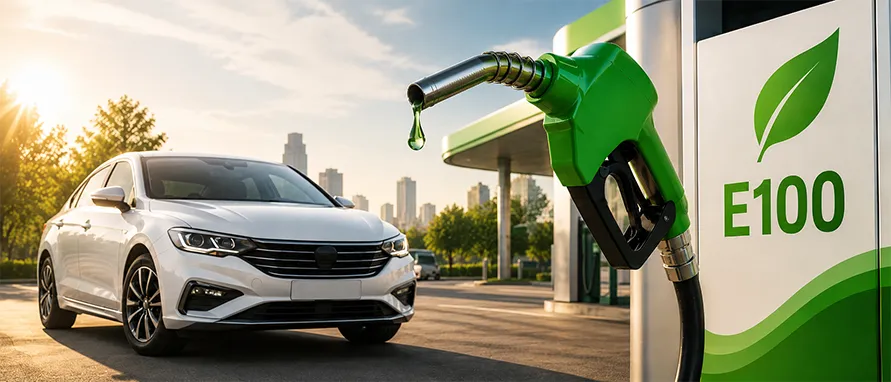
As India accelerates its transition toward cleaner mobility, what is e100 fuel has become a central question for motorists and automakers alike. Simply put, e100 fuel refers to a high-ethanol fuel blend that is composed almost entirely of ethanol. Specifically, E100 typically contains around 93% to 93.5% anhydrous e100 ethanol, with the remaining 5% to 7% consisting of petrol and co-solvent additives included for performance stability, safety, and denaturing purposes.
This composition makes it vastly different from E85, which contains 85% ethanol and 15% petrol, as well as mainstream E20 fuel, which contains only 20% ethanol. Formally approved by the Indian government in June 2026 under regulations signed by Union Minister Nitin Gadkari, E100 is legally authorised as a commercial transport option. However, it is not a drop-in replacement for standard petrol. E100 is strictly designated for specially engineered Flex-Fuel Vehicles (FFVs) capable of adapting to pure ethanol combustion.
To understand how e100 gas fits into India's long-term energy strategy, it is helpful to contrast it with existing choices like E20 and E85 across key parameters.
The primary distinction lies in the ethanol-to-petrol ratio. While E20 keeps petrol as the primary base, E100 effectively eliminates dependency on fossil fuels by treating anhydrous ethanol as the core fuel source.
Standard petrol engines can comfortably handle E20 without modification. However, transitioning to E85 or e100 petrol demands comprehensive hardware updates, including corrosion-resistant fuel lines, modified injectors, and unique Engine Control Unit (ECU) calibrations to safely map the fuel's chemical properties.
| Parameter | E20 Fuel | E85 Fuel | E100 Fuel |
|---|---|---|---|
Ethanol % |
20% |
85% |
~93% - 95% |
Petrol % |
80% |
15% |
~5% - 7% (plus additives) |
Vehicle Compatibility |
Most modern standard petrol cars |
Dedicated Flex-Fuel Vehicles (FFVs) |
Only specially calibrated FFVs |
Availability |
Nationwide across India |
Nascent / Select pilot stations |
Highly limited / Initial retail rollout |
Price |
Standard retail market price |
Lower than E20 (Approx. ₹20 less per litre) |
Expected cheapest per litre |
Mileage |
Standard/Baseline |
~20-25% reduction vs petrol |
~25-30% reduction vs petrol |
Emissions |
Moderately reduced CO2 |
Significantly lower tailpipe emissions |
Near-zero tailpipe greenhouse gases |
The production of e100 ethanol fuel relies entirely on domestic agricultural feedstocks rather than subterranean oil reserves. It begins with organic materials rich in sugar or starch, such as sugarcane juice, heavy molasses, corn (maize), damaged food grains, and agricultural waste.
Fermentation: The raw sugars from sugarcane or starches converted from corn are mixed with yeast, transforming the organic sugars into liquid ethanol.
Distillation: This fermented mixture undergoes distillation to separate the ethanol from the water and solid mass, yielding a solution that is roughly 95% pure alcohol.
Dehydration: To create e fuel 100, the remaining water must be entirely stripped away. The liquid goes through a molecular sieve dehydration process, yielding anhydrous ethanol with a purity level of 99.5% or higher.
Denaturing and Blending: Before it leaves the refinery, small amounts of petrol, co-solvents, and denaturants are added to ensure chemical stability, improve safety, and render the alcohol completely unfit for human consumption.
The short answer is no—unless you own a factory-built Flex-Fuel Vehicle (FFV). Standard petrol cars and older E20-compliant vehicles cannot use E100 fuel under any circumstances.
Because ethanol has a highly corrosive nature, using high concentrations in a standard vehicle will quickly degrade rubber seals, fuel lines, and metallic engine components. To safely run on E100, a vehicle's entire powertrain must be re-engineered:
The Fuel System: Must feature advanced, ethanol-resistant stainless steel or specialised plastic fuel lines, heavy-duty fuel pumps, and modified fuel injectors.
The Engine and ECU: The engine requires robust valves and valve seats to handle the unique combustion temperatures. Simultaneously, the ECU must be programmed with automated sensors that detect the exact ethanol-to-petrol ratio in real time, adjusting fuel injection and spark timing instantaneously.
Furthermore, pure ethanol presents prominent cold-start challenges. Ethanol does not vaporise as easily as petrol at low temperatures. If ambient temperatures drop below approximately 15°C, an E100 engine requires a petrol-assist mechanism or dual-fuel injection sequence to fire up reliably.
The formalised framework for E100 fuel unlocks extensive economic and ecological opportunities:
Near-Zero Tailpipe Emissions: Pure ethanol burns far cleaner than conventional fossil fuels. It dramatically reduces particulate matter, carbon monoxide, and net tailpipe carbon dioxide ($\text{CO}_2$), directly combating urban air pollution.
Energy Independence: India currently imports nearly 85% to 87% of its crude oil requirements, costing the national economy approximately ₹22 lakh crore annually. Scaling up domestic E100 production directly lowers this heavy import bill.
Fully Renewable: Unlike finite fossil fuels, ethanol is a renewable biofuel that can be replenished continuously through seasonal agricultural cycles.
Massive Support for the Agricultural Sector: The demand for feedstocks like sugarcane and maize provides a highly lucrative, stable secondary income streams for Indian farmers, channeling wealth directly back into rural economies.
Higher Octane Rating: Ethanol naturally features a higher octane rating than standard petrol or E85. This enables higher engine compression ratios, allowing automakers to design smaller, high-performance engines with superior thermal efficiency.
Biofuel Policy Alignment: The legalisation of E100 aligns perfectly with India's National Policy on Biofuels, accelerating the timeline for absolute self-reliance in energy production.
Despite the immense benefits, widespread E100 implementation faces critical hurdles:
Lower Energy Density (Mileage Drop): Ethanol contains about 30% less energy per unit volume than petrol. Consequently, drivers will experience a ~25% to 30% drop in mileage, meaning more frequent refuelling stops.
Cold-Start Issues: In colder regions or during winter months where temperatures drop below 15°C, pure ethanol struggles to vaporise, causing noticeable ignition delays without secondary petrol-assist infrastructure.
High Water Footprint: Cultivating the crops required for ethanol production demands massive amounts of water. Refining a single litre of sugarcane-derived ethanol can consume up to 2,800 litres of water, raising long-term environmental sustainability concerns.
Nascent Vehicle Ecosystem: Mass-market availability remains limited. While manufacturers like Maruti Suzuki (with the flex-fuel WagonR), Toyota, MG, Hyundai, and Hero MotoCorp are rapidly prepping models, the choice for consumers is initially narrow.
Logistical Infrastructure Gap: Transitioning a nationwide network requires dedicated transport tankers and storage tanks that prevent moisture absorption, creating a bottleneck at standard retail fuel pumps.
At present, there is no widespread, fixed commercial retail e100 price across all fuel stations in India, as the network is undergoing its initial phased expansion. However, pricing structures can be deduced from related segments. For instance, E85 fuel has been rolled out in select regions like Delhi at roughly ₹82.12 per litre, making it significantly more affordable at the pump than standard petrol.
When E100 hits full commercial standardisation, the price per litre is projected to be even lower than E85 and regular petrol due to government tax exemptions and direct domestic sourcing. However, consumers must factor in the "real cost per kilometre." Because E100 results in a 25% to 30% reduction in vehicle mileage, the lower price per litre at the pump will be partially offset by the fact that the vehicle will burn through the fuel faster.
India's readiness for an E100 future is a mix of policy triumph and ongoing infrastructural development. On the regulatory front, the country is fully prepared; the government finalised and approved the official E100 guidelines in June 2026, creating a clear legal pathway for testing agencies, fuel suppliers, and manufacturers.
However, the physical infrastructure is still in its nascent stages. While IndianOil originally seeded E100 across 183 pilot retail outlets across states like Maharashtra, Karnataka, Uttar Pradesh, Tamil Nadu, and Delhi, the vast majority of fuel pumps nationwide are not yet equipped with the specialised storage systems needed to keep ethanol free from moisture contamination. The automotive ecosystem is answering the call quickly, with major brands deploying prototypes and mass-market flex-fuel variants. Ultimately, while India has successfully laid the legal and automotive foundation, scaling the storage, refining capacity, and pump availability to a national level remains a gradual roadmap that will unfold over the coming years.
E100 denotes a high-ethanol fuel blend consisting almost entirely of ethanol. In the Indian context, it represents a mixture of roughly 93% to 95% pure anhydrous ethanol combined with a small percentage of petrol and stabilising additives for safety and combustion performance.
The primary difference is the chemical ratio of ethanol to petrol. E85 contains 85% ethanol and 15% conventional petrol. E100 maximises the renewable component, pushing ethanol volume up to 93-95% and leaving only a minimal fraction of petrol and additives for engine safety.
No. IndianOil's XP95 is a premium, 95-octane high-performance regular petrol. While standard regular petrol across India is moving towards an E20 (20% ethanol) blend, premium high-octane fuels like XP95 follow separate formulation standards focused on performance tuning rather than maximum ethanol blending.
A standard car cannot run on E100. Using E100 in a conventional petrol engine will result in severe engine misfires, fuel system corrosion, and long-term mechanical failure. Only vehicles explicitly built or modified as Flex-Fuel Vehicles (FFVs) with ethanol-compatible components and specialised ECUs can run on E100.
Yes, but availability is currently highly localised. Following the government's official regulatory approval in June 2026, E100 is available at an initial network of select IndianOil retail outlets across states like Delhi, Maharashtra, Uttar Pradesh, Tamil Nadu, and Karnataka, with a broader rollout planned as infrastructure expands.



Academy by Bajaj Markets

 47201
47201

Navigate the tax maze with ease! Uncover Income Tax 101, demystify jargon with Terms for Beginners, and choose between Old or New Regimes.
 165300
Unlock the world of credit! From picking the perfect card to savvy loan management, navigate wisely.
 97876
97876
Money Management and Financial Planning covers personal finance basics, setting goals, budgeting...
 28591
28591
Explore the investment cosmos! From beginner's guides to sharp-witted strategies, explore India's treasure trove of options.
 18763
18763
Discover essential insights on various types of insurance in India.
 4583
4583
Welcome to Tech in Finance, where we explore the exciting intersection of technology and finance...












 Academy