Our Products
 Loans
Loans
 Cards
Cards
 Insurance
 Investment
 Stock Market
 Electronics Mall
 CIBIL Score
 Knowledge Centre
 Calculators
Our Services

 Do not call
 En
En
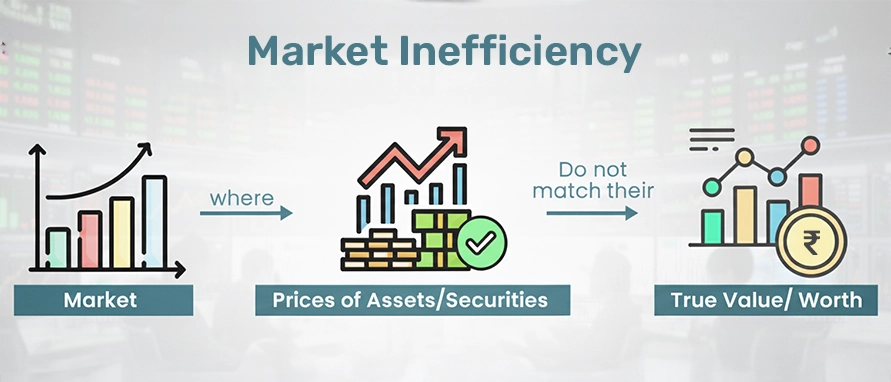
Markets are expected to reflect all available information in asset prices, but in reality, they often fail to do so. Such situations are called market inefficiencies, and they create opportunities as well as risks for traders and investors.
Market inefficiency occurs when asset prices fail to fully reflect all available information, leading to securities being mispriced. In such cases, the market price of a stock, bond, or other asset deviates from its intrinsic value. For example, if a company’s true worth is estimated at ₹500 per share but it trades at ₹650 due to hype, the market is inefficient. These inefficiencies challenge the Efficient Market Hypothesis (EMH), which assumes that markets always price assets correctly.
An inefficient market is one where investors do not have equal access to information, or where emotions and behavioural biases distort pricing. Factors like speculation, herd behaviour, and panic selling can push prices away from fundamental values. For instance, during financial bubbles, stock prices may rise far beyond what earnings support, while in crashes, panic can drive prices below fair value. Inefficient markets often create opportunities for traders to exploit mispricings, though such opportunities may be temporary.
There are three main types of market efficiency. Weak-form efficiency suggests that current prices reflect all past trading data, making technical analysis ineffective. Semi-strong form efficiency states that prices incorporate all publicly available information, so neither technical nor fundamental analysis can consistently outperform the market. Strong-form efficiency claims that prices reflect all information—public and private—implying that even insider knowledge cannot give an advantage.
Several reasons can cause markets to become inefficient:
Information Asymmetry: Some investors have more or faster access to data.
Behavioural Biases: Overconfidence, fear, or herd mentality distort decision-making.
Speculation and Hype: Excessive optimism drives valuations away from reality.
Regulatory Gaps: Weak oversight may allow manipulation or unfair practices.
Liquidity Constraints: Thinly traded securities often show price distortions.
In trading, inefficiencies can create both risks and opportunities:
Arbitrage Opportunities: Traders profit by exploiting price differences across markets.
Mispricing of Assets: Stocks may temporarily trade at values above or below fair worth.
Speculative Trading: Short-term inefficiencies can allow quick gains.
Higher Risk: Mispriced assets may suddenly correct, leading to losses.
Example: If a stock’s intrinsic value is ₹300 but it trades at ₹420 due to speculative demand, traders may short-sell it, expecting a correction. Conversely, if it falls to ₹250 during panic selling, value investors may see an opportunity to buy.
Real-world cases highlight how markets can become inefficient:
| Scenario | Description | Impact |
|---|---|---|
Dot-com Bubble (2000) |
Tech stocks soared without earnings support. |
Prices far exceeded intrinsic values before crashing. |
2008 Financial Crisis |
Mispricing of mortgage-backed securities. |
Triggered a global financial meltdown. |
Emerging Markets |
Limited transparency and liquidity in some regions. |
Stocks often trade at valuations detached from fundamentals. |
These examples show how speculation, lack of transparency, or systemic risks can distort asset pricing.
Markets typically become inefficient under the following conditions:
Information Delays: Prices do not adjust quickly to new data.
Speculative Activity: Excess hype or panic leads to price swings.
Low Liquidity: Illiquid stocks often show larger price gaps.
External Shocks: Economic crises, policy changes, or geopolitical events.
Weak Regulation: Poor oversight can enable manipulation and insider trading.
| Basis | Efficient Market | Inefficient Market |
|---|---|---|
Pricing |
Reflects all available information. |
Deviates from intrinsic value. |
Investor Access |
Equal access to data. |
Unequal or delayed access. |
Arbitrage |
Rare opportunities. |
Frequent opportunities. |
Risk |
Prices move logically with news. |
Prices may move irrationally. |
Example |
Developed equity markets. |
Speculative bubbles or illiquid stocks. |
Assumes all investors act rationally.
Ignores behavioural biases and speculation.
Overlooks market manipulation and insider trading.
Fails during crises when markets behave irrationally.
Not applicable in illiquid or emerging markets.
Market inefficiency occurs when securities trade at prices that diverge from their intrinsic values due to speculation, incomplete information, or behavioural biases. For example, if a stock’s fair value is estimated at ₹400 but it trades at ₹600 because of hype, the market is inefficient. While inefficiencies create trading opportunities, they also carry higher risks of correction. Understanding the balance between efficiency and inefficiency helps investors make sense of real-world market dynamics.
This content is for informational purposes only and the same should not be construed as investment advice. Bajaj Finserv Direct Limited shall not be liable or responsible for any investment decision that you may take based on this content.
An efficient market reflects all available information in asset prices, while an inefficient market shows deviations due to delays, biases, or mispricing.
Efficient markets reflect information quickly but not always perfectly, whereas perfect markets assume flawless information flow and no transaction costs.
The dot-com bubble is a classic case, where tech stocks traded far above intrinsic value before prices crashed.
Inefficiencies may last minutes in highly liquid markets or extend for years in less transparent or speculative environments.
.jpeg)












 Academy


.jpeg "image not found")