Our Products
 Loans
Loans
 Cards
Cards
 Insurance
 Investment
 Stock Market
 Electronics Mall
 CIBIL Score
 Knowledge Centre
 Calculators
Our Services

 Do not call
 En
En
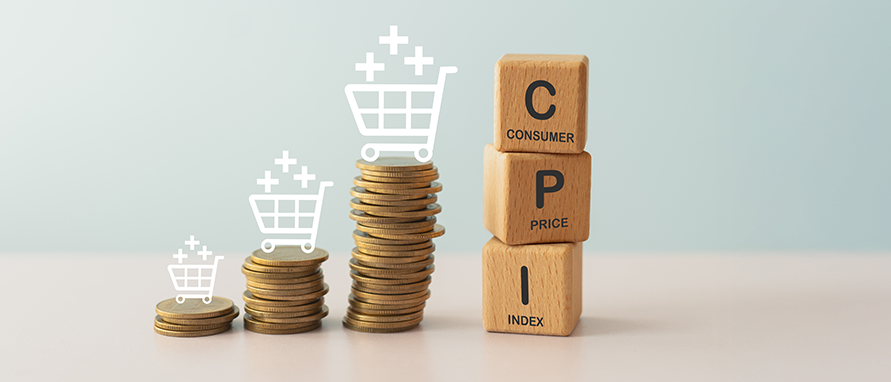
Discover the Consumer Price Index to understand how CPI tracks inflation by measuring price changes in everyday goods and services.
The Consumer Price Index (CPI) is one of the most widely used economic indicators for measuring inflation and understanding changes in the cost of living. Governments, policymakers, analysts, and investors rely on CPI to evaluate price trends, adjust wages, and assess purchasing power. This article explains the meaning of CPI, its formula, calculation process, examples, factors influencing it, and its relevance in India.
The Consumer Price Index (CPI) measures the average change in the prices of a representative basket of goods and services consumed by households over a specific period. It tracks how much consumers are paying for items such as food, fuel, housing, healthcare, clothing, and transportation.
In simpler terms, CPI tells us:
How expensive everyday life has become
Whether the general price level is rising or falling
How purchasing power changes over time
Because it reflects changes in household expenses, CPI is the key metric used to calculate inflation.
CPI plays an important role in economic planning and financial decision-making. Its importance includes:
Measuring inflation: CPI is the most widely used inflation indicator.
Adjusting salaries and pensions: Governments revise DA (Dearness Allowance) and pensions based on CPI.
Policy decisions: RBI uses CPI-based inflation to set interest rates.
Cost of living adjustments (COLA): Helps adjust wages to maintain purchasing power.
Indexation: Bonds, contracts and tax slabs often use CPI for indexation.
Because CPI directly impacts household budgets, it is one of the most closely watched indicators in economics.
In India, CPI is calculated and published monthly by the Ministry of Statistics and Programme Implementation (MoSPI). India publishes four major CPI indices:
CPI (Rural)
CPI (Urban)
CPI (Combined)
CPI for Industrial Workers (CPI-IW)
The Reserve Bank of India (RBI) uses the CPI (Combined) as the official benchmark for setting monetary policy under the inflation-targeting framework. The CPI basket includes categories such as food & beverages, housing, clothing, fuel, and miscellaneous services.
The general formula for CPI is:
CPI = (Cost of Basket in Current Year ÷ Cost of Basket in Base Year) × 100
Where:
Basket = set of goods and services commonly consumed
Base year = reference year with CPI = 100
Current year = the year for which CPI is being calculated
This formula shows the percentage change in the price level relative to the base year.
Here’s the step-by-step process:
Select a base year (e.g., 2012).
Identify a representative basket of goods and services.
Assign weights to each item based on consumption patterns.
Record the prices of each item in both base and current year.
Calculate cost of the basket for both years.
Apply the CPI formula to compute the index.
Let’s assume a simple basket of three items:
| Item | Quantity | Base Year Price (₹) | Current Year Price (₹) |
|---|---|---|---|
Rice |
10 kg |
40 |
50 |
Milk |
10 litres |
40 |
50 |
Vegetables |
5 kg |
20 |
25 |
Cost in Base Year:
= (10×40) + (10×40) + (5×20)
= 400 + 400 + 100
= ₹900
Cost in Current Year:
= (10×50) + (10×50) + (5×25)
= 500 + 500 + 125
= ₹1,125
CPI = (1,125 ÷ 900) × 100 = 125
This means prices have risen 25% compared to the base year.
A simplified CPI sample table:
| Year | CPI Index | Annual Inflation |
|---|---|---|
2020 |
100 |
— |
2021 |
105 |
5% |
2022 |
112 |
6.7% |
2023 |
118 |
5.4% |
This illustrates how CPI changes year-to-year, influencing inflation numbers.
Major factors influencing CPI include:
Changes in income and consumption patterns
Supply chain disruptions
Import prices and exchange rate fluctuations
Seasonal variations (esp. food items)
Government taxes and subsidies
Fuel price movements
Global commodity price changes
Common types of CPI:
CPI (Urban)
CPI (Rural)
CPI (Combined)
CPI-IW (Industrial Workers)
CPI-AL (Agricultural Labourers)
CPI-RL (Rural Labourers)
Each index tracks a different population group's cost of living.
Despite being widely used, CPI has some limitations:
Substitution bias—people switch to cheaper goods when prices rise.
Quality changes may distort price comparisons.
Limited ability to measure new goods added to the market.
Basket weights may get outdated unless revised periodically.
CPI may not fully represent individual household experiences.
The Consumer Price Index plays a central role in tracking how prices change and how inflation affects everyday spending. It helps policymakers, businesses, and households in making informed financial decisions. Although CPI has certain limitations, it remains one of the most commonly used measures for assessing cost-of-living trends and overall economic conditions.
Main Highlights:
Tracks inflation by measuring changes in the cost of a fixed basket of goods and services
Influences monetary policy, fiscal decisions, wages, and social benefits
Is used by businesses when analysing pricing, budgeting, and planning trends
Must be interpreted with caution due to sampling limits and substitution bias
Remains a foundational indicator of economic health and consumer purchasing power
This content is for informational purposes only and the same should not be construed as investment advice. Bajaj Finserv Direct Limited shall not be liable or responsible for any investment decision that you may take based on this content.
The Consumer Price Index represents a measure that tracks how the average prices of a selected basket of goods and services change over time for households, offering insight into variations in consumer-related costs.
CPI is calculated by taking the cost of a defined basket of goods and services in the current period and comparing it with the cost of the same basket in a designated base year, resulting in a measure of price movement.
The formula for Consumer Price Index is expressed as the cost of the current year’s basket divided by the cost of the base year’s basket, multiplied by 100, producing a numerical value that reflects price changes.
The Consumer Price Index in India is released each month by the Ministry of Statistics and Programme Implementation, and the value reflects the most recent assessment of retail price movements across the economy.
The Consumer Price Index holds importance because it indicates inflation trends, supports wage and income adjustments, and contributes to policy assessments carried out by authorities responsible for economic management.
The difference between CPI and WPI lies in the prices they track, as CPI focuses on retail consumer-level prices of goods and services, whereas WPI monitors price movements at the wholesale level.
The Consumer Price Index in India is published by the Ministry of Statistics and Programme Implementation, which compiles and reports the data every month.
CPI is calculated on a monthly basis, reflecting regular updates on changes in the prices of goods and services commonly purchased by households.
CPI serves as an inflation indicator because it reflects changes in the retail prices paid by consumers, making it the official measure of inflation adopted for economic evaluation in India.
.jpeg)












 Academy


.jpeg "image not found")