Our Products
 Loans
Loans
 Cards
Cards
 Insurance
 Investment
 Stock Market
 Electronics Mall
 CIBIL Score
 Knowledge Centre
 Calculators
Our Services

 Do not call
 En
En
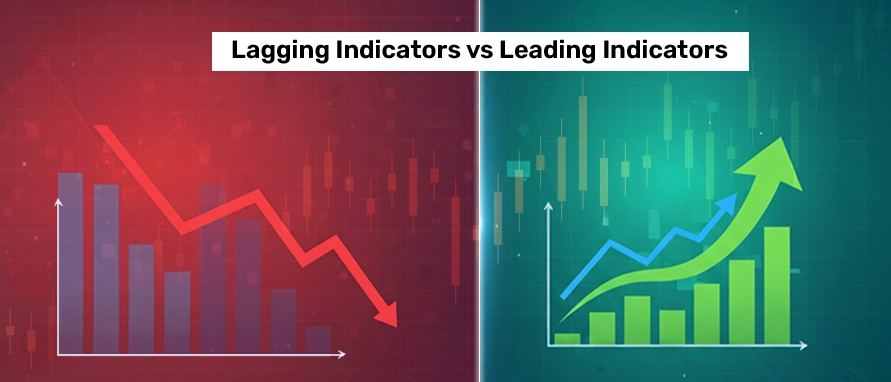
In Indian markets, traders often mix up leading and lagging indicators. One predicts future moves. The other confirms past trends. Understanding the difference clarifies how traders use indicators for timing and trend analysis.
Leading indicators help forecast future price movements. They’re used to time entries before trends begin.
Lagging indicators confirm trends after they’ve started. They’re more reliable but slower.
In India, traders use both types across equities, forex, and commodities.
Platforms like Avatrade, CMC Markets, and TastyFX offer these tools.
Statsig and BSCDesigner.com also support indicator-based analysis.
Understanding leading vs lagging indicators helps Indian traders avoid false signals and improve decision-making.
| Feature | Leading Indicators | Lagging Indicators |
|---|---|---|
Purpose |
Predict future moves |
Confirm existing trends |
Timing |
Early |
Delayed |
Reliability |
Less reliable |
More reliable |
Use Case |
Entry timing |
Trend confirmation |
Key points:
Leading indicators are proactive.
Lagging indicators are reactive.
Leading helps with timing.
Lagging helps with confirmation.
Analysts often note that combining both types of indicators can provide a more balanced analysis.
Leading indicators help forecast price direction. They’re useful for spotting early trend changes.
Popular examples in India:
RSI: Used widely on NSE stocks.
Stochastic Oscillator: Tracks momentum shifts.
CCI: Common in intraday setups.
Fibonacci Levels: Popular among Bank Nifty traders.
Platforms like CMC Markets and Avatrade offer these tools.
They are often applied in short-term trading setups or for early entry signals.
Lagging indicators confirm trends after they begin. They’re more reliable but slower.
Common examples in Indian trading:
Moving Averages: Used in swing trading.
MACD: Popular for trend confirmation.
ADX: Measures trend strength.
Bollinger Bands: Used in volatility setups.
These tools are available on CMC Markets and mentioned on Wikipedia.
They’re ideal for confirming signals and avoiding false entries.
Leading indicators are typically applied when:
Timing entries
Spotting reversals
Anticipating market moves
Use lagging indicators when:
Confirming trends
Reducing false signals
Holding positions longer
Indian traders often combine both.
Blueberry Markets and ForexStatsig suggest using leading for entry and lagging for confirmation.
This improves accuracy and reduces risk.
Think of indicators like safety tools:
Leading indicators are like weather forecasts. They warn ahead but may be wrong.
Lagging indicators are like damage reports. They show what already happened.
Neither is foolproof.
Leading vs lagging indicators safety depends on how they’re used.
Sources like Urbint.com and BMC highlight that combining multiple tools may enhance situational awareness. In the context of Indian markets, leading indicators are often used to track possible price movements early, while lagging indicators tend to help assess trend confirmation.
The way indicators are applied—individually or together—can influence how patterns are interpreted. Understanding their roles may support more informed observation rather than relying on any single signal.
Leading indicators are often used to anticipate potential market moves, while lagging indicators are typically used to confirm existing trends. In Indian trading contexts, both types are commonly observed. Some traders refer to a mix of predictive and confirmatory indicators to form their strategies, aiming to improve timing and assess trend strength more effectively
This content is for informational purposes only and the same should not be construed as investment advice. Bajaj Finserv Direct Limited shall not be liable or responsible for any investment decision that you may take based on this content.
RSI, CCI, and Stochastic are leading. MACD, ADX, and Moving Averages are lagging.
Leading gives early signals. Lagging confirms them. Together, they improve accuracy.
Lagging indicators are generally considered more reliable as they confirm established trends, though they may react more slowly.
They fail in sideways markets or during false breakouts.
Sometimes. They confirm trends after they start, missing early moves.
Yes. RSI can predict reversals and confirm trend strength.
Yes. MACD reacts to price changes and confirms trends.
Based on strategy, timeframe, and market conditions.
Yes. Use stop-loss, confirmations, and diversify tools for safer trades.
.jpeg)












 Academy


.jpeg "image not found")