Market Insights: Trends, Analysis & Expert Views
250 Views
| 1min read
Posted on 03 Jun
Roshani Ballal
Personal Loan Based on Your Needs
Personal Loan for Wedding Personal Loan for Travel Personal Loan for Medical Emergency ₹1 Lakh Personal Loan ₹50,000 Personal Loan Personal Loan for EmergencyBusiness Loan Details
Compare Business Loan Interest Rates Business Loan EMI Calculator Business Loan Eligibility Business Loan Documents RequiredBusiness Loans Based on Your Needs
Business Loan for Startups Business Loan for Women Machinery Loan ₹5 Lakh Business Loan ₹50 Lakh Business LoanHome Loan Based on Your Needs
Home Construction Loan Home Renovation Loan ₹50 Lakh Home Loan EMI Home Loan on ₹40,000 Salary Home Loan for Women Home Loan for Bank EmployeesPopular Home Loan Balance Transfer Options
Bajaj Housing Finance Home Loan Balance Transfer PNB Housing Finance Home Loan Balance Transfer LIC Housing Finance Home Loan Balance Transfer ICICI Bank Home Loan Balance Transfer L&T Finance Home Loan Balance Transfer Sammaan Capital Home Loan Balance TransferHome Loan Balance Transfer Overview
Home Loan Balance Transfer EMI Calculator Documents Required for Home Loan Balance TransferLoans for Studying Abroad
Education Loan for UK Education Loan for Australia Education Loan for SingaporePopular Two Wheeler Loans
Bajaj Auto Credit Two Wheeler Loan Muthoot Capital Two Wheeler Loan L&T Finance Two Wheeler LoanUsed Car Loan Overview
Used Car Loan Eligibility Criteria Used Car Loan Interest Rates Used Car Loan EMI Calculator Used Car Loan StatusPopular Used Car Loan
Bajaj Finance Used Car LoanLoan Against Property Based on Your Needs
Commercial Property Loan Mortgage Loan Loan Against Property To Start Business ₹40 Lakh Loan Against PropertyPopular Loan Against Property Balance Transfer Options
Bajaj Housing Finance Loan Against Property Balance Transfer ICICI Bank Loan Against Property Balance Transfer L&T Finance Loan Against Property Balance Transfer LIC Housing Finance Loan Against Property Balance Transfer PNB Housing Finance Loan Against Property Balance Transfer Sammaan Finserve Loan Against Property Balance TransferCard Usage & Benefits
How to Use EMI Card Where EMI Card is Accepted Pay EMI Online Insta EMI Card OffersUnderstanding an EMI Card
What is EMI Card? Features & Benefits EMI Card Charges & Fees EMI Card FAQs EMI Card Vs Credit CardThings You Need to Know
Credit Card Login Credit Card Statement Credit Card Interest Rates Credit Card Payment Credit Card Charges Credit Card Limit Credit Card Reward Points Credit Card OffersEligibility & Application Process
Credit Card Eligibility Documents Required for Credit Card Credit Card Application StatusExplore Health Insurance
Individual Health Insurance Top Up Health Insurance Health Insurance Renewal Critical Illness Insurance Preventive Health Check Up Family Health InsurancePopular Health Insurance Plans
Niva Bupa Health Insurance Tata AIG Health Insurance Care Health InsuranceHealth Plans by Coverage Amount
₹1 Lakh Health Insurance Plan ₹3 Lakh Health Insurance Plan ₹5 Lakh Health Insurance Plan ₹50 Lakh Health Insurance PlanMonthly Interest Rate on Fixed Deposit
₹1 Lakh Fixed Deposit ₹3 Lakh Fixed Deposit ₹6 Lakh Fixed Deposit ₹8 Lakh Fixed Deposit ₹10 Lakh Fixed DepositDemat Account Overview
How to open a demat account Documents Required for Demat Account Eligibility criteria for Demat AccountTypes of Demat Account
Basic Service Demat Account Repatriable Demat Account Non Repatriable Demat AccountAccount Holder Types
Corporate Demat Account Joint Demat Account Minor Demat Account NRI Demat AccountStock Market Sectors
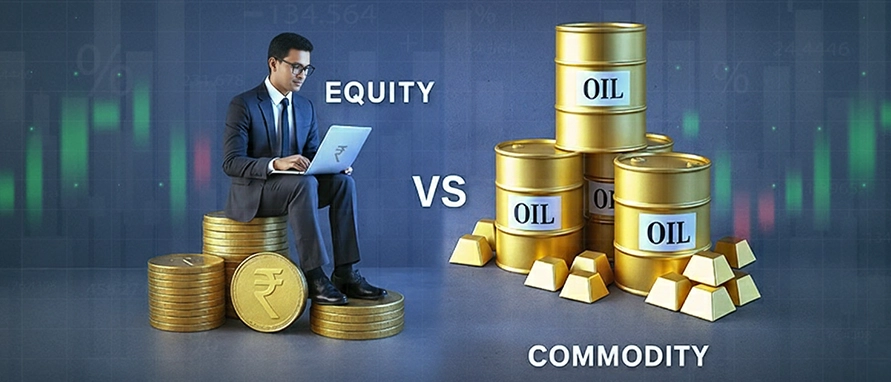
All Sectors Banking Sector Finance Sector Infrastructure Sector Health Care SectorEquity and commodities are two distinct investment classes, each serving different purposes in a portfolio. Equity represents ownership in a company, while commodities represent tangible goods or raw materials traded on markets. Understanding the differences between them helps investors align their decisions with financial goals and risk appetite.
Equity refers to ownership in a company. When you buy shares, you become a part owner and may benefit from dividends and price appreciation. Equity investing is typically suited for long-term growth. Market fluctuations are influenced by company earnings, macroeconomic trends, and investor sentiment.
Ownership stake in a business
Potential returns through capital appreciation and dividends
Traded on stock exchanges like NSE or BSE
Governed by regulations ensuring transparency
A commodity is a basic, fungible good—such as oil, gold, or wheat—representing raw materials or primary agricultural products. Commodities are commonly traded via futures contracts or ETFs rather than through physical possession. Traders often use commodities for short-term speculation or to hedge against inflation and economic uncertainty.
Represents physical goods, not companies
Traded on exchanges like MCX using derivatives such as futures
Influenced strongly by supply and demand dynamics
Can act as a hedge against inflation or currency fluctuation
Here’s a quick comparison to highlight the key distinctions:
| Feature | Equity | Commodity |
|---|---|---|
Ownership |
Owns a part of a company |
No ownership—exposure to raw materials |
Investment Focus |
Long-term growth, fundamentals |
Shorter-term price movement, hedging |
Income Potential |
Dividends and capital gains |
Price fluctuations; no dividends |
Volatility & Risk |
Moderate to high, depending on the company |
Typically higher volatility than large-cap equities |
Market Drivers |
Earnings, economy, management |
Supply, demand, weather, geopolitics |
Trading Instruments |
Stocks, mutual funds, ETFs |
Futures, ETFs, ETNs, commodity funds |
Regulatory Structure |
Regulated by stock authorities |
Regulated by commodity exchanges |
Equities are typically chosen for long-term wealth building. They offer ownership, income potential, and often lower volatility compared to commodities.
Commodities are preferred by traders seeking portfolio diversification, inflation protection, or speculative gains—though they carry higher short-term risk and require close market monitoring.
Equities and commodities serve different roles in investment strategy: equities for growth and ownership, commodities for diversification and hedging. A balanced portfolio may include both, depending on personal goals, risk tolerance, and investment timeframe.
This content is for informational purposes only and the same should not be construed as investment advice. Bajaj Finserv Direct Limited shall not be liable or responsible for any investment decision that you may take based on this content.
The main difference between equity and commodity investing is that equities represent ownership in a company and may provide dividend income, while commodities involve trading physical goods like gold, oil, or agricultural products without ownership of any business.
Equity investing is commonly used for long-term wealth creation due to potential capital appreciation and dividends.
Commodities such as gold, silver, and crude oil can serve as a hedge since they often retain or increase in value during inflation or economic downturns, providing portfolio stability.
Equities can generate regular income in the form of dividends, which are periodic payments made by companies to their shareholders from profits.
Commodities are generally more volatile than equities because their prices can change sharply due to factors like geopolitical events, weather conditions, and fluctuations in global supply and demand.
With a Postgraduate degree in Global Financial Markets from the Bombay Stock Exchange Institute, Nupur has over 8 years of experience in the financial markets, specializing in investments, stock market operations, and project management. She has contributed to process improvements, cross-functional initiatives & content development across investment products. She bridges investment strategy with execution, blending content insight, operational efficiency, and collaborative execution to deliver impactful outcomes.
250 Views
| 1min read
Posted on 03 Jun
Roshani Ballal
Unlock the world of credit! From picking the perfect card to savvy loan management, navigate wisely.
Money Management and Financial Planning covers personal finance basics, setting goals, budgeting...
Explore the investment cosmos! From beginner's guides to sharp-witted strategies, explore India's treasure trove of options.
Navigate the tax maze with ease! Uncover Income Tax 101, demystify jargon with Terms for Beginners, and choose between Old or New Regimes.
Discover essential insights on various types of insurance in India.
Welcome to Tech in Finance, where we explore the exciting intersection of technology and finance...