Our Products
 Loans
Loans
 Cards
Cards
 Insurance
 Investment
 Stock Market
 Electronics Mall
 CIBIL Score
 Knowledge Centre
 Calculators
Our Services

 Do not call
 En
En
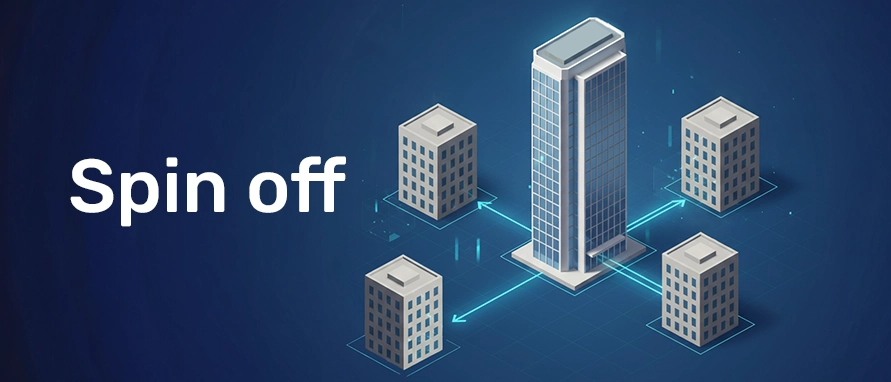
Discover how a spin-off works to learn why companies separate business units into independent, publicly traded entities.
A spin-off is a major corporate restructuring strategy where a company creates a new, independent entity by separating part of its operations, assets, or business divisions. Spin offs are widely used in global and Indian markets to unlock value, improve operational focus, and create more efficient business structures. For shareholders, they often result in receiving shares of the newly formed company while still holding shares of the parent company.
Understanding how spin offs work helps investors evaluate future potential, risk, and the value created through such restructuring.
A spin-off is a corporate action in which a company separates a portion of its business to form a new, independent company, and distributes shares of this new entity to existing shareholders on a pro-rata basis. The parent company does not receive cash for the transfer; instead, shareholders gain ownership in both companies.
Spin-offs usually occur when a business segment requires a different growth strategy, management style, or operational focus from the parent entity. They help both entities operate more efficiently and unlock independent market valuations.
In the stock market context, a spin-off refers to the creation and listing of a new company on the stock exchange by separating it from an existing listed parent company. Shareholders get shares of the spun-off entity without paying anything extra.
For example, if a shareholder holds 100 shares of Company A and Company A spins off Company B in a 1:2 ratio, the shareholder will receive 50 shares of Company B.
Although often confused, these terms refer to different forms of corporate restructuring:
Spin Off – Shareholders receive shares of the new company for free, in proportion to their existing holdings.
Split Off – Shareholders must exchange shares of the parent company to receive shares of the new company.
Carve Out – The company sells a portion of the business to the public through an IPO, creating a new entity while the parent retains majority control.
These differences impact shareholder ownership, dilution, and control.
Companies choose spin offs for several strategic reasons:
To increase focus on core business operations
To unlock hidden value through separate market valuation
To improve management efficiency in distinct divisions
To reduce operational complexity
To address regulatory or compliance pressures
To separate high-risk or non-core businesses
To attract investors with different risk or growth preferences
A spin off typically follows these key steps:
Identification of a division or unit suitable for separation
Transfer of assets, liabilities, business operations, and employees to the new entity
Regulatory filings and approval processes
Allotment of new company shares to existing shareholders
Listing of the spun-off entity on the stock exchange
Independent operation with its own management and strategy
This process creates two separate listed companies operating independently.
Some well-known Indian market spin offs include:
Wipro spinning off Wipro Enterprises to separate consumer care and infrastructure businesses
Demerger of Adani Enterprises’ businesses such as Adani Ports, Adani Power, and Adani Green
ITC spinning off its hotels business into ITC Hotels (ongoing process)
L&T Infotech and Mindtree merger after demerger processes within the L&T Group
These spin offs helped the businesses gain independent valuations and strategic flexibility.
Spin offs can significantly affect shareholder portfolios:
Shareholders gain additional shares without extra investment
Both companies may achieve more accurate valuations
The market may reward value unlocking with price appreciation
Shareholders can choose which company suits their investment profile
In some cases, short-term volatility increases as markets adjust
Dividend policies of both companies may vary
Tax implications vary depending on jurisdiction and structuring
Overall, spin offs aim to increase long-term shareholder value.
Here’s an overview of the advantages of spin offs:
Improved operational focus for both entities
Separate management teams driving distinct strategies
Higher transparency and efficient financial reporting
Possibility of improved market valuations
Increased flexibility in capital allocation
Greater investor choice and portfolio customisation
Here are the disadvantages shareholders should be aware of:
Short-term market uncertainty and volatility
Higher administrative and restructuring costs
Operational disruption during the separation phase
Duplication of resources across two companies
Possible strategic misalignment post-separation
Risk that the spun-off entity may underperform independently
Spin-offs can reshape a company’s future by creating focused, independent businesses with clearer strategic direction. They often unlock value, improve operational efficiency, and give investors improved visibility into each segment’s true performance. While they may bring short-term uncertainty, understanding the rationale and expected outcomes provides insights into potential shareholder impacts.
Key Takeaways:
Spin-offs help unlock shareholder value by separating focused business units.
They improve strategic clarity and operational efficiency.
Short-term volatility and execution challenges are common.
Understanding the structure and financial impact helps investors make informed decisions.
Spin-offs are generally effective when they result in independent units with clear growth potential.
This content is for informational purposes only and the same should not be construed as investment advice. Bajaj Finserv Direct Limited shall not be liable or responsible for any investment decision that you may take based on this content.
A spin-off occurs when a company transfers part of its business into a separate, independent entity and distributes the new company’s shares to existing shareholders at no cost. This creates two stand-alone companies with distinct operations.
Notable examples include Wipro Enterprises’ separation from Wipro Ltd., various Adani Group demergers, and the ongoing ITC Hotels spin-off process. These transactions illustrate how large groups create independent units to unlock value.
In a spin-off, shareholders automatically receive shares of the newly formed company without giving up any of their existing holdings. In a split-off, shareholders must surrender part or all of their parent company shares in exchange for shares in the newly created entity.
.jpeg)












 Academy



.jpeg "image not found")