Our Products
 Loans
Loans
 Cards
Cards
 Insurance
 Investment
 Stock Market
 Electronics Mall
 CIBIL Score
 Knowledge Centre
 Calculators
Our Services

 Do not call
 En
En
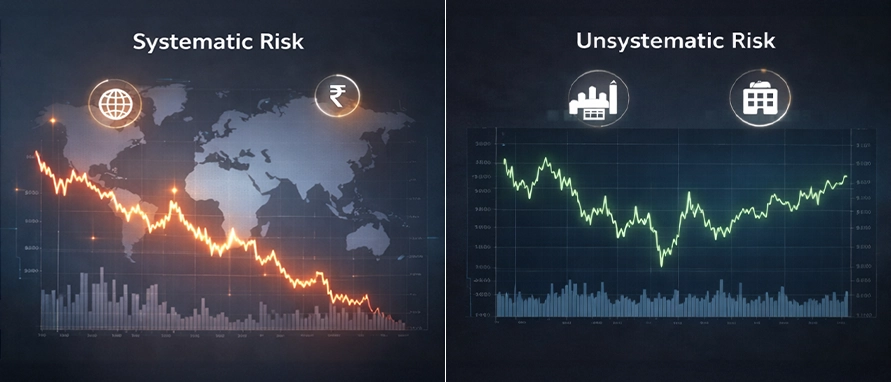
Understand the difference between systematic and unsystematic risk and how each type relates to market-wide and asset-specific factors.
Risk in financial markets is commonly grouped into broad categories based on how widely its effects are spread. Some risks influence many assets at the same time, while others are limited to specific companies or sectors. Distinguishing between these categories helps describe how different sources of uncertainty are classified in investment analysis and performance measurement, without focusing on individual outcomes.
Systematic risk, also known as market risk, refers to the risk that affects the entire market or economy. This risk arises from factors such as interest rates, inflation, or political instability that influence all assets across the market. It cannot be avoided or mitigated through diversification, as it impacts all investments in the market.
Unsystematic risk, on the other hand, is specific to individual companies or industries. It arises due to factors such as management decisions, company performance, or industry changes. Unlike systematic risk, unsystematic risk can be reduced or eliminated through diversification by holding a variety of investments across different sectors.
Below is a comparison table that highlights the key differences between systematic and unsystematic risk:
| Parameter | Systematic Risk | Unsystematic Risk |
|---|---|---|
Nature |
Market-wide risk affecting all assets |
Company or industry-specific risk |
Diversifiability |
Cannot be diversified |
Can be diversified through portfolio mixing |
Examples |
Inflation, interest rates, recession |
Business failure, management decisions |
Impact |
Affects the entire market |
Affects a specific company or sector |
Management |
Mitigated through hedging or market timing |
Mitigated through diversification in a portfolio |
The examples below illustrate how market-wide factors and company-specific events can affect investments in different ways:
Interest Rate Risk: When the central bank raises interest rates, it often leads to a downturn in the stock market as a whole, affecting both bonds and equities.
Economic Recession: A nationwide recession impacts most sectors and industries, causing widespread financial losses in the stock market.
Company Bankruptcy: If a company goes bankrupt, its stock value declines, but this may not affect other companies or sectors in the market.
Product Failure: A company’s product might fail, leading to a drop in stock price, but other companies in different industries may remain unaffected.
The points below highlight common features of market-wide risk:
Market Exposure: Systematic risk represents market-wide fluctuations that affect most assets in the economy.
Predictable Movements: Market trends influenced by systematic risk reflect broader economic or financial conditions affecting multiple assets
The points below outline common challenges associated with market-wide risk:
Inherent and Unavoidable: Systematic risk is unavoidable as it impacts the entire market, making it impossible to eliminate or avoid even with diversification.
Market Volatility: Economic factors such as inflation or geopolitical issues can lead to heightened market volatility, affecting investor confidence.
The points below describe features commonly associated with company-specific or sector-specific risk:
Variation in Returns: Unsystematic risk can lead to differing returns depending on the performance of individual companies or sectors.
Diversification: Unsystematic risk may be reduced by holding a broad range of assets across different sectors or industries.
The points below outline typical challenges linked to risks affecting individual companies or sectors:
Company-Specific Impact: If a company faces financial troubles, such as bankruptcy, its stock may decline without affecting the broader market.
Operational and Financial Risk: Poor management decisions or operational failures can hurt a company’s performance, negatively affecting stock value.
Systematic risks include several macroeconomic and market-wide factors that affect the entire market:
Interest Rate Risk: Fluctuations in interest rates impact asset prices across the market.
Inflation Risk: Rising inflation decreases the purchasing power of money, which negatively affects the market.
Market Risk: Overall market volatility due to economic factors or global events.
Unsystematic risks are specific to individual companies and industries and include:
Business Risk: The risk that a company will underperform due to internal factors such as operational inefficiencies.
Financial Risk: The risk that a company’s financial health, such as high debt levels, may harm its profitability.
Industry Risk: Risks specific to an industry, such as regulatory changes or technological shifts that affect the sector.
Systematic risk is measured using beta, a statistical measure of how much an asset’s price fluctuates compared to the overall market. A beta greater than 1 indicates the asset is more volatile than the market, while a beta less than 1 indicates it is less volatile.
Unsystematic risk, however, can be minimised by diversification. By holding a broad range of assets across different industries, investors reduce the impact of company-specific events on their overall portfolio.
Systematic risk is unavoidable and affects the entire market, while unsystematic risk is specific to individual companies or industries. Understanding both types of risk provides insight into how market-wide and company-specific factors influence investments. By diversifying investments, investors can reduce the impact of unsystematic risk, while systematic risk remains a fundamental factor that must be managed through hedging or other market strategies.
This content is for informational purposes only and the same should not be construed as investment advice. Bajaj Finserv Direct Limited shall not be liable or responsible for any investment decision that you may take based on this content.
Systematic risk affects the entire market due to broad economic or financial factors. Unsystematic risk is specific to an individual company or industry and arises from internal issues such as management decisions or operational challenges.
Systematic risk refers to market-wide risks that impact all investments, such as inflation or economic downturns. Unsystematic risk relates to company- or sector-specific factors that affect only certain businesses or industries.
Unsystematic risk can be reduced through diversification by investing across multiple companies and sectors. This approach helps limit the impact of negative events affecting any single company or industry within a broader portfolio.
Systematic risk cannot be avoided through diversification because it affects the entire market. Its impact may be managed through various financial approaches, but exposure to overall market movements remains inherent in most investments.
Examples of systematic risk include interest rate changes, inflation, or economic recessions affecting markets broadly. Unsystematic risk examples include company bankruptcy, labour disputes, or product failures impacting specific businesses.
Systemic risk is not the same as systematic risk. Systemic risk refers to the potential collapse of the entire financial system, while systematic risk relates to broad market risks that affect most investments simultaneously.
.jpeg)












 Academy



.jpeg "image not found")