Our Products
 Loans
Loans
 Cards
Cards
 Insurance
 Investment
 Stock Market
 Electronics Mall
 CIBIL Score
 Knowledge Centre
 Calculators
Our Services

 Do not call
 En
En
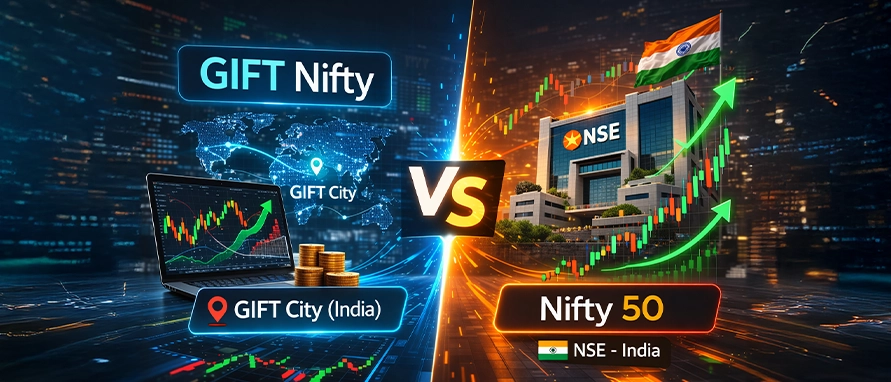
Learn the difference between GIFT Nifty and Nifty 50, including how they function, what they track, and their roles in market analysis.
In the Indian financial markets, GIFT Nifty and Nifty 50 are often discussed together because GIFT Nifty derivative contracts are based on the Nifty 50 index. However, they are different market instruments. Nifty 50 is a benchmark equity index comprising 50 stocks, while GIFT Nifty refers to Nifty 50-based derivative contracts traded on the NSE International Exchange (NSE IX) at GIFT City. They differ in their structure, trading venue, currency denomination and trading hours.
Nifty 50 is the flagship index of the National Stock Exchange (NSE) of India, comprising 50 companies selected under the index methodology. The Nifty 50 serves as a benchmark for the Indian equity market and represents the performance of companies across various sectors.
The index covers a broad range of sectors, including banking, IT, pharmaceuticals, and energy, and is widely used as a reference for the Indian equity market.
Here are some points about Nifty 50:
GIFT Nifty refers to Nifty 50-based derivative contracts traded on the NSE International Exchange (NSE IX) at GIFT City. The contracts include futures and options based on the Nifty 50 index and are traded under the regulatory framework applicable to the International Financial Services Centre (IFSC).
Here are some points about GIFT Nifty:
Underlying: Nifty 50 Index
Trading Venue: NSE International Exchange (NSE IX) at GIFT City
Currency: US dollars
Settlement: Cash settlement in US dollars
Instrument: Nifty 50-based futures and options
NSE IX lists NIFTY as an index derivative with the Nifty 50 Index as the underlying asset. Its contract specifications state that the contracts are denominated in US dollars and are cash settled.
GIFT Nifty trades across two sessions on the NSE International Exchange (NSE IX), covering nearly 21 hours a day, Monday to Friday:
This runs well beyond the Nifty 50's regular trading window of 9:15 AM to 3:30 PM IST on the NSE. GIFT Nifty's Session 1 begins nearly 2 hours and 45 minutes before the Indian market opens, and Session 2 continues late into the night.
The introduction of GIFT Nifty was a structural initiative under the International Financial Services Centre (IFSC) framework to expand the international accessibility of Indian equity derivatives. GIFT Nifty was structured to facilitate international participation in Nifty 50-based derivative contracts through the NSE International Exchange (NSE IX).
GIFT Nifty has several structural features within the IFSC framework:
Extended Trading Hours: GIFT Nifty is traded beyond the regular Indian market session.
US Dollar Denomination: GIFT Nifty derivative contracts are denominated in U.S. dollars, allowing participation through the international exchange framework.
GIFT Nifty was introduced to facilitate international participation in Nifty 50-based derivative contracts through the IFSC framework while providing extended trading hours and USD-denominated trading.
Participation in GIFT Nifty is subject to the eligibility requirements applicable to products traded on NSE IX and the regulatory framework governing the IFSC.
NSE IX states that participants such as Non-Resident Indians (NRIs), Foreign Portfolio Investors (FPIs) and Eligible Foreign Investors (EFIs) can trade GIFT Nifty products through NSE IX trading members, subject to the applicable requirements.
Eligibility and access may depend on the participant category, applicable regulations and the route through which the participant accesses the NSE IX market.
The differences between GIFT Nifty and Nifty 50 are summarised in the table below:
| Aspect | GIFT Nifty | Nifty 50 |
|---|---|---|
Nature |
Nifty 50-based derivative contracts |
Equity market index |
Underlying |
Nifty 50 Index |
50 constituent stocks |
Venue |
NSE International Exchange (NSE IX) at GIFT City |
NSE |
Currency |
US Dollars |
Index points; INR-denominated derivatives are traded separately on NSE |
Trading Hours |
6:30 AM to 2:45 AM next day, with an inter-session break |
NSE equity market: 9:15 AM to 3:30 PM IST |
Regulation |
IFSC regulatory framework |
Indian securities-market framework |
Purpose |
Trading Nifty 50-based derivatives through NSE IX |
Benchmarking and measuring the performance of the represented Indian equities |
Settlement |
GIFT Nifty derivative contracts are cash settled in US dollars |
Nifty 50 itself is an index; derivatives based on it on NSE have their own contract and settlement specifications |
GIFT Nifty derivative contracts are based on the Nifty 50 index and trade on NSE IX during hours that extend beyond the regular NSE equity-market session. Their prices therefore reflect trading activity in Nifty 50-based derivatives during those trading hours.
The Nifty 50, meanwhile, is an equity index calculated by NSE Indices. Since GIFT Nifty contracts and the Nifty 50 are linked through the same underlying index, their market values are related, but they are different instruments traded in different market environments.
GIFT Nifty trading activity can provide information on how Nifty 50-based derivatives are being priced outside the regular NSE equity-market session. However, movements in GIFT Nifty do not directly determine movements in the Nifty 50.
The Nifty 50 and GIFT Nifty are related but represent different market instruments. The Nifty 50 is the benchmark equity index of the National Stock Exchange (NSE) and represents the performance of 50 companies selected under the index methodology. It is widely referenced within the domestic securities market.
GIFT Nifty refers to Nifty 50-based derivative contracts traded on the NSE International Exchange (NSE IX) at GIFT City under the International Financial Services Centre (IFSC) framework. These contracts provide a mechanism for trading Nifty 50-based derivatives through the international exchange ecosystem.
While the Nifty 50 is a benchmark equity index used to represent the performance of its constituent companies, GIFT Nifty contracts are traded within the IFSC framework. NSE IX states that eligible participants, including FPIs, NRIs, and Eligible Foreign Investors, can access GIFT Nifty products through NSE IX trading members, subject to the applicable regulatory requirements.
Also Read: PCR Bank Nifty
Nifty 50 and GIFT Nifty are related but different market instruments. Nifty 50 is a benchmark equity index comprising 50 companies and is used to represent the performance of the segment of the Indian equity market covered by the index. GIFT Nifty refers to Nifty 50-based derivative contracts traded on the NSE International Exchange (NSE IX) at GIFT City. These contracts are denominated and cash settled in US dollars and trade during extended market hours under the applicable IFSC regulatory framework.
The main differences between them relate to their nature, trading venue, currency, trading hours and regulatory framework.
No. Nifty 50 is an equity index comprising 50 constituent stocks, whereas GIFT Nifty refers to derivative contracts based on the Nifty 50 index. They also differ in trading venue, currency denomination and trading hours.
GIFT Nifty derivative contracts trade on NSE IX during hours that begin before the regular NSE equity-market session. This allows trading in Nifty 50-based derivatives before the domestic equity market opens.
GIFT Nifty and Nifty 50 are different instruments, although GIFT Nifty derivative contracts are based on the Nifty 50 index. Trading in GIFT Nifty does not directly determine the movement of the Nifty 50. Their prices can reflect related market conditions because they are linked through the same underlying index.
GIFT Nifty derivative contracts and the Nifty 50 operate in different market environments but are linked through the Nifty 50 index. GIFT Nifty trades on NSE IX during extended hours, while the Nifty 50 is the benchmark equity index calculated by NSE Indices. Market participants may refer to the two for information on Nifty 50-based market activity across different trading sessions.
.jpeg)












 Academy


.jpeg "image not found")