Our Products
 Loans
Loans
 Cards
Cards
 Insurance
 Investment
 Stock Market
 Electronics Mall
 CIBIL Score
 Knowledge Centre
 Calculators
Our Services

 Do not call
 En
En
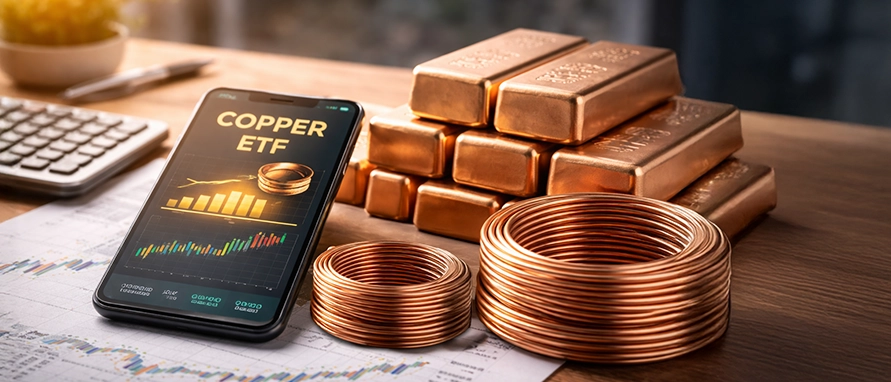
Learn what copper ETFs are, how they work, and how they offer exposure to copper price movements through market-linked instruments.
A Copper Exchange-Traded Fund (ETF) is a financial product that provides investors with exposure to the price movements of copper, a key industrial metal. Copper ETFs track the performance of copper by holding physical copper or copper-related assets such as mining stocks or futures contracts. These ETFs provide an easy and liquid way for investors to invest in copper without directly buying or storing the metal.
A Copper ETF is a type of exchange-traded fund that aims to track the price of copper or copper-related assets. It works by investing in copper futures contracts, physical copper, or copper mining stocks. The value of a Copper ETF fluctuates with the price of copper, providing investors with an indirect way to gain exposure to the commodity’s price movements.
Investors buy units of Copper ETFs, which are traded on stock exchanges like other stocks or ETFs. The price of Copper ETFs is linked to copper prices in global markets, allowing investors to gain exposure to price movements without directly trading or storing the physical metal.
Copper ETFs work by investing in a variety of copper-related assets, depending on the fund’s structure:
Underlying Assets: Copper ETFs either hold physical copper or trade copper futures contracts. Some ETFs also invest in stocks of companies involved in copper mining.
Price Tracking: The price of a Copper ETF typically tracks the spot price of copper or the price of copper futures. The ETF's value increases or decreases based on the performance of copper.
Liquidity and Cost: Copper ETFs are generally liquid, as they are traded on exchanges. Management fees vary across funds, and investors typically review the expense ratio when evaluating exposure to copper through ETFs.
As of now, Indian stock exchanges do not list a dedicated Copper ETF that directly holds physical copper. Investors seeking copper exposure typically access international ETFs or commodity derivatives, subject to regulatory norms. These ETFs provide Indian investors with an easy way to access the global copper market, especially for those looking to benefit from copper’s demand in industries like construction, electronics, and renewable energy.
While the Indian market offers some Copper ETFs, the sector is still evolving, and the regulation surrounding these products continues to develop. Investors should carefully consider the available options, which include ETFs linked to copper mining stocks or those tracking copper prices directly.
Here is a list of Copper ETFs that are available for investment. Please note that the list includes major global Copper ETFs that can be accessed by Indian investors through international platforms:
| Fund Name | Ticker | Type | Investment Focus |
|---|---|---|---|
iShares Copper ETF |
ICP |
Commodity |
Copper futures |
Global X Copper Miners ETF |
COPX |
Equity ETF |
Copper mining stocks |
Invesco DB Base Metals Fund |
DBB |
Commodity ETF |
Copper and other metals |
These ETFs primarily trade on international exchanges, but investors in India can access them via brokerage firms that allow trading in global ETFs
Consider the following table:
| Feature | Copper Stocks ETFs | Commodity Copper ETFs |
|---|---|---|
Focus |
Copper mining stocks |
Physical copper or futures contracts |
Exposure |
Indirect exposure to copper price through mining companies |
Direct exposure to copper price fluctuations |
Risk |
Risk of mining company performance and market conditions |
Risk of copper price volatility |
Liquidity |
Depends on stock performance and sector dynamics |
Generally higher liquidity due to direct commodity exposure |
Copper ETFs in India provide a structured avenue for investors to gain exposure to the copper market without the need for physical ownership. The Indian market is witnessing increased participation in these funds due to the rising demand for copper, especially in sectors like renewable energy and electric vehicles.
Liquidity: Copper ETFs are traded on the stock exchange, making them easily accessible.
Diversification: Exposure to the copper market without holding physical assets.
Low Cost: Compared to physical copper or direct copper futures, ETFs have lower transaction costs.
Like all commodity investments, Copper ETFs come with certain risks:
Price Volatility: Copper prices can fluctuate due to economic cycles, geopolitical factors, and changes in industrial demand.
Tracking Error: The ETF may not perfectly track the price of copper, leading to deviations between the ETF performance and the underlying asset.
No Physical Delivery: Investors cannot take delivery of physical copper from the ETF.
To invest in a Copper ETF in India, the process generally involves the following steps:
Open a Demat and Trading Account: A Demat account and a trading account with a broker that provides access to international ETFs are required.
Choose a Copper ETF: Investors typically review factors such as fund structure, underlying exposure, and risk considerations before selecting a Copper ETF.
Place an Order: Units of the Copper ETF are purchased through the trading account, with prices reflecting real-time movements in copper markets.
Copper ETFs generally offer returns in line with the price of copper, with some funds outperforming or underperforming due to the performance of mining stocks or the fund's management. Copper prices have historically shown correlation with global industrial activity.
Here is how these copper investment options differ across key factors:
| Feature | Copper ETF | Physical Copper | Copper Stocks |
|---|---|---|---|
Ownership |
Indirect ownership of copper |
Direct ownership of physical copper |
Ownership in copper mining companies |
Liquidity |
Highly liquid, traded on exchanges |
Less liquid, requires physical sale |
Depends on company performance and market conditions |
Cost |
Low management fees |
High transaction, storage, and insurance costs |
Varies by stock price and company performance |
Exposure |
Direct exposure to copper prices |
Limited to the value of physical copper |
Exposure to both copper price and company management |
In India, taxation of Copper ETFs depends on their structure and classification under income tax rules. If treated as non-equity mutual funds or international ETFs, gains are generally considered long-term if held for more than three years and taxed at 20% with indexation benefits. Short-term capital gains (if held for less than three years) are typically taxed as per the investor’s applicable income tax slab. Tax treatment may vary based on the specific product structure and prevailing tax regulations.
Copper ETFs provide a structured way to gain exposure to copper price movements without holding the metal directly. They combine exchange-traded liquidity with commodity-linked performance, making them useful for tracking industrial metal trends. However, their returns, risks, and taxation depend on market conditions, fund structure, and holding period, so understanding how they function helps in interpreting their role within a broader investment approach.
This content is for informational purposes only and the same should not be construed as investment advice. Bajaj Finserv Direct Limited shall not be liable or responsible for any investment decision that you may take based on this content.
A Copper ETF tracks the price of copper directly, while a Copper Stocks ETF invests in stocks of companies involved in copper mining.
Yes, Indian investors can access Copper ETFs via international brokerages or platforms that offer global ETFs.
The price of a Copper ETF is linked to the Net Asset Value (NAV), which reflects the price of copper or the value of the underlying assets held by the ETF.
Copper ETFs generally do not pay dividends as they are designed to track the price of copper rather than distribute earnings.
Copper ETF gains are subject to capital gains tax in India. Long-term gains (over three years) are taxed at 20% with indexation, while short-term gains are taxed as per slab rates.
.jpeg)












 Academy


.jpeg "image not found")