Our Products
 Loans
Loans
 Cards
Cards
 Insurance
 Investment
 Stock Market
 Electronics Mall
 CIBIL Score
 Knowledge Centre
 Calculators
Our Services

 Do not call
 En
En
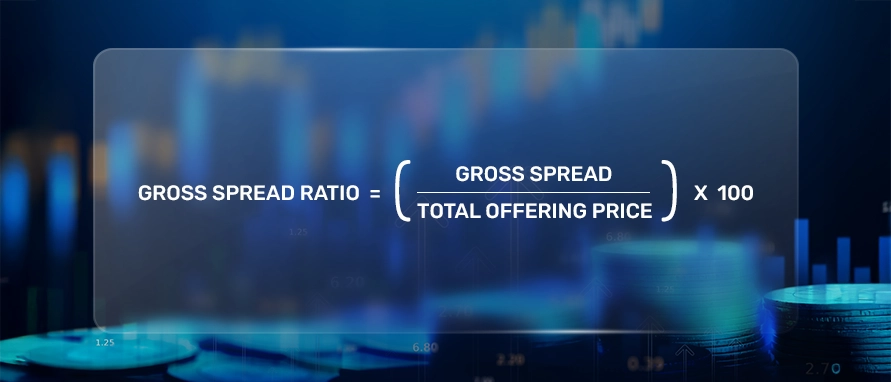
Understand how the gross spread ratio reflects the cost of raising capital and evaluates underwriting efficiency in financial offerings.
The gross spread ratio measures the difference between the price investors pay for securities and the amount received by the issuing company. This gap represents the underwriting fees and associated issuance costs charged by investment banks for managing the offering.
Understanding this ratio is essential for assessing the true cost of raising capital through public or private issues. A higher gross spread indicates greater intermediary costs, while a lower one suggests more efficient fundraising.
In essence, the gross spread ratio provides insight into how much of the raised capital actually reaches the issuer after all underwriting expenses are deducted.
The Gross Spread Ratio (also called the Underwriting Spread) is expressed as a percentage of the total proceeds raised. It includes all underwriting fees, commissions, and other issuance-related expenses.
Gross Spread (%) = [(Public Offer Price – Issuer’s Net Proceeds) ÷ Public Offer Price] × 100
or equivalently,
Gross Spread (%) = (Underwriting Fees + Selling Commissions + Management Fees) ÷ Total Issue Size × 100
Public Offer Price: The price investors pay per share/unit.
Issuer’s Net Proceeds: The amount the issuing company actually receives after fees.
Total Issue Size: The overall capital raised from investors.
Let’s consider a simple example:
Offer Price per Share: ₹500
Issuer Receives per Share: ₹475
Difference (Underwriter Fee): ₹25
Gross Spread = (₹500 – ₹475) ÷ ₹500 × 100 = 5%
Interpretation:
The gross spread ratio is 5%, meaning 5% of the total capital raised will go to the underwriters and intermediaries as fees.
The Gross Spread typically includes the following fee components:
| Component | Description |
|---|---|
Management Fee |
Compensation for organising and managing the issue. |
Underwriting Fee |
Payment for assuming the risk of unsold securities. |
Selling Commission |
Compensation for marketing and distributing the securities. |
Deal Size: Larger issues generally have lower percentage spreads.
Issuer’s Creditworthiness: Stronger issuers negotiate lower fees.
Market Volatility: Higher risk markets often mean higher spreads.
Type of Security: IPOs and high-yield bonds typically carry higher spreads.
Underwriter Reputation: Top-tier banks charge premium spreads for reliability and reach.
When companies raise funds through public offerings or private placements, they incur several direct and indirect costs, with the gross spread being one of the most significant.
These costs collectively determine the total cost of capital issuance.
Underwriting Fees (Gross Spread)
Legal and Compliance Costs
Accounting and Audit Fees
Registration and Listing Charges
Marketing and Roadshow Expenses
Example:
In large IPOs, the gross spread can range between 3% to 7% of total proceeds, while total capital raising costs can reach up to 10% of the issue size.
| Market Type | Typical Gross Spread Range | Notes |
|---|---|---|
U.S. IPOs |
5% – 7% |
Standardised across large equity offerings |
Indian IPOs |
2% – 4% |
Lower due to competitive underwriting |
Debt Offerings |
0.5% – 2% |
Lower spreads due to reduced underwriting risk |
Private Placements |
1% – 3% |
Negotiated directly between issuer and arranger |
In developed markets, gross spreads are tightly regulated and fairly consistent, while in emerging markets, spreads depend on issuer profile and market sentiment.
While gross spread is a standard measure of issuance cost, it has a few limitations:
Doesn’t Include All Costs: Excludes legal, marketing, and compliance expenses.
Varies by Market Conditions: Economic cycles and investor demand can alter spreads.
Negotiation-Driven: Spreads depend heavily on issuer-underwriter bargaining power.
Lack of Transparency: Some deals may include hidden or performance-linked fees.
Companies typically analyse total “all-in” costs, not just the spread, before proceeding with a public issue.
A Gross Spread Calculator helps estimate underwriting costs for IPOs or bond issuances.
Inputs Required:
Total Issue Size
Offer Price
Net Proceeds to Issuer
Output:
Gross Spread (in % and absolute ₹ value)
Example:
If a company issues ₹1,000 crore worth of shares with a 4% spread,
Then Underwriting Cost = ₹40 crore
The gross spread ratio is an important component of fundraising economics, reflecting the cost-efficiency of capital market transactions.
Key points to remember:
Gross Spread Ratio measures the underwriter’s compensation for raising capital.
It’s expressed as a percentage of total proceeds raised in an offering.
A lower spread indicates a more efficient and cost-effective fundraising process.
Spreads depend on factors like deal size, issuer reputation, and market risk.
Consider all associated costs including underwriting, legal, and administrative fees, to accurately assess the total cost of raising capital.
This content is for informational purposes only and the same should not be construed as investment advice. Bajaj Finserv Direct Limited shall not be liable or responsible for any investment decision that you may take based on this content.
The gross spread ratio is the percentage difference between the price paid by investors in a public offer and the amount the issuing company receives. It represents the underwriters’ fees, commissions, and other costs incurred during the capital-raising process.
The gross spread is calculated using the formula: (Offer Price – Net Proceeds to Issuer) ÷ Offer Price × 100. The result expresses the proportion of underwriting and distribution costs as a percentage of the offer price.
The size of a deal influences the gross spread because larger offerings often benefit from economies of scale. As fixed costs are distributed across more units, the percentage spread generally decreases in bigger issues.
Apart from the gross spread, companies incur additional expenses such as legal, accounting, compliance, listing, and marketing fees. These costs contribute to the overall expenditure of issuing securities to the public.
.jpeg)












 Academy



.jpeg "image not found")